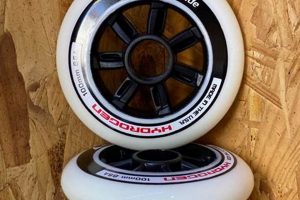
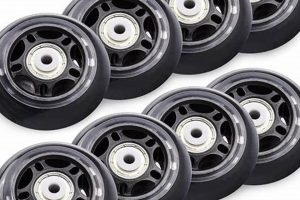
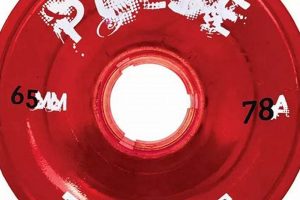
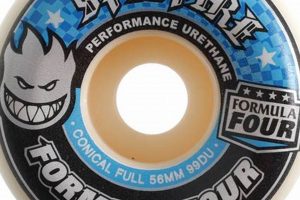
The measurement specifications of rolling components for inline skates define their performance characteristics. These specifications, typically expressed in millimeters (mm) for diameter and durometer (A) for hardness, impact skating speed, grip, and wear resistance. For instance, a wheel labeled “80mm 82A” indicates an 80-millimeter diameter and a hardness rating of 82A.
Precise wheel measurements are critical for optimizing skate performance based on skating style and surface conditions. Larger diameters generally provide increased speed and smoother rolling over rough surfaces, beneficial for distance skating and outdoor use. Conversely, smaller diameters offer enhanced maneuverability and acceleration, preferred for aggressive skating and indoor rinks. Hardness ratings dictate grip and durability, with softer wheels providing superior grip but faster wear, and harder wheels offering extended lifespan but reduced traction.
Understanding these specifications allows skaters to choose appropriately sized and hardness-rated wheels, customizing their equipment to achieve peak performance and enjoyment. Subsequent sections will delve into the individual parameters, exploring the effects of wheel diameter, durometer, and profile on overall skating experience.
Considerations for Selecting Rolling Components
The following guidelines offer direction in the proper selection of components for inline skates, prioritizing performance and longevity.
Tip 1: Diameter Selection: Evaluate skating environment. Larger diameters (e.g., 100mm-110mm) optimize speed on smooth, open surfaces. Smaller diameters (e.g., 72mm-80mm) improve maneuverability for agility-focused disciplines.
Tip 2: Durometer Matching: Determine wheel hardness based on grip requirements and abrasion resistance needs. Softer wheels (e.g., 78A-82A) enhance grip, especially on slick surfaces. Harder wheels (e.g., 84A-88A) improve durability on abrasive surfaces.
Tip 3: Profile Optimization: Consider the wheel profile. Round profiles provide smooth transitions during turns, suitable for recreational skating. Flat profiles offer enhanced stability and grip, advantageous for aggressive skating.
Tip 4: Core Material Examination: Analyze the wheel core. Stiff cores improve energy transfer, maximizing speed and responsiveness. Flexible cores enhance shock absorption, increasing comfort on rough surfaces.
Tip 5: Bearing Compatibility: Ensure compatibility between wheels and bearings. Select bearings that match the wheel’s core diameter and meet the skater’s performance needs. Precision bearings contribute to smoother rolling and increased speed.
Tip 6: Regular Inspection and Maintenance: Routinely inspect components for wear and tear. Replace worn wheels to maintain optimal performance and prevent safety hazards. Rotate wheels regularly to ensure even wear.
Tip 7: Surface Condition Adaptation: Modify wheel parameters in response to surface conditions. Use harder wheels on abrasive surfaces to prolong wheel life. Use softer wheels on slick surfaces to improve grip and control.
Selecting the appropriate rolling components according to these guidelines will optimize speed, grip, durability, and overall skating experience.
The succeeding section will address specific maintenance procedures to extend the lifespan of skate wheels.
1. Diameter (mm)

The diameter, measured in millimeters (mm), is a fundamental parameter defining the size and operational characteristics of inline skate wheels. As a critical element of the dimensional specifications, the diameter directly influences the skate’s speed, maneuverability, and ability to traverse varied surfaces. Larger diameters generally equate to higher top speeds due to a greater circumference per revolution, enabling a skater to cover more distance with each push. Conversely, smaller diameters tend to offer enhanced acceleration and agility, facilitating tighter turns and quicker stops. Examples include speed skaters utilizing larger wheels (e.g., 100mm-125mm) for maximum velocity on straightaways, and aggressive skaters opting for smaller wheels (e.g., 55mm-72mm) to enhance control in skate parks.
The relationship between diameter and surface interaction is also significant. Larger wheels bridge gaps and roll over obstacles more effectively, providing a smoother ride on rough terrain. This advantage is particularly evident in recreational skating or urban environments where uneven surfaces are common. Smaller wheels, while less effective at overcoming obstacles, offer a lower center of gravity, increasing stability. This stability is valued in disciplines requiring precise footwork and controlled landings, such as artistic skating or hockey. Furthermore, the frame design of the skate must accommodate the wheel diameter. Using wheels that exceed the frame’s capacity can compromise stability and potentially damage the equipment.
In summary, the diameter is a determinant factor in inline skate wheel dimension, shaping the skater’s experience by impacting speed, maneuverability, and surface adaptability. Understanding the effect of diameter selection is vital for optimizing performance and tailoring skate setups to specific skating styles and environments. While larger wheels excel in speed and rough surface navigation, smaller wheels offer agility and stability. Selecting the appropriate diameter represents a fundamental choice in customizing the skating experience.
2. Durometer (A)

Durometer, denoted by the “A” scale, is a critical material property specifying the hardness of inline skate wheels. Within the context of wheel specifications, the durometer rating dictates grip, wear resistance, and vibration absorption characteristics. This rating directly impacts the skater’s control, comfort, and the wheel’s lifespan.
- Grip and Traction
Lower durometer values (e.g., 78A-82A) indicate softer wheels, which offer enhanced grip and traction, particularly on smooth or slick surfaces. This increased grip facilitates tighter turns and improved control. Conversely, higher durometer values (e.g., 84A-88A) denote harder wheels, which provide reduced grip but increased rolling efficiency on smooth surfaces.
- Wear Resistance and Durability
Harder wheels, possessing higher durometer ratings, exhibit superior wear resistance and durability. They are less prone to abrasion and deformation, making them suitable for skating on rough or abrasive surfaces. Softer wheels, while providing enhanced grip, wear down more rapidly, necessitating more frequent replacement.
- Vibration Absorption and Comfort
Softer wheels, with lower durometer values, absorb vibrations more effectively, resulting in a smoother and more comfortable skating experience, particularly on uneven terrain. Harder wheels transmit more vibrations, leading to a less comfortable ride but improved energy transfer and speed.
- Skating Style and Discipline
Durometer selection is often influenced by the skater’s style and chosen discipline. Aggressive skaters and hockey players typically prefer harder wheels for increased durability and responsiveness, while recreational skaters and speed skaters may opt for softer or mid-range durometers for improved grip or vibration absorption.
In summation, the durometer rating, as part of wheel’s dimensional specifications, is a critical factor in determining overall performance characteristics. Understanding the trade-offs between grip, wear resistance, and comfort enables skaters to choose wheels that align with their specific needs and preferences. As such, hardness considerations are crucial when selecting wheels for inline skates.
3. Wheel Profile

Wheel profile, integral to overall wheel specifications, directly impacts maneuverability, grip, and rolling efficiency. Profile denotes the cross-sectional shape of the wheel, influencing the contact patch between the wheel and the skating surface. Variances in profile affect the distribution of pressure across the contact patch, consequently altering the skating experience. A round profile facilitates smooth transitions during turns, offering a predictable and forgiving feel. Conversely, a flatter profile maximizes the contact area, enhancing grip and stability, especially during straight-line skating.
Consider the application of varied profiles in specific skating disciplines. Speed skaters often favor elliptical profiles, minimizing rolling resistance and maximizing speed. Aggressive skaters commonly employ flatter profiles, providing a larger contact patch for enhanced stability during grinds and landings. Hockey players may utilize a slightly rounded profile for agility and quick directional changes. Furthermore, the wheel profile interacts with other wheel specifications, such as diameter and durometer. A larger wheel with a flat profile maximizes speed and grip, while a smaller wheel with a round profile optimizes maneuverability in confined spaces.
Ultimately, the wheel profile represents a crucial dimension, influencing handling characteristics and performance capabilities. Selection requires careful consideration of skating style, surface conditions, and desired performance attributes. The profile, in conjunction with diameter and durometer, dictates the wheel’s suitability for a given application. Correct understanding will provide to optimize the skating experience.
4. Core Material
The core material within inline skate wheels plays a critical role in determining performance characteristics, directly influencing how wheel specifications translate into on-skate behavior. The material composition and design of the core influence energy transfer, weight, and the wheel’s overall structural integrity.
- Energy Transfer Efficiency
The core material dictates the efficiency with which energy from the skater’s push is converted into forward momentum. Stiffer materials, such as high-density polyurethane or reinforced nylon, minimize energy loss through deformation, enhancing responsiveness and speed. A less rigid core absorbs more energy, resulting in a softer, less efficient roll.
- Weight Optimization
Core material significantly contributes to overall wheel weight. Lightweight materials, like advanced polymer blends, reduce rotational inertia, facilitating quicker acceleration and enhanced maneuverability. Conversely, denser core materials add weight, potentially increasing stability at higher speeds but sacrificing agility.
- Structural Integrity and Durability
The core material must withstand the stresses of skating, maintaining its shape and preventing deformation under load. High-quality materials, such as glass-filled nylon, offer superior strength and resistance to wear, extending the lifespan of the wheel. A weak or poorly designed core can lead to premature wheel failure, compromising safety and performance.
- Influence on Durometer Perfromance
The core material can subtly alter the perceived performance of a wheel’s durometer. A stiff core can make a wheel feel harder than its durometer rating suggests because less of the force is absorbed by the core’s deformation. Conversely, a more flexible core may make a wheel feel softer. This interaction highlights the complexity of selecting components for inline skates.
Understanding core material properties is essential for optimizing performance based on skating style and conditions. Selecting the appropriate core material, in conjunction with wheel diameter and durometer, allows skaters to fine-tune their equipment for speed, agility, and durability. The core interacts with wheel specifications to dictate rolling characteristics.
5. Bearing Size

Bearing size is intrinsically linked to inline skate wheel dimensions, specifically the diameter of the wheel’s core. The vast majority of inline skate wheels are designed to accommodate industry-standard 608 bearings. These bearings have an outer diameter of 22mm, an inner diameter of 8mm (the axle bore), and a width of 7mm. The wheel’s core is engineered to precisely house these bearings, ensuring a secure and concentric fit. A mismatch in these dimensions would render the wheel unusable, as the bearings would either not fit into the core or would not be securely held in place, leading to instability and potential equipment failure. For example, attempting to use a bearing smaller than the wheel core diameter would result in excessive play and wobbly performance, while a bearing larger than the core’s bearing seat would be impossible to install without damaging the wheel.
The relationship between bearing size and wheel dimensions extends beyond simple fit. The precision of the bearing seat within the wheel core directly impacts bearing performance. A well-machined bearing seat ensures that the bearing rolls smoothly and efficiently, maximizing speed and minimizing friction. Conversely, an improperly sized or poorly finished bearing seat can cause the bearing to bind or wobble, reducing performance and potentially shortening the bearing’s lifespan. Furthermore, certain specialized wheel designs, particularly those used in aggressive skating, may utilize integrated bearing spacers that further interact with the bearing and core dimensions, influencing the wheel’s rigidity and responsiveness.
In summary, the selection of inline skate wheels hinges on compatibility with standard bearing sizes. The precise fit between the bearing and the wheel’s core is crucial for optimal performance and safety. Variations in bearing seat tolerances or deviations from standard bearing dimensions can severely compromise the functionality of the skate. Consequently, adherence to standard dimensions and careful inspection of wheel and bearing compatibility are essential practices for skaters and equipment manufacturers alike.
6. Contact Patch

The contact patch, a key attribute influenced by inline skate wheel dimensions, represents the area of interface between the wheel and the skating surface. Its size and shape directly impact grip, rolling resistance, and ultimately, skater control. Wheel diameter, profile, and durometer collectively dictate the dimensions of this crucial interface. For instance, a larger wheel diameter inherently increases the potential contact patch size, fostering greater stability and enhanced roll-over capability on uneven surfaces. A flatter wheel profile further expands the contact patch, maximizing grip, especially beneficial for aggressive skating maneuvers requiring substantial ground contact. Softer durometer wheels, owing to their increased deformation under load, also tend to enlarge the contact patch, augmenting traction at the expense of rolling efficiency. Conversely, smaller diameter wheels, rounder profiles, and harder durometers reduce the contact patch, prioritizing speed and maneuverability.
Consider the practical implications of contact patch manipulation. Speed skaters often favor larger diameter wheels with slightly rounded profiles to minimize rolling resistance and maximize speed on smooth tracks, accepting a smaller contact patch as a trade-off. Hockey players, needing agility and sharp turning capabilities, might opt for mid-sized wheels with a more rounded profile, balancing grip and maneuverability. Aggressive skaters, focused on performing grinds and slides, typically select smaller diameter wheels with flatter profiles and harder durometers, ensuring a stable platform with controlled slide characteristics. The shape of the contact patch further contributes to performance; a longer, narrower contact patch might provide directional stability, while a shorter, wider patch enhances lateral grip.
The contact patch, therefore, constitutes a vital element in the design and selection of inline skate wheels. Understanding how dimensions influence the contact patch enables skaters to optimize their equipment for specific disciplines and skating conditions. However, challenges persist in accurately measuring and predicting contact patch behavior under dynamic skating loads. Advanced materials and sophisticated wheel designs continue to evolve, striving to maximize both grip and rolling efficiency by precisely engineering the dimensions and characteristics of the contact patch. This continued pursuit of optimization underscores the fundamental importance of this interface in shaping the skating experience.
Frequently Asked Questions
This section addresses common inquiries regarding inline skate wheel parameters, providing clarity on their impact and selection criteria.
Question 1: What is the typical range of diameters available for inline skate wheels?
The diameter commonly ranges from 47mm to 125mm, catering to varied skating disciplines and preferences. Smaller diameters (47-72mm) are prevalent in aggressive skating, while larger diameters (80-125mm) are typical for recreational, fitness, and speed skating.
Question 2: How does wheel durometer affect skating performance?
Wheel durometer, measured on the A scale, directly influences grip, wear resistance, and rolling efficiency. Softer wheels (74A-82A) offer superior grip but faster wear, while harder wheels (82A-90A) provide increased durability and speed on smooth surfaces.
Question 3: What role does wheel profile play in handling characteristics?
Wheel profile defines the cross-sectional shape of the wheel and affects turning agility and stability. Round profiles enable smoother transitions, whereas flatter profiles provide increased grip and stability.
Question 4: Are there standard bearing sizes for inline skate wheels?
Yes, the 608 bearing is the industry standard for inline skate wheels. It features an 8mm inner diameter, a 22mm outer diameter, and a 7mm width.
Question 5: How does the wheel core material impact performance?
The core material influences energy transfer, weight, and structural integrity. Stiffer cores enhance energy transfer and responsiveness, while lighter cores reduce rotational inertia, improving acceleration.
Question 6: How does the contact patch influence grip and rolling resistance?
The contact patch defines the area where the wheel meets the skating surface. A larger contact patch generally provides increased grip, while a smaller contact patch reduces rolling resistance and enhances speed.
Understanding these fundamental aspects empowers skaters to select wheels that optimize performance based on individual skating needs and environmental conditions.
The subsequent section transitions into a discussion of specific wheel maintenance practices.
Conclusion
The preceding analysis has elucidated the critical role of inline skate wheel dimensions in determining performance attributes. Diameter, durometer, profile, core material, bearing size compatibility, and contact patch dynamics all contribute significantly to the overall skating experience. Precise understanding and informed selection of these parameters are imperative for optimizing speed, maneuverability, grip, and durability based on specific skating disciplines and surface conditions.
Continued advancements in materials science and manufacturing techniques promise further refinements in wheel design, enhancing performance capabilities and addressing persistent challenges related to rolling resistance and wear. A commitment to informed selection and diligent maintenance of rolling components will enable skaters to maximize their enjoyment and push the boundaries of their respective disciplines.