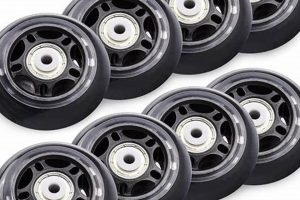
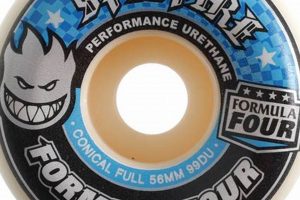
These components, typically constructed from polyurethane, are affixed in pairs to the plate of a specific type of roller skate. Their durometer, size, and profile significantly influence the skater’s experience, affecting factors such as speed, grip, and maneuverability on various surfaces. For example, a harder composition lends itself to smoother, faster rolling, while a softer compound offers enhanced traction.
The performance and characteristics of these crucial elements directly contribute to the skater’s agility, control, and overall enjoyment. The selection of appropriate attributes is paramount for achieving optimal performance in diverse skating disciplines, ranging from recreational skating and roller derby to artistic expression and jam skating. Historically, advancements in materials and designs have continuously shaped the evolution of roller skating.
The following sections will delve deeper into the various types available, factors to consider when selecting them, maintenance best practices, and how these factors impact the skating experience.
“Skate Quad Wheels” Selection and Maintenance
Optimizing the roller skating experience necessitates careful consideration of these components. The following tips outline key aspects of selection, maintenance, and performance enhancement.
Tip 1: Durometer Assessment: Analyze the skating surface. Softer compounds (78A-88A) offer enhanced grip on slick surfaces, while harder compounds (90A-101A+) are more suitable for smooth, polished floors requiring speed and minimal friction.
Tip 2: Size and Profile Considerations: Larger diameter versions (62mm+) generally increase top speed and roll-over capability, while smaller diameter offerings (55mm-62mm) enhance maneuverability. Rounded profiles promote smooth transitions, while flat profiles maximize grip.
Tip 3: Material Composition Evaluation: Polyurethane formulations vary in rebound, durability, and resistance to wear. Research specific formulations to ensure they align with the intended skating style and surface.
Tip 4: Bearing Compatibility Verification: Ensure compatibility between the chosen wheels and the skater’s bearings. Standard bearing size is 608, but it’s essential to confirm to avoid compatibility issues.
Tip 5: Regular Cleaning and Inspection: Remove debris and dirt from the these regularly to maintain optimal rolling efficiency. Inspect for cracks, chips, or uneven wear, replacing as needed.
Tip 6: Rotation Practices: Rotate the positions of the wheels periodically to ensure even wear and prolong their lifespan. Common rotation patterns include X-pattern and straight rotation.
Tip 7: Tightening Torque Management: Avoid overtightening axle nuts, as this can impede bearing rotation and negatively impact performance. Ensure a snug fit that allows for free spinning.
Adherence to these guidelines will contribute to enhanced performance, extended lifespan, and a safer, more enjoyable skating experience.
The next section of this article will explore common issues, troubleshooting techniques, and advanced optimization strategies.
1. Durometer (Hardness)

Durometer, in the context of these components, is a measurement of their hardness, typically assessed on the Shore A scale. This characteristic fundamentally dictates the wheel’s performance characteristics, influencing grip, speed, and suitability for various skating surfaces.
- Grip versus Speed Trade-off
Lower durometer ratings (e.g., 78A-85A) signify softer compounds, providing increased grip, particularly on slick or uneven surfaces. These are often preferred for recreational skating or roller derby where maneuverability and control are paramount. Conversely, higher durometer ratings (e.g., 95A-101A+) denote harder compounds, minimizing rolling resistance and maximizing speed on smooth, polished surfaces like indoor rinks.
- Surface Compatibility
The ideal durometer is directly correlated to the surface. Using a soft wheel on a rough surface will cause premature wear and reduce speed. Conversely, a hard wheel on a smooth surface will offer minimal grip, potentially leading to loss of control. Matching the durometer to the surface is crucial for optimal performance and safety.
- Wear Resistance and Durability
Harder formulations tend to exhibit greater wear resistance, making them more durable over time, especially when used on abrasive surfaces. Softer versions, while providing superior grip, may wear down more quickly, requiring more frequent replacement. The selection represents a balance between performance and longevity.
- Impact on Skating Style
The chosen durometer can profoundly impact skating style. Skaters prioritizing speed and distance often opt for harder wheels. Those emphasizing agility and control, such as artistic skaters or roller derby players, typically prefer softer options. The optimal choice enhances the skater’s specific technique and objectives.
In summary, durometer is a critical specification impacting the performance characteristics of these wheels. Selecting the appropriate hardness requires careful consideration of the skating surface, intended style, and desired balance between grip, speed, and durability. The choice is not arbitrary but rather a deliberate decision influencing the overall skating experience.
2. Wheel Diameter (Size)

Wheel diameter, a key specification in these components, directly influences the skater’s speed, acceleration, and maneuverability. Measured in millimeters (mm), the size affects the rolling efficiency and the skater’s response to changes in direction and momentum.
- Top Speed and Roll-Over Capability
Larger diameter versions (e.g., 65mm-70mm) generally exhibit higher top speeds due to the increased circumference covering more ground per rotation. Additionally, they offer improved roll-over capability, allowing skaters to navigate uneven surfaces and small obstacles more easily. These are often preferred for outdoor skating, speed skating, or distance skating.
- Acceleration and Agility
Smaller diameter options (e.g., 55mm-62mm) provide quicker acceleration and enhanced agility due to their lower rotational inertia. The reduced size allows for faster changes in direction and quicker stops, making them suitable for disciplines requiring rapid maneuvers, such as roller derby, jam skating, or artistic skating.
- Center of Gravity and Stability
Smaller diameters generally lower the skater’s center of gravity, contributing to increased stability. This can be particularly beneficial for beginners or skaters prioritizing balance. Conversely, larger sizes elevate the center of gravity slightly, potentially requiring more experienced skaters to maintain equilibrium at higher speeds.
- Wear and Abrasion Resistance
Larger ones, due to their greater surface area, tend to wear down more slowly compared to smaller ones, assuming equal material composition and usage conditions. This can translate to a longer lifespan, especially when used on abrasive surfaces. However, the weight difference can affect energy expenditure over prolonged skating sessions.
The selection of an appropriate diameter represents a compromise between speed, agility, stability, and wear characteristics. Matching the diameter to the intended skating style and environment is critical for optimal performance and skater satisfaction. The relationship demonstrates the intricate design considerations involved in engineering these crucial skate components.
3. Wheel Profile (Shape)

The wheel profile, or cross-sectional shape, of roller skate wheels is a crucial design element directly impacting skating performance. This attribute affects the contact patch between the wheel and skating surface, influencing grip, maneuverability, and the smoothness of transitions. A rounded profile promotes smooth turns and reduces friction during edge work, a desirable characteristic for artistic skating or roller derby where agility is paramount. In contrast, a flatter profile maximizes the contact area, providing increased grip and stability, beneficial for recreational skating or speed skating where straight-line speed and control are priorities. The specific contour influences how the skater engages with the surface, translating force and direction into movement.
Consider the difference between a conical and elliptical profile. Conical profiles, prevalent in artistic skating, facilitate sharp, precise turns with minimal effort, enabling intricate maneuvers. Elliptical profiles, offering a blend of rounded and flat characteristics, provide a balanced approach, suitable for versatile skating styles. The profile’s impact on grip translates directly into control; a poorly chosen shape can hinder performance and increase the risk of instability or loss of traction. For instance, using a flat-profile wheel on a highly banked track could lead to abrupt transitions and compromised agility.
Ultimately, the selection of an appropriate wheel profile is not arbitrary. It requires careful consideration of the skating discipline, surface characteristics, and the skater’s individual preferences. Understanding the interplay between the wheel’s shape, grip, and maneuverability is essential for optimizing performance and ensuring a safe, enjoyable skating experience. Inappropriate profile selection can lead to decreased efficiency, increased fatigue, and potential hazards, highlighting the practical significance of this design parameter.
4. Bearing Seat (Precision)

The bearing seat, a critical component of these components, dictates the precision with which the bearings are housed within the wheel’s core. Inadequate precision in this area directly translates to inefficiencies in rolling resistance, potential bearing damage, and reduced overall skating performance. A well-engineered bearing seat ensures proper alignment and consistent contact between the bearing and the wheel, facilitating smooth, unimpeded rotation. Conversely, a poorly manufactured or damaged seat can cause bearings to bind or wobble, diminishing speed and increasing wear. This is particularly evident in competitive disciplines like roller derby or speed skating, where even marginal losses in efficiency can impact performance outcomes.
The dimensional accuracy of the bearing seat is typically measured in thousandths of an inch, highlighting the tight tolerances required for optimal function. Variations in this dimension can cause bearings to sit unevenly, leading to premature failure and inconsistent rolling characteristics. For example, a bearing seat that is too tight can restrict bearing rotation, while one that is too loose allows for excessive play, resulting in instability and reduced control. Manufacturers often employ advanced machining techniques and quality control measures to ensure consistent precision in the bearing seat construction. The materials utilized also contribute to the seat’s integrity; higher-grade polyurethanes or reinforced composites offer improved dimensional stability and resistance to deformation under load.
In summary, bearing seat precision is a fundamental factor affecting the performance and longevity. Precise engineering of this component is essential for minimizing rolling resistance, preventing bearing damage, and ensuring a smooth, efficient skating experience. Discrepancies in seat dimensions or material integrity can manifest as reduced speed, diminished control, and accelerated wear, underscoring the practical importance of meticulous manufacturing standards in these components.
5. Material Composition

The selection of materials in the construction of these components exerts a significant influence on performance characteristics, durability, and overall skating experience. Material science principles directly impact wheel grip, rebound, wear resistance, and the ability to withstand varying environmental conditions. Different polymers and additives impart unique properties, necessitating careful consideration during the design and manufacturing processes.
- Polyurethane Formulation
Polyurethane is the predominant material employed in their manufacture due to its tunable properties, allowing engineers to tailor the compound for specific performance requirements. The formulation can be adjusted to control hardness (durometer), rebound (energy return), and resistance to abrasion. For example, a high-rebound polyurethane is advantageous for speed skating, maximizing energy transfer with each stride. In contrast, a lower-rebound formulation may be preferred for roller derby, offering increased grip and controlled slides.
- Fillers and Additives
Various fillers and additives are incorporated into the polyurethane matrix to modify its mechanical and thermal properties. Carbon black can enhance abrasion resistance and UV stability, extending the lifespan of the wheel. Silica fillers can improve wet grip, particularly beneficial for outdoor skating in damp conditions. Colorants and dyes are added for aesthetic purposes but can also influence the material’s response to sunlight. The selection and concentration of these additives require precise control to avoid compromising the wheel’s integrity.
- Core Materials
Many modern feature a core, or hub, typically constructed from rigid plastics or reinforced polymers. The core provides structural support to the polyurethane tire and ensures precise bearing alignment. The core material’s stiffness influences the wheel’s responsiveness and energy transfer. A stiffer core enhances power transmission, while a more flexible core can improve shock absorption. The bonding between the core and polyurethane is crucial to prevent delamination under stress.
- Impact on Rolling Resistance
The material composition directly affects the wheel’s rolling resistance, a critical factor influencing skating speed and efficiency. Softer compounds, while providing increased grip, generally exhibit higher rolling resistance compared to harder formulations. Material hysteresis, the energy lost during deformation and recovery, contributes to rolling resistance. Optimizing the material composition to minimize hysteresis is essential for achieving maximum speed and minimizing skater fatigue. Testing under controlled conditions is essential to quantify and compare rolling resistance across different material formulations.
The material composition is a complex interplay of polymer science, engineering design, and performance considerations. Understanding the properties of different materials and their influence on key performance metrics is essential for selecting or designing the correct type for any given application. Continuous advancements in material science promise further refinements in wheel performance, durability, and skater experience.
6. Hub Construction (Core)

The hub, or core, of a skate quad wheel represents a foundational element influencing performance, durability, and overall skater experience. Its design and material composition are inextricably linked to the wheel’s ability to translate energy efficiently, withstand stress, and maintain dimensional stability under varying conditions. The following points outline key facets of hub construction and its impact on roller skating.
- Material Composition and Stiffness
Hubs are typically constructed from rigid plastics, reinforced polymers, or aluminum alloys. The material’s stiffness directly affects energy transfer; a stiffer hub minimizes deformation under load, resulting in improved power transmission and responsiveness. For instance, wheels intended for speed skating often utilize high-modulus materials to maximize efficiency. Conversely, a more flexible hub can enhance shock absorption, beneficial for skaters navigating rough or uneven surfaces. The material selection dictates the hub’s ability to withstand repeated stress cycles and resist cracking or deformation.
- Design and Ribbing Patterns
The hub’s design, including ribbing patterns and spoke configurations, contributes significantly to its structural integrity and weight distribution. Ribbing patterns enhance stiffness without adding excessive weight, optimizing the strength-to-weight ratio. Spoke designs can be tailored to influence the wheel’s flex characteristics and responsiveness. Finite element analysis (FEA) is often employed to optimize hub designs, ensuring they can withstand anticipated stresses and loads. An example is seen in derby wheels, the complex design offer enhance performance.
- Bearing Seat Integration
The hub’s bearing seat, the recess that houses the bearings, must be manufactured to exacting tolerances to ensure precise bearing alignment. Misalignment or dimensional inaccuracies in the bearing seat can cause bearing binding, increased rolling resistance, and premature bearing failure. High-precision machining techniques are essential to achieve the required tolerances. The hub material’s stability also affects bearing seat integrity; materials prone to creep or deformation can compromise bearing alignment over time, negatively impacting performance.
- Bonding with Urethane Tire
The interface between the hub and the urethane tire represents a critical bond line that must withstand significant shear forces during skating. The bonding process, often involving chemical adhesives or mechanical interlocking features, must ensure a secure and durable connection to prevent delamination. Surface preparation techniques, such as roughening or priming the hub surface, are often employed to enhance adhesion. The compatibility between the hub material and the urethane compound is also crucial; incompatible materials can lead to bond failure and premature wheel degradation. Poor bonding dramatically impacts the safety and performance.
In conclusion, the hub’s design, materials, and manufacturing precision are integral to the overall performance and longevity of a quad wheel. A well-engineered hub contributes to efficient energy transfer, precise bearing alignment, and a durable bond with the urethane tire, resulting in a smoother, faster, and more controlled skating experience. Conversely, a poorly designed or manufactured hub can compromise performance, reduce wheel lifespan, and potentially increase the risk of injury.
7. Intended Application

The intended application of skate quad wheels serves as the primary determinant in selecting appropriate specifications and design features. Various skating disciplines impose unique demands on these components, influencing material composition, durometer, size, and profile selection. Consequently, matching the component characteristics to the intended use is crucial for optimizing performance, safety, and longevity.
- Recreational Skating
Recreational skating, typically conducted on smooth surfaces such as sidewalks or paved trails, demands wheels that prioritize comfort and grip. Softer durometer options (78A-85A) offer enhanced traction, particularly on uneven surfaces, while moderate diameters (60mm-65mm) strike a balance between speed and maneuverability. Durability is also a key consideration, as recreational skaters often traverse varied terrains. As a result, materials with high abrasion resistance are preferable.
- Roller Derby
Roller derby, a contact sport performed on a flat track, necessitates wheels optimized for agility, controlled slides, and rapid acceleration. Smaller diameter wheels (59mm-62mm) facilitate quick turns and stops, while durometer ratings ranging from medium to hard (88A-95A) provide a balance between grip and slide. Some derby skaters prefer flat profiles for increased traction, while others favor rounded profiles for smoother transitions during maneuvers.
- Artistic Skating
Artistic skating, encompassing disciplines such as figure skating and dance, demands wheels that enable precise edge control, fluid transitions, and optimal glide. Harder durometer options (95A-101A+) minimize rolling resistance and maximize speed, while rounded profiles promote smooth turns and intricate footwork. Wheel size is often tailored to individual skater preferences and the specific demands of their routines.
- Speed Skating
Speed skating, focusing on achieving maximum velocity on indoor tracks or outdoor courses, requires wheels that minimize rolling resistance and maximize energy transfer. Larger diameter wheels (65mm-70mm) provide enhanced top speed, while harder durometer ratings (98A-103A+) minimize friction. Aerodynamic considerations also play a role in wheel design, with some manufacturers incorporating features to reduce drag and improve efficiency.
In summary, the intended application dictates the optimal specifications. Selecting wheels without considering this factor can compromise performance, increase the risk of injury, and reduce the overall skating experience. From recreational enjoyment to competitive performance, proper wheel selection is fundamental to achieving desired outcomes on skates.
Frequently Asked Questions
The following section addresses common inquiries and concerns regarding these essential roller skate components. The information presented aims to provide clarity and assist in informed decision-making.
Question 1: What durometer is appropriate for outdoor skating?
For outdoor surfaces such as sidewalks or asphalt, a softer durometer rating (78A-85A) is generally recommended. This provides enhanced grip and shock absorption, improving control and comfort on uneven terrains. Harder wheels are unsuitable for rough surfaces.
Question 2: How often should these be rotated?
Rotation frequency depends on usage intensity and skating style. However, a general guideline is to rotate them every 10-15 hours of skating time. Regular rotation ensures even wear and prolongs their lifespan. Failure to rotate can lead to uneven wear patterns.
Question 3: What is the standard bearing size for these components?
The standard bearing size is 608. This designation refers to a bearing with an 8mm inner diameter, a 22mm outer diameter, and a 7mm width. Compatibility between bearings and their seats should always be verified prior to installation.
Question 4: How does wheel size affect skating performance?
Larger diameter types (65mm+) generally increase top speed and roll-over capability, while smaller diameter versions (55mm-62mm) enhance maneuverability and acceleration. The selection should align with the skater’s skill level, style, and intended application.
Question 5: What materials are commonly used in wheel construction?
Polyurethane is the predominant material, offering a balance of durability, grip, and rebound. The specific formulation varies, but the base polymer remains consistent. Some also incorporate a core made of rigid plastics or reinforced polymers for structural support.
Question 6: Can they be cleaned? If so, how?
Yes, they can and should be cleaned. Remove dirt and debris using a soft brush or cloth dampened with mild soap and water. Avoid harsh chemicals or solvents, as these can damage the urethane. Ensure wheels are thoroughly dried before re-installing.
Careful selection and proper maintenance are crucial for ensuring optimal performance and extending their lifespan. Neglecting these aspects can lead to diminished performance and potentially unsafe skating conditions.
The subsequent section will explore troubleshooting common issues and addressing performance concerns.
Conclusion
This article has explored the multifaceted characteristics of skate quad wheels, emphasizing their critical role in roller skating performance. From durometer and size to material composition and hub construction, each element contributes to a skater’s experience, influencing speed, agility, and control. Understanding these attributes is paramount for selecting appropriate components aligned with specific skating disciplines and individual preferences.
The selection and maintenance of these components represent a serious investment in safety, performance, and enjoyment. Continued advancements in materials and design promise further refinements, ensuring that skate quad wheels remain a central element in the evolution of roller skating. Skaters are encouraged to leverage this knowledge to make informed decisions, optimize their skating experience, and contribute to the ongoing legacy of this dynamic activity.