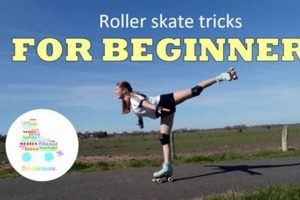
The actions performed while using wheeled footwear designed for gliding are diverse, encompassing basic strides for forward motion, turns executed through leaning and foot placement, and more complex sequences involving jumps and spins. A practical illustration involves initiating forward momentum with alternating leg thrusts, followed by a controlled directional shift achieved by angling the skates.
Mastery of these techniques provides a form of recreation, cardiovascular exercise, and a means of transportation. Historically, development of this skillset has evolved from rudimentary balancing acts to sophisticated athletic displays and artistic performances. The potential health benefits and the diverse range of activities are significant.
The following discussion will detail specific techniques, including forward and backward skating, turning maneuvers, and advanced variations. Each technique will be addressed with considerations for skill level and safety.
Essential Techniques for Wheeled Boot Maneuvering
This section outlines essential techniques that enable a smoother, safer, and more enjoyable experience while using rolling footwear.
Tip 1: Maintaining Proper Stance: Achieve optimal balance and control by keeping knees bent, weight centered, and shoulders aligned over the hips. This posture is crucial for stability during movement and minimizes the risk of falls.
Tip 2: Mastering the Forward Glide: Propel oneself forward efficiently by utilizing alternating leg pushes. Focus on extending the leg fully during the push and then bringing it back smoothly to maintain momentum. The push should originate from the inner edge of the wheels.
Tip 3: Executing Controlled Stops: Learn various stopping techniques, such as the T-stop (dragging one skate perpendicular to the other) or the plow stop (angling both skates inward to create resistance). Practice each method in a safe environment until proficiency is achieved.
Tip 4: Performing Efficient Turns: Initiate turns by leaning the body in the desired direction and applying pressure to the corresponding edge of the skates. Start with gentle turns and gradually increase the angle as comfort and control improve.
Tip 5: Backward Skating Fundamentals: Gain comfort with backward movement by practicing controlled pushes with alternating feet while looking over the shoulder in the direction of travel. Maintain a balanced stance and avoid excessive leaning.
Tip 6: Safe Fall Techniques: Learn how to fall safely by relaxing the body and aiming to land on fleshy areas, such as the buttocks or thighs. Tuck the head and roll to distribute impact.
Tip 7: Uphill Navigation: To ascend inclines, use a herringbone pattern (angling skates outward) or a “scooter” technique (using one foot to push off the ground). Control speed and maintain balance throughout the ascent.
Mastering these fundamental techniques enhances the skating experience, promotes safety, and lays the groundwork for more advanced skills. Diligent practice and a focus on controlled movements are key to success.
The subsequent segments will delve into advanced maneuvers and provide guidance on equipment maintenance and selection.
1. Balance

Balance is a foundational element, its presence or absence directly influences all actions performed on wheeled boots. A stable equilibrium is essential for initiating forward momentum, executing turns, and performing more complex maneuvers. Insufficient balance typically results in instability, increasing the risk of falls and hindering the ability to execute intended actions with precision. For example, maintaining a low center of gravity and proper weight distribution is crucial for performing a controlled spin; any disruption to this equilibrium immediately affects the spin’s smoothness and accuracy.
The influence of balance extends beyond basic movements. Advanced actions such as jumps, slides, and intricate footwork patterns demand a refined sense of equilibrium. Practicing balance-enhancing exercises, both on and off the wheeled boots, translates directly into improved control and finesse on the rink or street. Drills may include single-leg stands, core strengthening exercises, and practicing slow, deliberate movements to heighten awareness of body positioning. A skater preparing for a challenging jump, for example, will spend considerable time perfecting their balance to ensure a stable takeoff and landing.
Ultimately, the effective application of various actions using wheeled boots relies significantly on a skater’s ability to manage their center of gravity and maintain equilibrium. The capacity to quickly adjust to shifting weight and changing surfaces is critical for both recreational skating and competitive performance. Understanding and prioritizing balance not only enhances performance but also significantly reduces the risk of injury, contributing to a safer and more enjoyable skating experience.
2. Coordination
Coordination represents the synergistic integration of multiple muscle groups to execute complex actions while using wheeled boots. Actions, whether fundamental strides or intricate routines, necessitate precise timing and harmonious interaction between limbs, core, and sensory input. A deficit in coordination directly impacts the fluidity and efficiency of movement, increasing the likelihood of missteps, loss of control, and compromised performance. For instance, a synchronized spin demands simultaneous engagement of leg muscles for rotation, core muscles for stability, and arm movements for balancea failure in any of these areas disrupts the entire maneuver.
The practical significance of coordination extends beyond individual actions. Consider a choreographed sequence involving transitions between forward skating, backward skating, and intricate footwork. Each transition requires split-second adjustments and seamless integration of different motor skills. Successful execution hinges on the skater’s ability to anticipate and coordinate their movements proactively. Moreover, coordination is crucial for responding effectively to external factors, such as uneven surfaces or unexpected obstacles. Skilled skaters demonstrate an ability to subtly adjust their body position and muscle activation in response to changing conditions, maintaining balance and control.
Ultimately, optimized coordination is a critical determinant of skill and safety. It allows skaters to execute complex maneuvers with precision, respond effectively to dynamic environments, and minimize the risk of injury. While innate talent may contribute to a skater’s coordination potential, deliberate practice and targeted training are essential for refining and optimizing this essential skill. This refined coordination allows one to master the moves.
3. Agility

Agility, in the context of wheeled boot activities, is a multifaceted capability encompassing rapid directional changes, efficient maneuvering, and the ability to respond swiftly to dynamic environments. Its significance resides in enabling both precise execution of planned maneuvers and effective navigation of unexpected obstacles.
- Rapid Directional Changes
This facet involves the capacity to alter course quickly and efficiently, demanding a combination of balance, lower body strength, and spatial awareness. An example of this is a slalom course, where participants must negotiate a series of closely spaced cones. The effectiveness with which a skater navigates the course, minimizing wasted motion and maintaining speed, directly reflects their level of agility.
- Efficient Maneuvering in Confined Spaces
Agility facilitates navigating tight spaces, requiring refined control over momentum and precise footwork. This is exemplified by executing spins or intricate footwork patterns within a limited area, demonstrating command over body positioning and the ability to maintain balance while minimizing unnecessary movement.
- Reactive Adjustment to Obstacles
This pertains to the capacity to swiftly adapt to unforeseen obstructions, requiring rapid assessment of the situation and immediate corrective action. An illustration includes encountering an unexpected irregularity on a skating surface; a skater exhibiting high agility will instinctively adjust their posture and stride to maintain balance and avoid a fall, showcasing adaptability and quick reflexes.
- Integration of Skills
Agility is an overarching attribute that encompasses the ability to integrate various individual skills, like braking, turning, and accelerating, into a cohesive and fluid movement sequence. The capacity to seamlessly transition between these skills, adapting to the requirements of the moment, underscores the critical role of agility in overall performance and safety.
In synthesis, agility constitutes an indispensable asset for adept wheeled boot operation, contributing to both enhanced performance and reduced risk of injury. The capacity to execute rapid directional shifts, navigate constricted spaces, react to unanticipated impediments, and meld disparate skills renders agility a key component of overall competence.
4. Control

Control is paramount in the execution of wheeled boot maneuvers. It dictates the precision, safety, and overall success of each action. A deficiency in control manifests as instability, erratic movements, and an increased risk of injury. The capacity to regulate speed, direction, and body position determines the difference between a fluid, graceful motion and a hazardous, uncontrolled one. For instance, during a spin, maintaining consistent pressure and a stable core are essential for regulated rotation; a loss of control leads to imbalance and potential falls. Without adequate control, even basic movements become precarious.
The effect of control extends beyond simple actions. Complex routines, such as those seen in artistic disciplines, require a high degree of mastery. Precise footwork, synchronized arm movements, and coordinated transitions all rely on refined control. A skater executing a jump must manage their takeoff angle, rotation speed, and landing position, each demanding precise muscular control. Consider slalom skating, where participants navigate closely spaced cones at high speeds; success hinges on the ability to make minute adjustments to maintain course and avoid collisions. This level of command is not innate but cultivated through dedicated practice and a focus on technique.
In summation, control is an indispensable element in wheeled boot activities, serving as the foundation for skill development and safety. The ability to regulate one’s body and equipment is crucial for both basic locomotion and complex performances. Emphasizing control in training and practice allows for the attainment of higher skill levels and a reduced risk of incidents, enabling a more secure and fulfilling experience. Ultimately, mastery of control elevates the entire activity, transforming it from a potentially hazardous undertaking into a display of grace and skill.
5. Rhythm
Rhythm, in the context of wheeled boot locomotion, manifests as the underlying temporal structure that governs the coordination and sequencing of movements. It dictates the pacing, timing, and flow of motions, influencing both the efficiency and aesthetic quality of the activity. The integration of rhythm transforms discrete actions into a cohesive and fluid sequence. Without a well-defined rhythmic structure, movements appear disjointed and lack coordination. For example, consider a basic forward stride; consistent timing between leg pushes and glides creates a smooth, energy-efficient motion, while erratic pacing leads to jerky, inefficient progress.
The significance of rhythm extends to more complex routines, such as those seen in dance or artistic displays. In these disciplines, rhythm provides the framework upon which intricate patterns and sequences are constructed. The timing of spins, jumps, and footwork is precisely synchronized to musical cues, requiring a deep understanding of rhythmic structure. Furthermore, rhythm plays a critical role in maintaining balance and stability. The controlled transfer of weight from one leg to the other, timed to the underlying beat, helps maintain equilibrium and prevent falls. Consider a skater performing a waltz; the timing of each step is critical for maintaining both balance and the aesthetic appeal of the routine. Moreover, group skating activities like jam skating or choreographed routines benefit from all participants maintaining a shared sense of rhythm.
In conclusion, rhythm constitutes a foundational element in wheeled boot activities, impacting both technical execution and artistic expression. A well-developed sense of rhythm enhances efficiency, coordination, and balance, transforming disjointed movements into seamless and graceful routines. Ultimately, the effective integration of rhythm elevates the overall experience, enabling practitioners to achieve higher levels of skill and artistic expression. The ability to internalize and express rhythmic structure is crucial for both recreational enjoyment and competitive success.
6. Power

In the context of actions performed using wheeled boots, power is the capacity to generate substantial force rapidly, enabling high-velocity movements and the execution of dynamic maneuvers. Power is not merely strength, but rather the ability to apply strength quickly. Its relevance is paramount for maximizing performance and accomplishing demanding feats, underscoring its integral role in these physical activities.
- Impulse Generation
This aspect pertains to the rapid creation of propulsive force needed for acceleration and jumping. Consider a skater initiating a sprint; the effectiveness of their start hinges on the quick and forceful extension of the legs to generate initial momentum. The magnitude of this impulse directly influences acceleration rate. Furthermore, aerial maneuvers depend on a powerful upward thrust to achieve necessary altitude and rotation. Inadequate power results in compromised jump height and difficulty in executing complex aerial tricks.
- Dynamic Stability Maintenance
The ability to generate power rapidly is crucial for preserving balance during abrupt direction changes or when traversing irregular surfaces. Quick bursts of muscular force enable the skater to counteract destabilizing forces and maintain equilibrium. An instance of this is navigating a turn at high speed; the skater must exert significant force to lean into the turn while simultaneously preventing outward drift. Insufficient power leads to instability, increasing the risk of falls and compromising maneuverability.
- Maneuver Amplitude
Power dictates the extent of movement attainable during specific maneuvers. High levels of power allow skaters to execute larger, more impressive tricks and routines. For example, a powerful skater can achieve greater height and distance during a jump, allowing for the incorporation of additional rotations or complex grabs. Similarly, powerful leg muscles facilitate the execution of deep squats and dynamic slides. Limited power restricts the range of motion and complexity of attainable actions.
- Resistance Overcoming
Power is necessary to overcome external forces, such as wind resistance, gravity, and surface friction. Skating uphill or against a headwind requires the skater to generate considerable force to maintain speed. Similarly, executing tricks involving resistance, such as grinding on rails, demands significant power to maintain balance and control. Insufficient power leads to a decrease in speed, difficulty in maintaining balance, and an inability to perform demanding tricks.
These facets are intertwined and critically important. Activities involving wheeled boots depend on the interplay of impulse, dynamic stability, maneuver amplitude, and resistance overcoming, all of which depend on power. A holistic approach to training that encompasses strength, speed, and technique yields the greatest gains in power output and overall performance. Prioritizing power development enables practitioners to unlock their full potential.
Frequently Asked Questions About Wheeled Boot Techniques
The following addresses common inquiries regarding specific skills and applications in this domain.
Question 1: What constitutes a foundational skill for beginners?
Maintaining a stable stance, characterized by bent knees, a centered weight distribution, and aligned posture, constitutes a foundational skill. This posture promotes equilibrium and control, mitigating the potential for imbalance and subsequent injury.
Question 2: Which braking method is generally recommended for novices?
The T-stop method, achieved by positioning one wheeled boot perpendicular to the other, represents a suitable braking technique for beginners. This approach facilitates gradual deceleration and enhances control.
Question 3: How is forward momentum most effectively generated?
Forward progression is best attained through alternating leg pushes, emphasizing full extension and a return of the leg to the central position, ensuring sustained impetus. The thrust should originate from the inner wheel edge.
Question 4: What constitutes a safe approach to falling?
Mitigating potential injury during a fall necessitates relaxing the body and targeting impact on fleshy areas such as the buttocks or thighs. Tucking the head and initiating a rolling motion serves to disperse impact force.
Question 5: How does leaning influence directional control?
Inclining the body in the intended direction and applying pressure to the corresponding edge of the wheeled boot initiates turning. Gradual increases in the leaning angle enhance maneuverability.
Question 6: What steps can be taken to improve balance?
Regular practice of balance-enhancing exercises, both on and off wheeled boots, will improve core strength and positional awareness. These exercises may encompass single-leg stance drills, core-stabilizing activities, and intentional, measured movements.
Competent mastery of these skills will enhance the overall experience, improve user safety, and establish a firm groundwork for more sophisticated techniques.
The following section will provide guidance on maintenance and care of the equipment.
Roller Skate Moves
This article has explored a range of techniques and foundational elements related to actions performed with wheeled boots. From basic forward motion to advanced maneuvers requiring agility and precision, a comprehensive understanding of these techniques is essential for both recreational enjoyment and skill development. The integration of balance, coordination, rhythm, control, and power underpins successful execution and minimizes the risk of injury.
Continued dedication to refining technique and a commitment to safety are critical for advancing proficiency. Mastering these actions is an ongoing process that rewards diligent practice and a thoughtful approach to skill acquisition. The principles outlined serve as a solid foundation for further exploration and achievement within this activity.