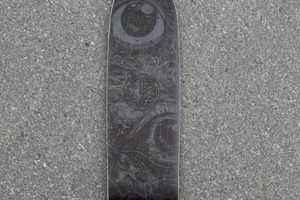
The application of designs, graphics, or images onto the surface of a skateboard is a specialized process. This typically involves techniques such as screen printing, heat transfer, or digital printing to permanently adhere artwork to the wooden deck. An example includes applying a custom logo to a board for brand promotion or creating a personalized design for individual use.
This process is vital for both aesthetic appeal and brand recognition within the skateboarding industry. It allows for creative expression, enabling artists and companies to showcase unique styles and messages. Historically, techniques have evolved from simple, single-color applications to complex, full-color designs, reflecting advancements in printing technology and artistic trends.
The following sections will delve into the specific methods employed, material considerations, and design factors that contribute to the quality and durability of the finalized product. This will provide a comprehensive understanding of how artistic visions are translated onto these surfaces.
Skate Deck Printing
The subsequent recommendations aim to enhance the effectiveness and longevity of designs applied to skateboard decks. These suggestions address critical aspects of the process, from initial design choices to final surface treatments.
Tip 1: Optimize Artwork Resolution: Ensure artwork is created at a sufficiently high resolution (typically 300 DPI) to prevent pixelation and maintain clarity when scaled to the dimensions of the skateboard deck. For instance, a low-resolution image will appear blurred and unprofessional upon application.
Tip 2: Implement Color Management: Employ a consistent color management system (e.g., Pantone Matching System) throughout the design and application phases. This minimizes color discrepancies between the digital design and the final printed result.
Tip 3: Utilize Durable Inks: Select inks specifically formulated for adherence to wood and resistance to abrasion. Solvent-based inks often provide superior durability compared to water-based alternatives in this application.
Tip 4: Prepare the Deck Surface Properly: Sand the deck surface to ensure a smooth, even base for ink adhesion. Remove all dust and debris prior to printing, as these imperfections can compromise the quality of the printed image.
Tip 5: Apply a Protective Clear Coat: After the design is printed, apply a durable clear coat to shield the artwork from scratches, UV damage, and general wear and tear. This protective layer extends the lifespan of the printed graphic.
Tip 6: Consider Layering Techniques: Employ layering techniques, such as using a white underbase for vibrant colors on dark-stained decks. This ensures the design’s colors remain true and do not become muted by the wood’s underlying tone.
Tip 7: Test Print Before Production: Conduct a test print on a sample deck or a similar material to verify color accuracy, image quality, and ink adhesion before committing to a full production run. This step helps identify and rectify potential issues early on.
By adhering to these guidelines, individuals and organizations involved in applying designs to skateboard decks can significantly improve the visual appeal, durability, and overall quality of the finished product.
The following section will explore specific materials commonly used in the process and their respective properties.
1. Ink Adhesion
Ink adhesion represents a critical parameter in applying graphics to skateboards. Insufficient adhesion compromises the aesthetic and functional integrity of the deck, leading to premature wear and design failure.
- Surface Energy and Wettability
Surface energy, a property of both the ink and the skateboard deck, dictates the ability of the ink to spread evenly (wetting) and adhere to the surface. A mismatch in surface energies can result in poor wetting, beading of the ink, and ultimately, inadequate adhesion. Surface treatments, such as sanding or the application of primers, modify the deck’s surface energy to promote improved ink wetting and subsequent adhesion. Consider, for example, a deck with a high resin content; without proper preparation, the ink may not properly adhere, resulting in chipping or peeling during use.
- Chemical Bonding Mechanisms
Adhesion relies on chemical bonds forming between the ink and the substrate. These bonds can be covalent, ionic, or van der Waals forces. Specific ink formulations incorporate polymers and resins designed to react with the wood fibers or pre-applied coatings on the deck, creating strong intermolecular bonds. When these bonds fail to form effectively, due to improper curing or incompatible materials, the graphic’s longevity is severely compromised.
- Mechanical Interlocking
Beyond chemical bonding, mechanical interlocking plays a role in anchoring the ink to the deck. A slightly porous surface allows the ink to penetrate and physically grip the wood fibers. This is often achieved through sanding or etching the surface prior to printing. Decks that are too smooth or coated with a non-porous sealant will offer minimal opportunity for mechanical interlocking, increasing the risk of the graphic detaching under stress.
- Curing Process Optimization
The curing process solidifies the ink and establishes the final bond between the ink and the deck. Inadequate curing, whether due to insufficient heat, UV exposure, or dwell time, prevents the complete cross-linking of the ink’s polymers, leaving it vulnerable to abrasion and environmental factors. Precisely controlled curing parameters, tailored to the specific ink chemistry and deck material, are essential for achieving optimal adhesion and graphic durability.
The interplay between surface energy, chemical bonding, mechanical interlocking, and the curing process collectively defines the effectiveness of ink adhesion. A comprehensive understanding of these factors is essential for skate deck manufacturers and designers to produce graphics that withstand the demanding conditions of skateboarding.
2. Graphic Resolution

Graphic resolution directly impacts the visual quality and clarity of graphics applied to skateboard decks. Low resolution source imagery inevitably translates to a pixelated or blurred design on the final product, diminishing aesthetic appeal. A high-resolution image, conversely, retains sharpness and detail, resulting in a professional and visually engaging deck design. The relationship is causal: inadequate resolution is the cause, and a degraded final image is the effect. A skate deck design utilizing a photograph scanned at 72 DPI, for instance, will exhibit noticeable pixelation when printed at the size required for a deck, whereas the same photograph scanned at 300 DPI will reproduce with significantly greater fidelity.
The importance of graphic resolution extends beyond mere aesthetics; it influences brand perception and product value. A high-quality graphic reflects positively on the brand, suggesting attention to detail and a commitment to excellence. In the skateboarding industry, where visual appeal is a significant driver of purchasing decisions, a well-defined graphic can differentiate a product and command a higher price. Furthermore, complex designs with intricate details necessitate higher resolutions to accurately capture the nuances of the artwork. The practical application involves careful consideration of the printing method, deck size, and viewing distance to determine the optimal resolution for the source imagery.
Ultimately, understanding the interplay between graphic resolution and reproduction quality is essential for producing visually compelling skateboard decks. While higher resolutions demand larger file sizes and potentially more processing power, the resulting improvement in image clarity and overall product appeal justifies the investment. Neglecting this aspect can lead to subpar results, negatively impacting brand image and consumer satisfaction. Successfully navigating the complexities of graphic resolution contributes to the creation of durable, visually striking skateboards that meet the expectations of both artists and consumers.
3. Surface Preparation

Surface preparation is a foundational component of successful skateboard graphics application. It is the initial step that directly influences the adhesion, durability, and overall aesthetic of the final printed design. Failure to properly prepare the deck surface results in a compromised bond between the wood and the ink, leading to premature peeling, chipping, and fading of the graphic. For example, applying a design to a deck with residual sanding dust prevents the ink from directly contacting the wood, significantly reducing adhesion.
The process typically involves sanding the deck to create a smooth and even surface, removing any existing finish or imperfections. This sanding process also increases the surface area available for ink adhesion. Following sanding, thorough cleaning is essential to eliminate dust, debris, and oils that could interfere with the bonding process. Some manufacturers employ chemical treatments to further enhance adhesion, such as applying a primer or adhesion promoter. The correct selection of grit sandpaper is crucial; a grit too coarse may leave scratches, while a grit too fine may not adequately remove the existing finish.
In summary, appropriate surface preparation is not merely a preliminary step, but an integral determinant of the longevity and visual impact of skateboard graphics. Rigorous adherence to proper surface preparation techniques is essential for producing high-quality, durable, and visually appealing designs. Overlooking this step invariably leads to compromised results, regardless of the quality of the inks or printing methods employed.
4. Curing Process

The curing process is a critical stage in skateboard graphics application. It solidifies the inks and adhesives, establishing a durable bond between the graphic and the deck surface. Proper curing ensures the longevity and visual integrity of the design, safeguarding against premature wear and environmental degradation.
- Temperature Control
Precise temperature control is paramount during curing. Exceeding the ink manufacturer’s recommended temperature can result in blistering, discoloration, or even degradation of the graphic. Conversely, insufficient temperature can lead to incomplete curing, leaving the ink vulnerable to abrasion and solvents. For instance, UV-cured inks require specific UV light intensity and exposure duration, while solvent-based inks often necessitate controlled heat and air circulation.
- Curing Time
Curing time is directly related to the type of ink used and the desired level of durability. Insufficient curing time prevents the ink from fully cross-linking, compromising its resistance to scratching and fading. Extending the curing time beyond the recommended duration can cause over-curing, leading to brittleness and potential cracking of the graphic. The optimal curing time is determined by carefully following the ink manufacturer’s specifications and conducting test prints to verify the results.
- UV Light Intensity (for UV-Cured Inks)
For UV-cured inks, the intensity of the UV light source directly influences the curing rate and completeness. Low intensity can result in under-cured ink that is tacky and easily damaged. Excessive intensity can lead to surface curing, where the top layer of the ink hardens prematurely, trapping uncured material underneath. Regular monitoring of the UV lamp output and proper calibration of the curing equipment are essential for maintaining consistent and reliable curing results.
- Environmental Factors
Environmental factors such as humidity and air circulation can also impact the curing process. High humidity can slow down the evaporation of solvents in solvent-based inks, potentially leading to incomplete curing. Adequate air circulation promotes even drying and prevents the build-up of solvent vapors. Controlling these environmental variables ensures that the curing process proceeds uniformly and effectively across the entire deck surface.
In conclusion, the curing process is not a singular event, but rather a carefully orchestrated sequence of events governed by temperature, time, UV light intensity (when applicable), and environmental conditions. Attention to these details is paramount for achieving optimal ink adhesion and ensuring the long-term durability and visual appeal of skateboard graphics.
5. Material Selection

Material selection significantly influences the efficacy and longevity of applying designs to skateboard decks. The choice of wood, ink, and any coatings directly impacts ink adhesion, image quality, and resistance to environmental factors. The substrate material’s surface energy, porosity, and chemical compatibility with the selected ink dictate the success of the printing process. An unsuitable combination, such as using a water-based ink on a heavily varnished deck, invariably results in poor adhesion and premature graphic failure. Conversely, selecting appropriate materials ensures a durable and visually appealing final product. For example, Canadian maple is commonly used for its strength and smooth surface, which lends itself well to various printing techniques.
Considerations extend to the inks employed. Solvent-based inks often provide superior adhesion and durability on wood surfaces compared to water-based alternatives, although environmental regulations may necessitate the use of the latter. UV-curable inks offer rapid curing times and excellent scratch resistance but require specialized equipment. Clear coats, applied post-printing, serve as a protective barrier against abrasion and UV degradation, extending the graphic’s lifespan. The selection of these coatings must be compatible with the ink system to prevent delamination or other adverse reactions. Ultimately, material selection acts as a foundational element of the overall production process, with each material interacting to influence the quality and lifespan of a deck graphic.
In summary, informed material selection is a prerequisite for successful printing on skateboard decks. It addresses the critical interplay between substrate, ink, and protective coatings. Careful consideration of these materials ensures the attainment of durable, high-quality graphics. Overlooking this fundamental aspect invariably compromises the aesthetic and functional integrity of the final product, regardless of the printing technique employed.
6. Design Complexity
The intricacies of artwork intended for skateboard decks introduce significant variables into the production process. The level of detail, color gradients, and layering directly impact the feasibility, cost, and ultimate visual fidelity of the printed graphic.
- Number of Colors
Designs utilizing a limited color palette are typically more straightforward and economical to reproduce, particularly when employing screen-printing techniques. Each additional color necessitates a separate screen, increasing setup time, production costs, and the potential for misregistration. Conversely, complex designs with numerous colors may require digital printing methods to achieve accurate color reproduction and mitigate registration issues. For instance, a simple two-color logo is significantly less complex to produce than a photorealistic image containing hundreds of distinct hues.
- Gradient and Shading
Smooth gradients and subtle shading effects pose challenges for certain processes. Screen printing, for example, relies on halftones to simulate gradients, which can result in visible dot patterns, especially in lighter areas. Digital printing methods offer superior gradient reproduction but may be more expensive or less durable. Complex shading in a design, therefore, demands careful selection of the appropriate printing technology to maintain visual integrity.
- Fine Detail and Line Width
Intricate details and thin lines can be difficult to accurately reproduce, particularly when using screen printing. The mesh size of the screen limits the resolution of the printed image, and fine lines may become broken or disappear entirely. Digital printing methods can handle finer details, but their suitability depends on the ink type and substrate material. Therefore, design complexity that incorporates small text or ornate patterns must consider the limitations of the chosen printing process.
- Layering and Transparency
Designs incorporating multiple layers or transparent elements require precise alignment and color management. Overlapping colors can create unintended hues or visual artifacts if not carefully controlled. Digital printing allows for greater control over layering and transparency effects, but screen printing can also be used with careful planning and execution. Complex multi-layered designs with varying opacities require meticulous preparation to achieve the desired visual outcome.
The relationship between design complexity and the selected printing method is therefore interdependent. Intricate designs necessitate advanced printing techniques and meticulous preparation, while simpler designs offer greater flexibility in the choice of printing process. Understanding these interactions is crucial for achieving the desired visual outcome while optimizing cost and production efficiency in skateboard graphics application.
Frequently Asked Questions about Skate Deck Printing
The following addresses common inquiries concerning the process of applying designs to skateboard decks. The responses aim to provide clarity on technical aspects and best practices.
Question 1: What resolution is optimal for artwork intended for skate deck printing?
Artwork should be created at a minimum resolution of 300 DPI at the final print size. Lower resolutions may result in pixelation and a loss of detail in the finished graphic.
Question 2: Which ink types are most durable for skate deck applications?
Solvent-based inks and UV-cured inks generally offer superior durability and adhesion to wood surfaces compared to water-based inks. The specific choice depends on the desired finish and environmental considerations.
Question 3: How should a skateboard deck be prepared prior to printing?
The deck surface should be thoroughly sanded to create a smooth and even surface. All dust, debris, and oils must be removed to ensure proper ink adhesion. Primers or adhesion promoters may be applied to further enhance bonding.
Question 4: What is the purpose of a clear coat applied after printing?
A clear coat protects the printed graphic from scratches, UV damage, and general wear and tear, significantly extending its lifespan. The clear coat should be compatible with the ink system to prevent delamination or other adverse reactions.
Question 5: How does design complexity affect the printing process?
Designs with numerous colors, gradients, and fine details require more complex printing techniques and may increase production costs. Careful consideration should be given to the limitations of the chosen printing method.
Question 6: What factors contribute to poor ink adhesion?
Poor ink adhesion can result from inadequate surface preparation, incompatible ink and substrate materials, improper curing, or environmental factors such as high humidity.
These FAQs highlight the critical considerations for effective graphics application. Attention to detail throughout the process is essential for achieving a durable and visually appealing result.
The following section explores future trends and emerging technologies in skateboard graphics.
Conclusion
The preceding discussion has illuminated the multifaceted nature of applying designs to skateboard decks. From meticulous surface preparation to the intricacies of ink selection and curing processes, successful implementation hinges on a comprehensive understanding of material properties and technical execution. Graphic resolution, design complexity, and environmental factors all contribute to the final outcome. Neglecting any of these key elements diminishes the potential for a durable, visually compelling product.
The continued advancement of printing technologies promises further refinements in applying designs to skateboards. The information provided serves as a foundation for informed decision-making, enabling manufacturers and designers to navigate the complexities of this specialized field and to strive for consistent quality and innovation. Continued vigilance regarding evolving techniques is critical for success.

![Buy the Best Toy Machine Skate Decks | [Year] Guide | How to Skateboard: A Beginner's Guide to Your First Board & Tricks](https://cruzskateshop.com/wp-content/uploads/2026/03/th-366-300x200.jpg "Buy the Best Toy Machine Skate Decks | [Year] Guide How to Skateboard: A Beginner's Guide to Your First Board & Tricks")