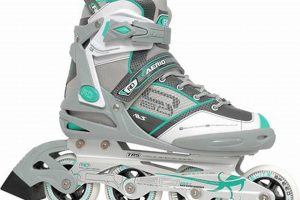
Urethane components, situated between the skate plate and the trucks, are essential for manipulating turning performance. These pliable elements compress in response to leaning, enabling the skater to initiate and maintain controlled arcs and directional changes. As an example, a skater might choose a softer material for increased maneuverability in rink skating or a firmer option for enhanced stability during high-speed outdoor skating.
These elements significantly influence the responsiveness and feel of the skating experience. Their durometer, or hardness, impacts the skater’s ability to execute precise movements. Historically, these components have evolved from rudimentary rubber materials to advanced polymers, allowing for greater customization and performance optimization. The selection of appropriate hardness and shape contributes to both comfort and control, impacting fatigue and overall enjoyment.
The following sections will delve into the various types available, factors influencing selection, and practical guidance on installation and maintenance to ensure optimal skating performance and longevity of the equipment.
Optimizing Performance
This section provides essential considerations for selecting and maintaining components critical to roller skate performance. The following guidelines facilitate informed decision-making and ensure optimal skating experiences.
Tip 1: Durometer Selection: Consider the intended skating environment and desired maneuverability. Lower durometer ratings (softer) enhance turning agility, ideal for rink skating or dance. Higher durometer ratings (firmer) provide increased stability for speed skating or outdoor surfaces.
Tip 2: Shape Considerations: Conical shapes offer greater lean and responsiveness, while barrel shapes provide enhanced stability and support. Experimentation may be required to determine the optimal shape for individual skating style and preferences.
Tip 3: Material Compatibility: Ensure compatibility between these components, kingpins, and skate plates. Using incompatible materials may lead to premature wear, reduced performance, or potential equipment failure.
Tip 4: Regular Inspection: Conduct routine visual inspections for signs of wear, cracking, or deformation. Prompt replacement of damaged components is crucial for maintaining safety and performance.
Tip 5: Proper Installation: Ensure proper alignment and tightness during installation. Over-tightening can compress them excessively, reducing their effectiveness and potentially damaging the skate plate or kingpins.
Tip 6: Consistent Maintenance: Clean these components regularly to remove dirt and debris, which can degrade the material and reduce performance. Use mild soap and water, avoiding harsh chemicals or solvents.
Tip 7: Break-in Period: Allow a break-in period after installing new ones. The materials may require some time to fully compress and conform to the skater’s weight and skating style.
Proper selection and maintenance of these components directly impact skating performance, stability, and safety. By adhering to these guidelines, skaters can optimize their equipment for specific needs and ensure a more enjoyable and controlled skating experience.
The following section provides a summary, reiterating key considerations and insights into the selection and optimization of this essential skating component.
1. Durometer (Hardness)

Durometer, a measurement of a material’s resistance to indentation, is a critical specification dictating the performance characteristics of urethane components within roller skate assemblies. It significantly affects a skater’s ability to control the skates and execute various maneuvers.
- Turning Radius and Agility
Softer materials, indicated by lower durometer values (e.g., 78A-85A), compress more readily, allowing for tighter turning radii. This attribute is advantageous for rink skating, dance routines, and situations requiring rapid directional changes. For example, a roller derby skater would likely benefit from softer elements to navigate crowded tracks and execute quick turns.
- Stability and Control at Speed
Conversely, firmer materials, denoted by higher durometer values (e.g., 90A-98A), offer increased resistance to compression, resulting in greater stability at higher speeds. This characteristic is desirable for speed skating, outdoor skating on uneven surfaces, and situations where maintaining a straight line is paramount. A speed skater, for instance, would choose a firmer element to minimize unwanted movement and maximize energy transfer during each stride.
- Impact Absorption and Vibration Dampening
Softer materials inherently possess superior impact absorption and vibration dampening properties. This translates to a smoother and more comfortable skating experience, particularly on rough or uneven surfaces. Skaters who frequently skate outdoors may opt for softer durometers to mitigate the effects of road imperfections.
- Wear Resistance and Longevity
Firmer materials generally exhibit greater wear resistance than softer materials. However, this comes at the expense of reduced flexibility and responsiveness. The optimal durometer selection involves a trade-off between performance characteristics and expected lifespan, depending on skating style and frequency of use.
In summary, durometer directly influences turning agility, stability at speed, impact absorption, and wear resistance. Careful consideration of the intended skating environment and desired performance characteristics is essential for selecting the appropriate durometer, optimizing skating performance and comfort. Skaters may experiment with various durometers to find the optimal balance for their specific needs.
2. Shape (Conical, Barrel)

Geometry significantly influences the operational characteristics of urethane elements within roller skate assemblies, dictating responsiveness and stability during various maneuvers. Conical and barrel shapes represent primary design options, each offering distinct performance attributes.
- Conical Profile: Enhanced Lean and Agility
Conical elements, characterized by a tapered profile, facilitate a greater degree of lean before encountering resistance. This promotes increased agility and tighter turning radii, advantageous for disciplines such as roller derby and artistic skating. A skater executing a spin, for instance, may benefit from the enhanced maneuverability afforded by this shape.
- Barrel Profile: Increased Stability and Control
Barrel elements, featuring a uniform diameter throughout their height, provide a broader contact surface, resulting in enhanced stability and control, particularly at higher speeds. Speed skaters and those traversing uneven surfaces often prefer barrel-shaped components for their superior stability. The expanded contact area minimizes unwanted oscillations and maximizes energy transfer.
- Progressive Resistance and Responsiveness
Shape influences the progressive resistance encountered during compression. Conical elements exhibit a more gradual increase in resistance as the skater leans, providing a responsive feel. Barrel elements offer a more immediate and substantial resistance, lending greater stability and predictability to skate behavior. The choice between these attributes depends on individual skating style and preferences.
- Combined Configurations: Hybrid Performance Characteristics
Skaters may employ hybrid configurations, utilizing different shapes in the upper and lower positions, to achieve customized performance characteristics. For example, a conical element in the upper position may enhance lean, while a barrel element in the lower position provides a stable base. Such configurations allow for fine-tuning of skate response to match specific needs.
Shape selection constitutes a critical component in optimizing roller skate performance. Careful consideration of the intended skating discipline, individual skating style, and desired balance between agility and stability is essential for informed decision-making. Experimentation with varying shapes is encouraged to determine the optimal configuration for individual requirements.
3. Rebound (Energy Return)

The elasticity, or rebound, of urethane components within roller skate assemblies critically influences energy transfer and responsiveness. The material’s capacity to store and release energy dictates the skater’s propulsion efficiency and the overall feel of the skate.
- Propulsion Efficiency and Energy Conservation
Elements with higher rebound characteristics store and release energy more effectively during compression and release cycles. This results in greater propulsion efficiency, reducing the energy expenditure required for each stride. For example, a skater executing a long-distance session may benefit from high-rebound material to minimize fatigue and maintain consistent speed.
- Responsiveness and “Pop”
Rebound directly affects the “pop” or responsiveness of the skates. Higher rebound values produce a snappier, more energetic feel, enhancing the skater’s ability to perform quick maneuvers and generate power. Artistic skaters often prioritize rebound to facilitate precise movements and expressive routines.
- Vibration Dampening Trade-off
While high rebound can enhance performance, it may also reduce vibration dampening. Materials optimized for energy return may transmit more road vibrations to the skater. The optimal balance between rebound and dampening depends on the skating environment and the skater’s preference for comfort versus responsiveness.
- Material Composition and Rebound Characteristics
The specific urethane blend significantly impacts rebound characteristics. Different polymers and additives can be used to tailor the material’s elasticity and energy return properties. Manufacturers often specify a rebound rating (expressed as a percentage) to indicate the material’s capacity to return stored energy. This rating serves as a valuable metric for comparing different options and selecting the optimal component.
In summation, rebound represents a critical performance parameter of urethane elements, influencing propulsion efficiency, responsiveness, and vibration dampening. Selecting appropriate components with suitable rebound characteristics contributes significantly to skating performance and overall experience. Careful consideration of these elements, along with individual skating needs and preferences, is essential for optimizing skating equipment.
4. Material (Urethane Blend)

The composition of the urethane blend used in these elements is paramount to their overall performance and durability. The specific polymers, additives, and manufacturing processes directly influence durometer, rebound, compression set, and resistance to environmental degradation. The selection of an appropriate blend is not arbitrary; it is a deliberate engineering decision intended to optimize performance characteristics for a specific skating style or environment. For example, a blend formulated for aggressive street skating would prioritize high abrasion resistance and impact absorption, potentially sacrificing some degree of rebound. Conversely, a blend intended for speed skating would prioritize high rebound and low compression set to maximize energy transfer, potentially compromising some degree of impact absorption. A skater, upon experiencing premature failure of a set, might attribute it to an inappropriate urethane blend for their typical use.
The practical significance of understanding the material blend lies in the ability to make informed purchasing decisions. A skater aware of the performance implications of different urethane formulations can select components that align with their specific needs and preferences. This knowledge also enables skaters to diagnose performance issues and troubleshoot equipment malfunctions. For instance, excessive deformation or cracking might indicate a blend susceptible to UV degradation or one that is not sufficiently robust for the imposed stress. Furthermore, understanding the influence of the urethane blend allows skaters to optimize maintenance practices, such as using appropriate cleaning agents and avoiding exposure to harmful chemicals that might compromise the material’s integrity. Ignoring such details would lead to suboptimal skating performance and potentially increase the frequency of replacement.
In summary, the urethane blend is not merely a material component but a critical determinant of performance, durability, and overall skating experience. A thorough understanding of the material’s properties and their implications enables skaters to make informed decisions, optimize equipment performance, and ensure longevity. The challenge lies in communicating these technical aspects to skaters in an accessible manner, empowering them to leverage this knowledge for improved skating outcomes. Failure to appreciate the nuances of urethane blends results in a less-than-optimal skating experience and potentially reduces the lifespan of the equipment.
5. Compression (Deformation Rate)

The rate at which a urethane component deforms under load, commonly termed compression or deformation rate, stands as a crucial performance parameter, influencing stability, responsiveness, and overall longevity within roller skate systems. The inherent ability to resist and recover from deformation dictates the skaters control and comfort. A low deformation rate is frequently sought for high-performance applications.
- Influence on Stability at Speed
A lower deformation rate translates to enhanced stability, particularly at elevated speeds. A material exhibiting minimal compression under load maintains a consistent geometry, preventing unwanted oscillations and contributing to predictable handling. Speed skaters and those navigating uneven surfaces often benefit from components engineered to resist deformation, ensuring consistent control and minimizing energy loss.
- Impact on Energy Transfer and Responsiveness
Deformation rate directly affects the efficiency of energy transfer during skating. A material with a low deformation rate stores and releases energy more effectively, leading to improved responsiveness and “pop.” This attribute is particularly valuable for maneuvers requiring quick directional changes and explosive power, such as those encountered in roller derby or artistic skating.
- Link to Material Durability and Lifespan
The rate of deformation is intrinsically linked to the long-term durability and lifespan of these components. Materials exhibiting excessive compression or permanent deformation under load are prone to premature wear and failure. Selecting a material with a low compression set (the permanent deformation remaining after load removal) is crucial for ensuring long-term reliability and minimizing the need for frequent replacements.
- Role in Vibration Damping
While a low deformation rate generally enhances stability and energy transfer, it can also impact vibration damping characteristics. Materials that resist compression may transmit more road vibrations to the skater, potentially reducing comfort on rough surfaces. Therefore, a balance between deformation rate and vibration damping is essential for optimizing the overall skating experience. The skater’s style, typical surface conditions, and personal tolerance for vibration should be carefully considered when selecting components with a particular deformation profile.
In conclusion, the deformation rate serves as a pivotal element influencing stability, energy return, component life span, and vibration damping in roller skate systems. By carefully evaluating this parameter, skaters can optimize the performance of the skates to match their specific needs and terrain conditions. Neglecting it may lead to equipment failure and non-optimal performance.
6. Compatibility (Plate/Kingpin)

Proper fitment between the urethane components, the skate plate, and the kingpin is crucial for optimal roller skate performance. Dimensional mismatches or incompatible designs can induce premature wear, compromised handling characteristics, or even equipment failure. The kingpin, a threaded bolt securing the trucks to the plate, exerts compressive force upon the urethane. Incorrect dimensions or unsuitable thread patterns can lead to uneven loading, resulting in skewed compression and inconsistent turning response. For example, attempting to use a component designed for a 7mm kingpin on a plate with an 8mm kingpin seat would likely result in excessive play and unstable handling.
Failure to consider compatibility also manifests in the components interaction with the plates geometry. Some plates feature specific recesses or contours designed to accommodate particular shapes and sizes. Force-fitting an incompatible component can distort its shape, altering its durometer and rebound characteristics, thereby negating the intended performance benefits. Furthermore, the component’s height must align with the kingpin length to ensure adequate compression without bottoming out or excessive slack. Over-tightening the kingpin nut to compensate for insufficient height can damage the threads or deform the plate, while under-tightening results in instability and potential loosening during use. A real-world application of the result of this concept: An artist skater installed roller skate cushions that are larger than it should be, the component’s height does not align with the kingpin length. The plate becomes deformed, this has resulted in to unsafe skating.
In summary, compatibility extends beyond simple dimensional conformity. It encompasses the interplay of forces and geometries between all interconnected components. Careful consideration of the specifications outlined by both the plate and component manufacturers is essential for safe and effective roller skating. Neglecting these compatibility considerations often culminates in reduced performance, accelerated wear, and an elevated risk of equipment malfunction or failure. This detailed analysis is crucial for skaters aiming to optimize their equipment and ensure a safe skating experience.
Frequently Asked Questions
This section addresses common inquiries regarding urethane components in roller skates, providing detailed explanations to enhance understanding and informed decision-making.
Question 1: What is the purpose of roller skate cushions?
These pliable elements, situated between the skate plate and the trucks, facilitate turning and maneuverability. Compression of these components allows skaters to initiate and maintain controlled directional changes.
Question 2: How does durometer affect performance?
Durometer, a measure of hardness, dictates the turning radius and stability. Lower durometer values (softer) enhance agility, while higher values (firmer) improve stability at higher speeds.
Question 3: What are the primary shape options available?
Conical shapes promote greater lean and responsiveness, suitable for disciplines requiring agility. Barrel shapes offer increased stability and control, favored for speed skating and uneven surfaces.
Question 4: How does rebound influence skating?
Rebound, or energy return, impacts propulsion efficiency and responsiveness. Higher rebound values generate a snappier feel, while lower values may improve vibration dampening.
Question 5: How critical is compatibility with the plate and kingpin?
Ensuring proper fitment is essential. Mismatched components can cause premature wear, compromised handling, or equipment failure. Adherence to manufacturer specifications is crucial.
Question 6: How does material composition impact these components?
The urethane blend dictates durometer, rebound, compression set, and resistance to degradation. Selection of an appropriate blend is paramount for optimizing performance characteristics.
Careful consideration of durometer, shape, rebound, compatibility, and material composition enables skaters to optimize their equipment and ensure a controlled skating experience.
The following section will offer supplementary insights, solidifying understanding of these critical components and their broader impact on skating mechanics.
Roller Skate Cushions
This exposition has delineated the multifaceted role of roller skate cushions in influencing performance characteristics. Durometer selection, shape considerations, rebound properties, material composition, compression dynamics, and plate/kingpin compatibility collectively determine the responsiveness, stability, and longevity of the skate assembly. Understanding these interdependencies is essential for optimizing equipment to meet specific skating demands.
The informed selection and maintenance of these components represent a direct investment in skating performance and safety. Continued exploration of advanced materials and innovative designs promises further refinement of skating technology, potentially yielding enhanced control and reduced risk of equipment failure. The discerning skater will prioritize data-driven decision-making to maximize the potential of this critical, yet often overlooked, element.