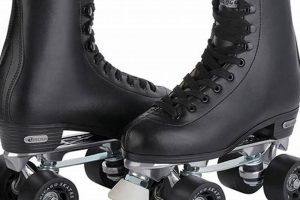
Protective headgear designed specifically for use while participating in the activity of skating on wheeled boots. This equipment typically incorporates a hard outer shell and an impact-absorbing inner liner to mitigate potential head injuries. A representative instance involves an individual utilizing such headgear while performing tricks at a skate park.
The application of appropriate head protection significantly reduces the likelihood and severity of head trauma resulting from falls or collisions. Historically, the implementation of safety standards and increased awareness of the risks associated with skating have led to a greater adoption rate of this crucial safety measure. The utilization enhances overall safety and contributes to a more secure skating experience.
Subsequent sections will detail specific features to consider when selecting headgear, discuss relevant safety standards and certifications, and provide guidance on proper fit and maintenance procedures to ensure optimal protective capabilities.
Tips for Selecting Protective Headgear
The following guidance is designed to aid in the selection of appropriate headgear for skating activities. Prioritize safety and proper fit to maximize protection.
Tip 1: Prioritize Safety Standards: Ensure that the headgear meets recognized safety standards, such as those set by ASTM International or the Consumer Product Safety Commission (CPSC). Verification of certification markings is crucial.
Tip 2: Proper Fit is Paramount: Measure head circumference and consult sizing charts provided by the manufacturer. The headgear should fit snugly and securely, without excessive movement.
Tip 3: Consider Ventilation: Adequate ventilation prevents overheating and improves comfort during prolonged use. Opt for headgear with strategically placed vents.
Tip 4: Assess Impact Absorption: Evaluate the inner liner material, typically expanded polystyrene (EPS) foam. Denser foam generally offers greater impact absorption.
Tip 5: Check Retention System: The chinstrap and buckle mechanism must be secure and easily adjustable. A properly adjusted chinstrap prevents the headgear from dislodging during a fall.
Tip 6: Inspect for Damage: Regularly inspect the headgear for cracks, dents, or other signs of damage. Replace headgear after any significant impact, even if no visible damage is apparent.
Tip 7: Specific Design Features: Look for models designed specifically for skating, which may offer enhanced coverage or impact protection in areas prone to injury.
Adhering to these tips promotes a safer skating experience by ensuring the use of headgear that meets safety standards, fits correctly, and provides adequate protection. Regular inspection and timely replacement are essential for maintaining optimal protective capabilities.
The subsequent section will delve into the long-term care and maintenance of headgear, further emphasizing the importance of responsible equipment management.
1. Impact Absorption

Impact absorption is a crucial function of protective headgear designed for skating. It directly mitigates the transmission of kinetic energy to the user’s head during a fall or collision, thereby reducing the risk of head trauma.
- Expanded Polystyrene (EPS) Foam
EPS foam is commonly utilized as the primary impact-absorbing material within skating headgear. Upon impact, the foam crushes, dissipating energy and prolonging the deceleration of the head. This process converts a sharp, potentially injurious force into a more gradual one. For instance, a skater falling directly backward onto pavement will experience a significantly reduced impact force due to the EPS foam’s deformation.
- Shell Material and Construction
The outer shell, typically constructed from polycarbonate or ABS plastic, serves not only to protect the EPS foam but also to distribute impact forces across a wider area. The shell’s rigidity and shape contribute to overall impact absorption by preventing localized penetration and promoting a more uniform distribution of stress. A helmet with a robust shell and well-integrated EPS foam layer enhances the protection offered during high-impact incidents.
- Multi-Impact vs. Single-Impact Design
Some protective headgear is designed for single-impact events, requiring replacement after a significant impact, while others are designed for multi-impact scenarios, providing some residual protection after minor impacts. Single-impact designs prioritize maximum absorption for a single event, whereas multi-impact designs focus on lower-level, repeated protection. Skaters engaged in high-risk activities should prioritize single-impact rated helmets, while those seeking everyday protection may opt for multi-impact rated models.
- Impact Testing and Certification
The effectiveness of impact absorption is rigorously tested through standardized procedures established by organizations such as ASTM International and the Consumer Product Safety Commission (CPSC). Certification marks indicate that the headgear has met minimum performance criteria for impact resistance. These tests simulate various impact scenarios and measure the force transmitted to a headform within the helmet. Compliance with these standards provides assurance that the headgear offers a verifiable level of impact protection.
The interplay of these facets determines the overall impact absorption capability of the skating headgear. Selection of appropriate headgear should prioritize verified impact performance, proper fit, and suitability for the intended skating activity to ensure optimal protection against head injuries.
2. Proper Fit

Proper fit is a non-negotiable element in the effective functioning of headgear for skating. An improperly fitted helmet, regardless of its safety certifications, offers diminished protection, potentially leading to serious injury. The correct size ensures that the helmet’s energy-absorbing materials are positioned optimally to manage impact forces. A loose helmet can shift or dislodge during a fall, leaving the head vulnerable. Conversely, a helmet that is too tight can cause discomfort and may not provide adequate impact protection due to compressed or distorted internal structures. For instance, a skater executing a jump who falls and whose helmet slides backward due to being too large will not receive the intended protection on the front of the head upon impact, potentially resulting in facial or head injury.
The connection between proper fit and protective efficacy is further illustrated in studies of head injury prevention. Data consistently shows that correctly fitted helmets reduce the incidence and severity of head trauma in skating-related accidents. Correct fit can be verified by ensuring the helmet sits level on the head, covering the forehead approximately one inch above the eyebrows. The chinstrap should be snug enough to prevent the helmet from moving but not so tight as to cause discomfort or restrict breathing. Moving the helmet from side to side and front to back should result in the skin of the forehead moving with the helmet, indicating a secure fit. Practical application involves educating skaters and retailers on proper fitting techniques, encouraging routine fit checks, and providing clear sizing guidance from manufacturers.
In summary, achieving a proper fit is critical to realizing the full protective potential of skating headgear. Challenges include varying head shapes and sizes, as well as the difficulty in consistently enforcing fit checks. However, emphasizing the importance of a snug, level, and secure fit ensures that the skater benefits from the designed safety features of the headgear, reducing the risk of head injury. This understanding is vital in the broader context of promoting safe skating practices.
3. Safety Standards

The adherence to established safety standards is paramount in the design, manufacture, and distribution of protective headgear intended for use during roller skating activities. These standards ensure a minimum level of protection and are crucial for mitigating the risk of head injuries.
- CPSC 1203 Certification
The Consumer Product Safety Commission (CPSC) standard 1203 is a mandatory federal regulation for bicycle helmets sold in the United States. Due to the similar impact characteristics between cycling and skating, helmets meeting CPSC 1203 are commonly recommended for roller skating. This standard specifies performance requirements for impact attenuation, retention system strength, and coverage area. A helmet bearing the CPSC 1203 certification mark has undergone rigorous testing to verify its ability to protect the wearer’s head in a crash.
- ASTM F1447 Standard
ASTM F1447 is a voluntary standard developed by ASTM International, a global standards organization. While not mandatory like CPSC 1203 in the US, it is widely recognized and respected. ASTM F1447 establishes requirements for bicycle helmets and includes impact testing, strap strength, and other safety-related factors. Manufacturers who choose to meet this standard demonstrate a commitment to exceeding minimum regulatory requirements. A skater selecting a helmet that meets ASTM F1447 gains assurance of a higher level of protection.
- EN 1078 Standard
EN 1078 is the European standard for bicycle, skateboard, and roller skate helmets. This standard specifies requirements for construction, materials, shock absorption, retention system characteristics, and marking. Helmets sold in the European Union must comply with EN 1078. This standard provides a framework for assessing the safety and performance of helmets used in various recreational activities, including roller skating.
- Impact Testing Protocols
A core component of all relevant safety standards involves rigorous impact testing. This testing simulates real-world fall scenarios by dropping helmets onto different surfaces at specified velocities. Sensors within a headform inside the helmet measure the acceleration experienced during impact. Standards define maximum allowable acceleration levels, ensuring that the helmet effectively absorbs and dissipates impact energy. Compliance with these impact testing protocols is essential for certifying the protective capabilities of the headgear.
The existence and enforcement of these safety standards are fundamental to the safe participation in roller skating. Consumers are strongly advised to select headgear that carries certification marks indicating compliance with recognized standards, providing a verifiable assurance of protection against head injuries. Continual advancement and refinement of these standards is crucial to improving helmet technology and reducing the risk of skating-related trauma.
4. Ventilation

Ventilation, in the context of protective headgear for roller skating, is a critical design element influencing both comfort and potentially, safety. Effective ventilation facilitates the dissipation of heat and moisture generated during physical exertion, contributing to thermal regulation and reducing the likelihood of overheating. Inadequate ventilation can lead to discomfort, reduced concentration, and potentially impaired judgment, all of which increase the risk of accidents.
- Vent Placement and Design
The strategic placement and design of vents significantly impact ventilation efficiency. Typically, vents are located at the front of the helmet to draw air in, and at the rear to exhaust warm, moist air. The size, shape, and internal channeling of these vents determine the airflow volume and pattern. For example, a helmet with large, unobstructed front vents and integrated channels that direct air over the scalp will generally provide superior ventilation compared to a helmet with smaller, poorly positioned vents. This design optimizes convective heat transfer.
- Internal Channeling
Internal channels are integrated pathways within the helmet’s EPS (Expanded Polystyrene) liner that guide airflow between the vents. These channels create a continuous flow of air across the head, maximizing heat dissipation. Without internal channeling, airflow may be restricted, limiting ventilation effectiveness. The presence and configuration of these channels is a key factor in determining the overall breathability of the helmet. Some designs incorporate deep, wide channels to promote rapid air exchange, while others feature shallower, more intricate patterns to optimize airflow distribution.
- Material Properties
The materials used in the construction of the helmet, particularly the inner liner and padding, can influence ventilation indirectly. Breathable materials, such as moisture-wicking fabrics, facilitate the evaporation of sweat, contributing to a cooler and drier microclimate within the helmet. Non-breathable materials can trap heat and moisture, exacerbating discomfort and potentially hindering performance. The selection of appropriate materials is therefore an important consideration in optimizing ventilation.
- Aerodynamic Considerations
While the primary function of ventilation is thermal regulation, vent design can also impact the helmet’s aerodynamic properties. In some cases, vents may be shaped and positioned to minimize drag and improve airflow around the helmet. This is particularly relevant in competitive skating, where even small aerodynamic improvements can translate into performance gains. However, in recreational skating, the focus is typically on maximizing ventilation without necessarily prioritizing aerodynamic efficiency.
In conclusion, effective ventilation in headgear is achieved through a combination of strategic vent placement, optimized internal channeling, selection of breathable materials, and consideration of aerodynamic factors. The overall impact of ventilation on user comfort and performance underscores its importance in the design and selection of headgear for roller skating. By optimizing ventilation, manufacturers can create helmets that enhance the skating experience and potentially improve safety by maintaining thermal comfort and focus.
5. Retention System

The retention system is a critical component of headgear used during roller skating, serving as the mechanism that secures the helmet firmly on the wearer’s head. Its primary function is to maintain the helmet’s position during impact, preventing it from dislodging and exposing the head to potential injury. A properly functioning retention system ensures that the impact-absorbing materials of the helmet are positioned correctly to mitigate the force of a fall. For example, a skater who falls backward and whose helmet shifts forward due to a loose or broken retention system may sustain a serious head injury, even if the helmet itself is otherwise intact. The retention system’s integrity is thus directly linked to the helmet’s protective capabilities.
The retention system typically consists of a chinstrap and a buckle or fastening mechanism. The chinstrap should be adjustable to allow for a snug and comfortable fit, without causing undue pressure or restriction. The buckle must be robust and reliable, capable of withstanding significant force without failing. Some retention systems also incorporate a rear adjustment mechanism, such as a dial or slider, to fine-tune the fit and accommodate different head shapes. A properly adjusted and secured retention system ensures that the helmet remains stable during dynamic movements and impact scenarios. For instance, a skater performing aerial maneuvers relies on a secure retention system to prevent the helmet from shifting or falling off during rotations and landings.
In summary, the retention system is an indispensable element of protective headgear for roller skating. Its effectiveness in maintaining helmet stability during impact directly influences the helmet’s ability to protect the wearer’s head. Regular inspection and proper adjustment of the retention system are essential for ensuring optimal safety. Neglecting this aspect of helmet maintenance can significantly increase the risk of head injury. The understanding of the retention system’s importance and proper usage is therefore crucial for all roller skaters.
6. Durability
Durability, with respect to protective headgear for roller skating, signifies the capacity of the helmet to withstand the rigors of regular use and potential impacts without compromising its protective capabilities. It is a critical factor influencing the long-term effectiveness and value of the equipment.
- Material Composition
The selection of materials significantly influences a helmet’s durability. Outer shells constructed from high-impact plastics, such as polycarbonate or ABS, provide resistance to abrasion and impact forces. Inner liners utilizing expanded polystyrene (EPS) must maintain their structural integrity over time to effectively absorb energy during a collision. The degradation of these materials due to environmental factors like UV exposure or repeated impacts can compromise the helmet’s protective function. A durable helmet will employ materials designed to resist such degradation.
- Construction Techniques
The manner in which the helmet’s components are assembled also contributes to its overall durability. In-mold construction, where the outer shell is fused directly to the EPS liner, creates a unified structure that is more resistant to delamination and impact damage compared to helmets with mechanically attached shells. Reinforced edges and strategic use of bonding agents can further enhance structural integrity and prevent premature failure. Properly executed construction techniques ensure the helmet can withstand the stresses of regular use.
- Resistance to Environmental Factors
Prolonged exposure to sunlight, moisture, and temperature extremes can negatively affect the materials used in a helmet, leading to degradation and reduced impact performance. Helmets designed for enhanced durability will incorporate UV-resistant coatings and materials that are less susceptible to moisture absorption or temperature-induced deformation. Regular use in varying environmental conditions necessitates a helmet capable of withstanding these factors without compromising its protective capabilities.
- Retention System Integrity
The chinstrap and buckle system are integral to a helmet’s retention capability and, therefore, its overall durability. A robust chinstrap made from durable webbing and a buckle mechanism designed to withstand significant forces ensures the helmet remains securely in place during a fall. Weak or poorly constructed retention systems can fail under stress, rendering the helmet ineffective. The durability of the retention system is paramount to maintaining the helmet’s protective function throughout its lifespan.
These considerations collectively underscore the importance of durability in protective headgear for roller skating. A helmet that is not durable will require more frequent replacement, potentially increasing the risk of injury if its protective capabilities are compromised. Selection of a durable helmet, constructed from high-quality materials and employing robust construction techniques, ensures long-term protection and represents a sound investment in safety.
7. Coverage Area
Coverage area, in the context of headgear for roller skating, denotes the extent of the head protected by the helmet. The size and shape of the helmet directly influence the area of the head shielded from impact. Inadequate coverage leaves portions of the skull vulnerable, increasing the risk of injury during a fall or collision. For example, a helmet with a high-cut design may leave the temples or the back of the head exposed, whereas a helmet with extended coverage offers greater protection in these critical zones. The cause-and-effect relationship is clear: diminished coverage area correlates with increased risk of head trauma in the event of an accident. The practical significance of understanding this relationship is that it enables skaters to make informed decisions about helmet selection, prioritizing models that offer comprehensive protection.
The importance of adequate coverage area is underscored by analysis of common skating-related injuries. Data reveals that impacts frequently occur on the sides and back of the head. Helmets with extended rear coverage, often referred to as “skate-style” helmets, address this specific vulnerability. These helmets provide additional protection to the occipital lobe, an area crucial for vision and motor control. Similarly, some helmets feature extended side coverage to safeguard the temporal bones, which are relatively thin and susceptible to fracture. This design consideration is particularly relevant for skaters engaging in aggressive styles, such as ramp or park skating, where the risk of impacts from multiple angles is elevated. The practical application of this understanding extends to helmet manufacturers, who are continually refining helmet designs to optimize coverage without compromising comfort or ventilation.
In conclusion, coverage area is a non-negotiable aspect of protective headgear for roller skating. Its correlation with injury prevention is demonstrable, and its practical significance lies in informed decision-making by skaters and design innovation by manufacturers. While challenges remain in balancing coverage with other factors like weight and ventilation, the fundamental principle remains constant: maximizing coverage area minimizes the risk of head trauma. Understanding this key insight ensures a safer skating experience, highlighting the necessity for comprehensive head protection in the sport.
Frequently Asked Questions
The following addresses common inquiries regarding protective headgear for roller skating. The purpose is to provide clear, concise information to promote informed decision-making.
Question 1: What certifications should one look for when purchasing protective headgear for roller skating?
Protective headgear should bear certification from recognized testing organizations. Common certifications include CPSC 1203 (US Consumer Product Safety Commission) and ASTM F1447 (ASTM International). These certifications indicate the headgear meets minimum safety standards for impact protection.
Question 2: How is proper fit determined for protective headgear used during roller skating?
Proper fit is determined by measuring head circumference and consulting sizing charts provided by the manufacturer. The headgear should fit snugly and securely, without excessive movement. The chinstrap should be adjusted to ensure the helmet remains in place during activity.
Question 3: What is the expected lifespan of protective headgear intended for roller skating?
Protective headgear should be replaced after any significant impact, even if no visible damage is apparent. Under normal use, replacement is recommended every three to five years, or as specified by the manufacturer.
Question 4: Is protective headgear necessary for all types of roller skating?
Protective headgear is strongly recommended for all types of roller skating. Regardless of skill level or skating environment, the risk of falls and head injuries exists. Protective headgear mitigates the severity of such injuries.
Question 5: How should protective headgear be cleaned and maintained?
Protective headgear should be cleaned with mild soap and water. Abrasive cleaners or solvents should be avoided, as they can damage the materials. Allow the headgear to air dry completely before use. Regular inspection for damage is essential.
Question 6: Are there different types of protective headgear designed specifically for roller skating?
While some headgear is marketed specifically for roller skating, the primary factor is compliance with relevant safety standards. Headgear certified for bicycle use is often suitable for roller skating, provided it meets CPSC or ASTM standards.
In summary, selecting certified headgear, ensuring proper fit, and adhering to maintenance guidelines are crucial for maximizing protection while roller skating.
The next section will explore advanced headgear technologies and emerging trends in safety equipment.
Conclusion
This exploration has underscored the critical role of head protection during roller skating activities. The analysis has covered essential aspects ranging from safety standards and proper fit to material composition and coverage area. Effective headgear, certified and appropriately sized, demonstrably reduces the risk and severity of head injuries, a paramount consideration for participant safety.
Given the potential for serious head trauma inherent in roller skating, the conscientious selection and consistent use of appropriate head protection remains of utmost importance. Prioritizing safety through informed decision-making and adherence to best practices will contribute to a safer and more enjoyable skating experience for all participants.
![Rolling Fun: Roller Skate Minnie Mouse Toy [Review] | How to Skateboard: A Beginner's Guide to Your First Board & Tricks](https://cruzskateshop.com/wp-content/uploads/2026/05/th-364-300x200.jpg "Rolling Fun: Roller Skate Minnie Mouse Toy [Review] How to Skateboard: A Beginner's Guide to Your First Board & Tricks")