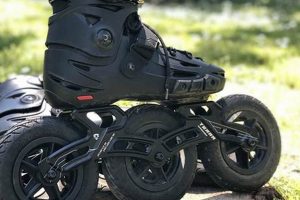
The component that connects the wheels to the board in various skating disciplines is a critical element influencing performance and handling. Functioning as the axis and suspension system, it facilitates turning and provides stability.
The selection of this hardware significantly impacts the rider’s experience, affecting turning radius, stability at varying speeds, and the overall feel of the ride. Historically, advancements in materials and design have led to improved durability, responsiveness, and customization options, enhancing the capabilities of skaters across different styles.
Further discussion will explore the different types available, factors to consider when choosing appropriate hardware, and maintenance practices to ensure optimal performance and longevity.
Selection Guidance
Effective component selection is essential for optimizing skating performance. Consideration of individual needs and skating style will result in an enhanced experience.
Tip 1: Determine Skating Discipline: The intended use, whether skateboarding, longboarding, or roller skating, should dictate hardware selection. Downhill applications necessitate components prioritizing stability, while park skating benefits from lighter, more maneuverable options.
Tip 2: Axle Width Consideration: Axle width should correspond with the deck width to ensure proper wheel alignment and stability. Discrepancies can negatively impact balance and turning ability.
Tip 3: Bushing Durometer Selection: Bushings influence turning resistance. Softer durometers allow for easier turning at lower speeds, while harder durometers provide greater stability at higher speeds. Experimentation may be required to find the optimal durometer for individual preferences.
Tip 4: Baseplate Angle Evaluation: Baseplate angle affects turning characteristics. Lower angles generally offer greater stability, while higher angles facilitate sharper turns. Mixing and matching angles can fine-tune responsiveness.
Tip 5: Material Quality Assessment: The durability of the materials employed, such as aluminum alloys or steel, will impact longevity and resistance to stress. Prioritize components manufactured from high-quality materials to withstand demanding conditions.
Tip 6: Kingpin Type Examination: Kingpin configuration, whether standard or inverted, influences turning responsiveness and board feel. Inverted kingpins are commonly found in longboarding applications for increased stability.
Strategic selection, incorporating discipline, dimensions, bushing durometer, baseplate angles, materials, and kingpin configuration, will improve overall performance and enjoyment.
Following consideration of these selection tips, attention can be directed toward proper maintenance for continued functionality.
1. Axle Width

Axle width is a critical dimension in relating to the mechanisms that support wheels on a skateboard or similar device. This specification fundamentally affects stability, turning responsiveness, and the overall performance of the assembly.
- Alignment and Deck Width
The axle width should correlate directly with the deck width. Mismatched widths lead to instability and reduced control. An axle that is too narrow will cause the wheels to sit inboard, reducing leverage and stability, while an axle that is too wide will cause the wheels to sit outboard, increasing the risk of wheel bite and hindering maneuverability. The intended use (street, park, vert, or longboard) should also influence deck and axle width pairings.
- Turning Responsiveness
Axle width influences turning agility. A narrower axle facilitates quicker turning due to the decreased distance between the wheels and the pivot point. Conversely, a wider axle provides a more stable platform, reducing the likelihood of unintended turning at high speeds. The trade-off between responsiveness and stability is crucial for tailoring the equipment to the rider’s style and skill level.
- Wheel Compatibility
Axle width determines the range of wheel sizes that can be used. Certain wheel widths necessitate specific axle lengths to ensure proper bearing seating and prevent wobble or premature bearing failure. Failure to adhere to these compatibility guidelines can result in compromised performance and potential safety hazards.
- Stability and Control at Speed
Wider axles enhance stability, particularly at higher speeds. The increased surface area of contact between the wheels and the riding surface provides a more secure and predictable ride. This increased stability is particularly important for downhill skateboarding or longboarding, where maintaining control at high speeds is paramount. However, at lower speeds, a wider axle width can reduce the ease of turning and maneuverability.
In summary, axle width is not an isolated parameter, but rather an integral component that influences the entire ride experience. Understanding the relationship between axle width and deck width, turning responsiveness, wheel compatibility, and stability is crucial for optimizing the performance and safety.
2. Bushing Durometer

Bushing durometer, a measure of the material’s hardness, is a fundamental parameter affecting the performance. It dictates the turning responsiveness and stability characteristics of the assembly.
- Turning Responsiveness Modulation
The durometer rating directly influences the force required to initiate a turn. Softer bushings (lower durometer values) compress more easily, allowing for quicker and more responsive turns, particularly at lower speeds. This configuration is often preferred for carving or park skating where sharp maneuvers are common. Conversely, harder bushings (higher durometer values) require greater force to compress, resulting in a more stable and less responsive turning profile, suitable for high-speed applications like downhill skateboarding where stability is paramount.
- Stability at Speed Influence
Bushing durometer plays a critical role in maintaining stability at higher velocities. Harder bushings provide increased resistance to unwanted oscillations and vibrations, preventing speed wobbles and ensuring a more controlled ride. Soft bushings, while offering enhanced turning responsiveness, can become unstable at high speeds, leading to a loss of control. The selection of appropriate durometer ratings should, therefore, consider the intended application and the rider’s skill level.
- Rider Weight and Preference Customization
The optimal bushing durometer is contingent upon the rider’s weight and personal preferences. Heavier riders typically benefit from harder bushings, as they provide adequate support and prevent excessive compression, maintaining stability and control. Lighter riders may find softer bushings more suitable, as they allow for easier turning and greater maneuverability. Experimentation with different durometer ratings is often necessary to determine the ideal configuration for individual rider characteristics and preferences.
- Energy Absorption and Vibration Damping
Bushings also contribute to the overall comfort of the ride by absorbing energy from impacts and dampening vibrations. Softer bushings provide better shock absorption, reducing fatigue and improving the overall riding experience, particularly on rough or uneven surfaces. Harder bushings offer less shock absorption but provide greater responsiveness and control. The selection of bushing durometer should, therefore, consider the riding environment and the rider’s sensitivity to vibrations and impacts.
In conclusion, bushing durometer is a pivotal element influencing turning responsiveness, stability, and overall ride quality. A nuanced understanding of durometer ratings and their relationship to rider weight, skating style, and riding conditions enables a customized setup that optimizes performance and enhances the riding experience.
3. Baseplate Angle

The baseplate angle, a defining characteristic of the “trucks for skates,” governs the truck’s turning behavior and overall stability. This angle, measured relative to the deck, dictates the degree to which the hanger pivots in response to rider input. A higher baseplate angle translates to a more responsive turning action, allowing for tighter and quicker maneuvers. Conversely, a lower baseplate angle results in a more stable setup, reducing the likelihood of unwanted wobbles, particularly at higher speeds. The connection is direct: the angle mechanically alters the leverage and pivot point of the truck, thereby shaping the riding experience.
For instance, downhill longboarding setups frequently utilize trucks with lower baseplate angles (e.g., 40-45 degrees) to maximize stability and minimize the risk of speed wobbles. This stability is crucial for maintaining control at high speeds. In contrast, carving and slalom setups often employ higher baseplate angles (e.g., 50-60 degrees) to facilitate tighter turns and quicker transitions. Skateboard trucks, commonly used in park and street skating, often use an angle around 50-55 degrees. These examples demonstrate the practical application of baseplate angle selection to optimize performance within specific skating disciplines. Altering the baseplate angle effectively recalibrates the truck’s turning characteristics, impacting the rider’s ability to execute intended maneuvers.
In summary, the baseplate angle forms an integral component within the overall “trucks for skates” design, influencing turning response and stability. Selection requires balancing turning performance and overall steadiness. A deep understanding of how this single parameter shapes the riding experience allows skaters to personalize their setups for optimal performance within their chosen style. While other factors contribute, the baseplate angle remains a primary determinant of the truck’s behavior and the rider’s confidence.
4. Kingpin Geometry
Kingpin geometry, a critical element within the overall design of “trucks for skates,” significantly influences turning responsiveness and stability. The kingpin, a bolt that secures the bushings and hanger to the baseplate, dictates the pivot point around which the hanger rotates. Variations in kingpin design, specifically its orientation and angle relative to the baseplate, directly affect turning initiation, resistance, and the overall feel. Traditional kingpin configurations, often found in skateboarding trucks, feature a kingpin oriented perpendicular to the baseplate, resulting in a predictable turning arc and a stable feel. Inverted kingpin designs, common in longboarding, position the kingpin below the hanger, offering a lower center of gravity and increased stability, particularly at higher speeds. The choice of kingpin geometry thus aligns with the intended application and desired performance characteristics.
One practical example of kingpin geometry’s influence lies in the realm of downhill skateboarding. The inverted kingpin configuration enhances stability, crucial for maintaining control while navigating steep slopes. The reduced leverage on the kingpin minimizes unwanted hanger movement, preventing speed wobbles and enabling the skater to maintain a controlled trajectory. Conversely, street skateboarding often benefits from the more responsive turning action of a traditional kingpin, facilitating quicker maneuvers and tighter turns within the confines of skate parks and urban environments. The ability to fine-tune turning characteristics through kingpin geometry provides a critical advantage, enabling skaters to tailor their equipment to specific skating styles and terrain. Additionally, kingpin diameter, material, and thread pitch influence durability and resistance to stress, further contributing to overall performance.
In summary, kingpin geometry constitutes a fundamental design consideration within “trucks for skates,” directly shaping turning responsiveness and stability. The selected configuration, whether traditional or inverted, reflects a compromise between maneuverability and control, contingent upon the intended application. Understanding the nuanced effects of kingpin geometry allows skaters to optimize their equipment, achieving enhanced performance, control, and confidence. Challenges exist in balancing responsiveness and stability, requiring careful consideration of skating style, terrain, and rider preference. The kingpin’s role extends beyond simple attachment, functioning as a key determinant of overall performance and rider experience.
5. Material Composition
Material composition forms a cornerstone in the design and functionality of components used in various skating disciplines. The materials employed directly affect durability, performance, and overall rider safety. The following discussion will explore key facets of material selection and their implications for component performance.
- Aluminum Alloys: Weight and Strength
Aluminum alloys are prevalently used due to their favorable strength-to-weight ratio. Alloys like 6061 and 7075 provide significant strength while minimizing weight, enabling more responsive turning and reduced rider fatigue. Impurities and heat treatments modify mechanical properties. Example: A truck constructed from 7075 aluminum will typically withstand greater impact forces than one made from a lower-grade alloy. The implications include enhanced durability and performance in demanding conditions.
- Steel: Strength and Durability
Steel, particularly chromoly steel (4130), offers superior strength and durability compared to aluminum alloys. Steel is employed in components subject to high stress, such as axles and kingpins. The higher density of steel increases weight, potentially affecting turning responsiveness. Example: Axles constructed from chromoly steel exhibit greater resistance to bending and breaking under heavy loads. The implications involve enhanced reliability and longevity, particularly in high-impact scenarios.
- Bushings: Polyurethane Properties
Bushings, critical for dampening and turning resistance, are primarily made from polyurethane. The durometer (hardness) of the polyurethane significantly affects turning characteristics. Higher durometer values provide greater stability, while lower durometer values enhance turning responsiveness. Example: Bushings with a 90A durometer rating will offer greater resistance to turning compared to those with an 80A rating. The implications include customizable turning performance based on rider preference and skating style.
- Heat Treatment: Enhanced Mechanical Properties
Heat treatment processes, such as T6 tempering for aluminum alloys, enhance strength and hardness. These processes involve controlled heating and cooling cycles, altering the material’s microstructure and improving its resistance to deformation and fracture. Example: A truck that has been heat-treated will exhibit a higher yield strength compared to a non-heat-treated counterpart. The implications involve improved durability and performance under stress, extending the lifespan of the component.
The selection of materials is not arbitrary; it involves a careful balance of strength, weight, durability, and performance characteristics. The interplay between these material properties and manufacturing processes results in components optimized for specific skating disciplines and rider preferences. Continued innovation in material science will likely lead to even lighter, stronger, and more durable components in the future.
6. Mounting Hardware

Mounting hardware serves as the critical interface between “trucks for skates” and the skateboard deck. This collection of fasteners directly influences the structural integrity, stability, and overall safety of the assembled system. Selecting appropriate hardware and adhering to proper installation practices are essential for ensuring optimal performance.
- Bolt Length Selection
Bolt length must be carefully selected to accommodate the combined thickness of the deck and truck baseplate. Insufficient bolt length compromises the securement of the truck, potentially leading to premature failure or separation during use. Conversely, excessive bolt length protrudes beyond the nut, posing a safety hazard and potentially interfering with wheel movement. The implications include structural failure and wheel interference, both influencing safety and control.
- Hardware Materials and Strength
Mounting hardware is typically manufactured from steel alloys, with varying grades of tensile strength. Higher-grade hardware offers increased resistance to shear and tensile forces, crucial for withstanding the dynamic loads experienced during skating. Degradation or failure of the hardware can precipitate catastrophic component separation. Material strength should match the demands of the intended skating discipline. The implications involve material failure and equipment degradation.
- Locking Nut Mechanisms
The use of locking nuts, incorporating nylon inserts or deformed threads, prevents loosening due to vibration and impact forces. These mechanisms maintain clamping force over time, ensuring a secure connection between the truck and deck. Absence or degradation of the locking mechanism leads to gradual loosening, compromising stability and increasing the risk of failure. The implications involve decreasing clamping force.
- Installation Torque and Procedure
Proper installation requires applying appropriate torque to the mounting hardware. Insufficient torque fails to achieve adequate clamping force, while excessive torque risks stripping threads or damaging the deck. Following manufacturer-recommended torque specifications and employing proper tightening sequences are crucial for optimal securement. Improper torque values lead to stripping threats.
In summation, mounting hardware is not a trivial component; its selection and installation demand careful attention to detail. Proper bolt length, material selection, locking mechanisms, and installation procedures collectively contribute to the secure and reliable integration of “trucks for skates” with the skateboard deck. Neglecting these considerations compromises safety and performance.
Frequently Asked Questions
The following section addresses common inquiries and clarifies misunderstandings surrounding components used in skating disciplines. The information presented aims to promote a comprehensive understanding.
Question 1: What is the optimal method for determining the appropriate size?
Selection of an appropriate size mandates consideration of the deck width. The axle width should closely match the deck width to ensure proper wheel alignment and stability. Deviations from this principle can negatively affect handling. Refer to manufacturer specifications for guidance.
Question 2: How frequently should replacement occur?
Replacement frequency depends on usage intensity, skating style, and environmental conditions. Routine inspection for wear, damage, and loose components should be conducted. Cracks, bends, or significant wear necessitate immediate replacement to maintain safety and performance.
Question 3: What is the significance of bushing durometer?
Bushing durometer dictates turning resistance. Softer bushings (lower durometer) facilitate easier turning at lower speeds, while harder bushings (higher durometer) provide greater stability at higher speeds. Rider weight and preferred skating style influence optimal durometer selection. Experimentation may be required.
Question 4: Is there a difference between skateboard and longboard variants?
Yes, distinct differences exist. Skateboard are typically narrower and designed for maneuverability, while longboard versions are wider and prioritize stability, especially at higher speeds. Baseplate angles and kingpin configurations also differ to accommodate the specific demands of each discipline.
Question 5: What maintenance procedures are recommended?
Regular maintenance includes cleaning, lubrication of pivot points, and inspection of hardware for tightness. Bushings should be inspected for cracks or deformation. Axle nuts should be tightened to the manufacturer’s specifications. Periodic disassembly and cleaning can prolong component life.
Question 6: Can different brands be interchanged without issue?
While interchangeability is often possible, compatibility issues may arise. Baseplate mounting patterns, kingpin diameters, and bushing sizes can vary between brands. Verifying compatibility prior to attempting an exchange is crucial to avoid compromising safety or performance.
Understanding the factors influencing size selection, replacement frequency, bushing durometer, design variations, maintenance procedures, and brand compatibility promotes informed decision-making.
Following this clarification of common questions, the article will proceed to summarize key considerations for the selection of trucks for skates.
Conclusion
This exposition has underscored the pivotal nature of “trucks for skates” in determining the performance characteristics of skateboards and related equipment. From axle width and bushing durometer to baseplate angle and kingpin geometry, each element contributes significantly to the overall riding experience. The appropriate selection and maintenance of these components are not merely matters of preference but essential considerations for safety and optimal functionality.
Continued diligence in understanding the nuanced interplay between design parameters and rider needs will facilitate informed decision-making, leading to enhanced performance and reduced risk. The pursuit of knowledge and responsible equipment management remains paramount for participants in all skating disciplines. Further research and technological advancements will likely refine these components.