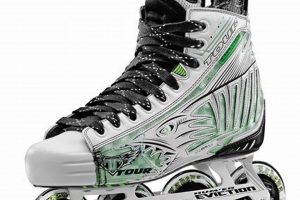
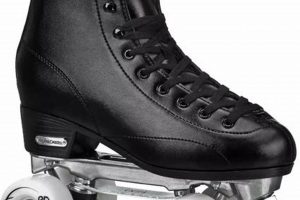
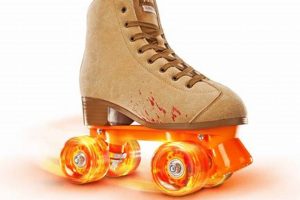
Footwear featuring an extended upper section that provides substantial ankle support and is affixed to a wheeled chassis designed for gliding across surfaces. These items are commonly employed in recreational skating, artistic performances, and certain athletic disciplines, offering a combination of mobility and stability.
The elevated design significantly contributes to ankle stability, mitigating the risk of injury, particularly during complex maneuvers or high-impact activities. Historically, this type of footwear has been integral to the evolution of roller sports, allowing for greater control and precision. This design permits users of all skill levels to maintain balance and proper form.
Subsequent sections will delve into specific features of this skating equipment, including material composition, wheel types, bearing quality, and closure systems. An analysis of the various applications and maintenance considerations will also be presented.
Guidance on Selection and Maintenance
Optimal utilization of the equipment necessitates careful consideration of various factors. Selecting the appropriate model and adhering to a strict maintenance regimen are critical for performance and longevity.
Tip 1: Assess Intended Usage: Prior to purchase, determine the primary application. Recreational use demands a different configuration than artistic or competitive skating.
Tip 2: Evaluate Boot Material: Leather offers durability and conforms to the foot over time. Synthetic materials provide water resistance and often require less break-in time.
Tip 3: Inspect Wheel Hardness: Softer wheels offer increased grip, suitable for indoor surfaces. Harder wheels provide greater speed and are preferable for outdoor use.
Tip 4: Examine Bearing Quality: ABEC ratings indicate precision. Higher ratings generally correspond to smoother, faster performance. Regular cleaning and lubrication are essential.
Tip 5: Verify Closure System: Laces offer a customizable fit and are preferred for precision skating. Buckles provide quick adjustments and are suitable for recreational use.
Tip 6: Regularly Inspect Axles: Ensure axles are securely fastened. Loose axles can compromise stability and lead to equipment failure. Replacement is necessary if damage is detected.
Tip 7: Clean and Lubricate: Regular cleaning prevents dirt and debris buildup, which can impede performance. Apply lubricant to bearings and axles to maintain smooth operation.
Adhering to these guidelines facilitates both enhanced performance and extended lifespan. Neglecting these recommendations may result in suboptimal operation and potential equipment degradation.
The subsequent sections will address advanced techniques and potential modifications.
1. Ankle Support Height
Ankle support height is a critical design parameter in this type of roller skates, intrinsically linked to user safety and performance. The extended upper portion of the boot, extending significantly above the ankle joint, functions as a protective brace. This increased height restricts excessive lateral movement and provides stability, which is particularly vital during dynamic maneuvers or when navigating uneven surfaces. Failure to provide adequate support height elevates the risk of ankle sprains, fractures, and other related injuries. For example, skaters engaging in artistic disciplines or aggressive skating styles, where rapid pivots and jumps are common, demand a greater degree of ankle stabilization.
The influence of ankle support height also extends to the skater’s control and power transfer. A secure and well-supported ankle enables more efficient transmission of force from the leg to the wheels. This is especially noticeable during acceleration, cornering, and executing precise footwork. Skaters with weaker ankles or those prone to instability may benefit significantly from skates offering a higher degree of ankle support, enabling them to skate with greater confidence and reduce fatigue. Consider speed skaters who require maximum power output; while some sacrifice height for maneuverability, many depend on a balance between ankle stability and freedom of motion.
In conclusion, ankle support height is a crucial and non-negotiable attribute. The appropriate height selection should be determined by the intended use, the skater’s individual anatomy, and any pre-existing conditions that impact ankle stability. Prioritizing adequate support mitigates injury risk and facilitates enhanced performance.
2. Wheel Durometer Rating

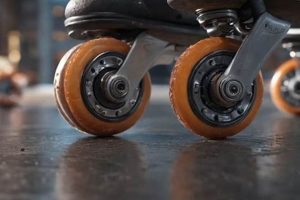
Wheel durometer rating, measured on the “A” scale, dictates the hardness of the wheel material and consequently, the performance characteristics of the high top roller skates. This rating directly influences grip, roll speed, and durability. Lower durometer values (e.g., 78A-85A) signify softer wheels, offering enhanced grip and shock absorption. This is particularly advantageous in indoor skating environments with slick surfaces or when performing intricate dance maneuvers. Conversely, higher durometer values (e.g., 95A-101A) denote harder wheels that prioritize speed and longevity, common in outdoor skating or rink environments where rolling resistance needs minimization. The selection of the durometer rating, therefore, is contingent upon the intended skating environment and the desired balance between grip and speed.
The correlation between the boot design and the wheel durometer directly effects performance. The supportive nature of high top roller skates often leads to their employment in situations requiring agility, control, or stability. In artistic skating, for instance, the skater is relying on both their balance through the high top boot, and also the grip on the ground through the wheel. This gives way to using softer wheels, usually. The boot’s design also contributes to the overall balance and stability, and high top roller skates are not for aggressive tricks and more about speed. Selecting the appropriate durometer rating ensures optimal energy transfer from the skater’s body, through the supportive boot, to the ground, maximizing propulsion and control. Selecting the wrong durometer would render the equipment less effective.
In summary, the wheel durometer rating represents a crucial specification directly influencing the performance of high top roller skates. Proper durometer selection, aligned with the skating environment and desired performance characteristics, optimizes grip, speed, and durability. Selecting the correct wheel durometer can also greatly increase or decrease performance.
3. Bearing Precision Grade

The bearing precision grade, typically indicated by the Annular Bearing Engineers’ Committee (ABEC) rating, significantly impacts the performance characteristics of high top roller skates. This rating, ranging from ABEC 1 to ABEC 9 (with higher numbers denoting greater precision), quantifies the manufacturing tolerances of the bearings. Lower ABEC ratings indicate wider tolerances, resulting in greater friction and reduced roll speed. Conversely, higher ABEC ratings signify tighter tolerances, leading to smoother rotation and enhanced speed. The impact on skating experience can be quite profound; for instance, a skater transitioning from ABEC 1 to ABEC 5 bearings often experiences a noticeable increase in glide efficiency. The selection of an appropriate ABEC rating should reflect the skater’s skill level and intended use case.
The interplay between bearing precision and the overall design of this type of footwear extends beyond simple speed considerations. High top roller skates, due to their increased ankle support, are often utilized in disciplines that demand precision and control, such as roller derby or artistic skating. In these applications, higher precision bearings contribute to a more responsive and predictable skating experience, facilitating intricate maneuvers and reducing energy expenditure. For example, a roller derby skater attempting a quick change of direction benefits from the minimized friction of higher ABEC rated bearings, allowing for faster acceleration and deceleration. Similarly, an artistic skater performing complex routines requires the smooth, consistent roll provided by precise bearings to maintain balance and execute precise footwork.
Ultimately, the bearing precision grade constitutes a critical component of high top roller skates, influencing both speed and control. While higher ABEC ratings offer potential performance advantages, they also tend to be more expensive and may require more frequent maintenance. The optimal choice depends on a careful evaluation of the skater’s skill, skating style, and budgetary constraints. Neglecting bearing quality can impede the effectiveness of even the most well-designed pair of high tops, highlighting the practical significance of understanding this connection.
4. Boot Material Composition

The selection of materials for the boot structure is crucial to the overall performance, durability, and comfort of high top roller skates. The composition directly influences factors such as ankle support, flexibility, weight, and resistance to wear and tear. Understanding the attributes of various boot materials facilitates informed purchase decisions and appropriate maintenance practices.
- Leather Construction
Leather, a traditional boot material, provides a balance of durability, flexibility, and support. It molds to the foot over time, enhancing comfort and fit. Leather’s breathability also contributes to moisture management, reducing discomfort during extended use. However, leather requires regular maintenance, including cleaning and conditioning, to prevent cracking and maintain suppleness. Certain grades of leather offer superior abrasion resistance, essential for high-impact activities like roller derby.
- Synthetic Polymers
Synthetic materials, such as reinforced nylon or polyurethane, offer alternatives to leather with varying performance characteristics. Synthetics are typically lighter, more water-resistant, and require less maintenance than leather. They can be engineered to provide specific levels of stiffness and flexibility, catering to different skating styles. However, synthetics may not conform to the foot as readily as leather, potentially compromising long-term comfort. The selection of a specific synthetic material depends on the intended application and desired balance of weight, durability, and support.
- Lining Materials
The internal lining of the boot significantly impacts comfort and moisture management. Common lining materials include foam padding, microfiber, and moisture-wicking textiles. Foam padding provides cushioning and reduces friction, while microfiber offers a soft and breathable surface against the skin. Moisture-wicking materials actively transport perspiration away from the foot, minimizing discomfort and preventing odor buildup. The selection of lining materials should prioritize comfort, breathability, and compatibility with the outer boot material.
- Reinforcement Elements
Beyond the primary boot material, reinforcement elements, such as carbon fiber inserts or thermoplastic overlays, contribute to structural integrity and support. These elements are strategically placed to reinforce critical areas, such as the ankle and heel, enhancing stability and power transfer. The incorporation of reinforcement elements allows for a more tailored boot design, optimizing performance and minimizing the risk of injury. The choice of reinforcement materials should balance strength, weight, and flexibility.
The composition of high top roller skate boots involves a complex interplay of materials, each contributing unique properties to the overall performance. Selecting the appropriate combination of materials, considering factors such as skating style, skill level, and environmental conditions, is critical for maximizing comfort, durability, and performance. The longevity of the equipment also relies on properly addressing the materials.
5. Closure System Security

The effectiveness of the closure system in high top roller skates is paramount to user safety, performance, and comfort. A secure closure system ensures that the foot is properly positioned within the boot, maximizing power transfer, minimizing the risk of injury, and promoting overall stability. Failure to adequately secure the foot can lead to compromised control, increased fatigue, and potential for ankle sprains or other related injuries.
- Lace Tension Distribution
The design of the lacing system significantly impacts how tension is distributed across the foot. Systems with evenly spaced eyelets and strategically placed lace hooks ensure uniform pressure, minimizing pressure points and maximizing support. Uneven tension can lead to discomfort, reduced circulation, and compromised ankle stability. For example, skaters engaging in demanding routines require a system that allows for precise adjustments and maintains consistent tension throughout the duration of the activity.
- Buckle Mechanisms and Retention Strength
Buckles, often used in conjunction with laces, provide a quick and secure method for fastening the boot. The retention strength of the buckle mechanism is crucial; a weak buckle may release unexpectedly during skating, leading to a loss of control. High-quality buckles employ robust materials and secure locking mechanisms to withstand the forces generated during skating activities. The reliability of the buckle is extremely important for a secure closure.
- Strap Integration and Placement
Straps, typically positioned across the instep or ankle, enhance support and prevent heel lift. Proper strap placement and adjustment are essential for maximizing effectiveness. Straps that are too loose offer minimal support, while straps that are too tight can restrict circulation and cause discomfort. Integrated straps that work in tandem with the lacing system provide a comprehensive approach to foot stabilization. A well-engineered strapping system provides better support to the entire closure system.
- Material Durability and System Longevity
The materials used in the closure system must withstand repeated use and exposure to environmental factors. Laces should be constructed from durable materials that resist fraying and breakage. Buckles and straps should be made from robust polymers or metals that maintain their integrity over time. Regular inspection and maintenance of the closure system are necessary to ensure continued security and prevent component failure, improving safety and ensuring longevity of the product.
In summary, the closure system security is an indispensable element of high top roller skates, directly influencing safety and performance. Prioritizing robust materials, thoughtful design, and proper maintenance ensures a secure and reliable fit, allowing skaters to confidently engage in their chosen activity. The closure can greatly affect the longevity of the skate itself.
Frequently Asked Questions
The following section addresses commonly encountered inquiries concerning the selection, utilization, and maintenance of this style of skating equipment. The information presented aims to provide clarity and promote informed decision-making.
Question 1: What distinguishes high top roller skates from low-cut models?
The primary distinction lies in the boot height. High top models extend above the ankle, providing enhanced support and stability. Low-cut versions terminate below the ankle, prioritizing maneuverability and range of motion.
Question 2: Are these skates suitable for beginners?
The added ankle support can be beneficial for novice skaters, aiding in balance and reducing the risk of ankle injuries. However, individual preferences and learning styles may vary.
Question 3: What factors influence the selection of wheel hardness?
The skating surface dictates the optimal wheel durometer. Softer wheels (lower durometer ratings) provide increased grip on slick surfaces, while harder wheels (higher durometer ratings) offer greater speed on smooth surfaces.
Question 4: How often should bearings be cleaned and lubricated?
Bearing maintenance frequency depends on usage and environmental conditions. Regular cleaning and lubrication, typically every few weeks for frequent skaters, preserves bearing performance and extends lifespan.
Question 5: Can the wheels be replaced on high top roller skates?
Yes, the wheels are generally replaceable. Ensure that replacement wheels are compatible with the existing axles and bearings.
Question 6: What are the recommended safety precautions when using these skates?
Wearing appropriate protective gear, including a helmet, wrist guards, elbow pads, and knee pads, is essential. Adhering to safe skating practices and being aware of surroundings minimizes the risk of accidents.
Proper understanding of these factors promotes safer and more enjoyable skating experiences. Ignoring or misinterpreting these guidelines may compromise performance and increase the likelihood of injury.
The subsequent section delves into advanced performance techniques and potential modifications.
Conclusion
This document has explored various facets of high top roller skates, encompassing design considerations, performance parameters, maintenance protocols, and safety imperatives. A thorough understanding of these elements is essential for informed decision-making and the maximization of performance potential. Boot material, closure design, wheel durometer, and bearing quality all play critical, interconnected roles.
The deliberate selection and conscientious maintenance of this equipment represents a commitment to both safety and optimal performance. Further research and experimentation are encouraged to refine skating techniques and advance the evolution of roller sports. Prioritize responsible practices to guarantee enjoyable and safe experiences within the discipline.