The process of securing footwear specifically designed for skateboarding through the use of laces is a fundamental aspect of the sport. This action ensures the shoe remains firmly on the foot, providing stability and control essential for executing tricks and maneuvers. For example, a skater meticulously adjusts the laces to achieve a snug fit that minimizes slippage during a kickflip.
Properly fastening footwear used in skateboarding offers numerous advantages. It enhances board feel, allowing the skater to perceive subtle movements and maintain balance. Historically, the method of securing skate footwear evolved from basic functionality to a nuanced technique, reflecting the increasing demands and technicality of skateboarding itself. The ability to effectively achieve a secure fit contributes directly to a skater’s performance and reduces the risk of injury.
Understanding the nuances of this fastening method is crucial for any skateboarder. The following sections will explore different lacing techniques, maintenance tips, and the impact of various footwear designs on the overall skateboarding experience.
Essential Techniques for Securing Skateboarding Footwear
The secure and appropriate fastening of skateboarding footwear is paramount for performance and safety. The following tips outline best practices for achieving optimal results.
Tip 1: Select the Correct Lace Material. The material composition of laces directly impacts durability. Options such as reinforced nylon or polyester blends offer increased resistance to abrasion from griptape, thereby extending the lifespan of the laces.
Tip 2: Employ a Consistent Lacing Pattern. Utilizing a uniform lacing pattern across the entire shoe ensures even pressure distribution. Overlapping or underlapping the laces consistently can prevent pressure points that may cause discomfort or restrict blood flow.
Tip 3: Adjust Tension Systematically. After the initial threading, incremental adjustments to the lace tension, starting from the toe and working towards the ankle, allow for a personalized fit. This prevents excessive tightness in one area while maintaining overall security.
Tip 4: Utilize Heel Lock Lacing. Incorporating a heel lock lacing technique, also known as a “lace lock,” helps to secure the heel within the shoe. This reduces slippage and provides enhanced ankle support, particularly crucial for preventing injuries during high-impact maneuvers.
Tip 5: Inspect Laces Regularly for Wear and Tear. Routine inspection of the laces is necessary to identify fraying or weakening. Prompt replacement of damaged laces prevents unexpected breakage during a skating session, which can lead to loss of control and potential injury.
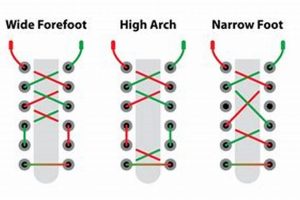
Tip 6: Adapt Lacing Based on Foot Shape. The fastening method can be adjusted to accommodate varying foot widths and arch heights. Individuals with wider feet might benefit from skipping certain eyelets to alleviate pressure, while those with high arches may require additional lacing to provide adequate support.
Tip 7: Consider Waxed Laces. Waxed laces offer increased friction, preventing them from loosening easily. This can be particularly advantageous during extended skating sessions or in environments where laces are prone to becoming untied.
Adherence to these techniques ensures that skateboarding footwear is properly secured, maximizing performance, comfort, and safety. By prioritizing these considerations, skateboarders can mitigate risks and focus on progression.
The next section will delve into the selection of skateboarding footwear best suited for individual needs and preferences.
1. Proper lace tension
The act of securing skateboarding footwear, an action crucial for performance and safety, is inextricably linked to the attainment of proper lace tension. This tension is not merely a byproduct of the securing action; rather, it is a carefully calibrated parameter that directly influences the skater’s control and board feel. Insufficient tension results in foot slippage within the shoe, diminishing responsiveness and increasing the risk of instability during complex maneuvers. Conversely, excessive tension constricts blood flow, leading to discomfort and potentially hindering performance over extended periods.
A real-world example illustrates the importance of this balance: a skater attempting a kickflip with inadequately secured footwear risks losing contact with the board during the critical flicking motion, resulting in a failed attempt and a potential fall. Conversely, overtightening can lead to numbness and fatigue, diminishing the skater’s ability to maintain a consistent stance and hindering subsequent attempts. Achieving optimal lace tension involves a systematic approach, adjusting the laces incrementally from the toe towards the ankle, allowing for a customized fit that accommodates individual foot morphology and skating style. Experimentation with different lacing patterns can further refine the tension distribution, addressing specific areas of concern such as heel slippage or pressure points.
In summary, the act of securing skateboarding shoes is not merely a formality but a critical adjustment that directly impacts performance, comfort, and safety. While the goal is to ensure a firm connection between foot and shoe, the process requires attention to detail and an understanding of individual needs. Failure to appreciate the nuance of lace tension can lead to diminished control, discomfort, and potentially, injury. The principle of achieving proper lace tension is a fundamental aspect of competent skateboarding practice.
2. Durable lace material

The selection of robust lace material is a critical consideration within the realm of skateboarding footwear. The integrity of these components directly affects the security, performance, and longevity of the shoes under the demanding conditions inherent in skateboarding.
- Abrasion Resistance
Abrasion resistance is a paramount characteristic of durable lace material for skateboarding. The constant friction between the laces and the griptape of the skateboard subjects them to significant wear and tear. Materials such as reinforced nylon or polyester blends exhibit superior abrasion resistance compared to standard cotton laces, mitigating the risk of fraying and breakage. Premature lace failure can compromise foot stability and necessitate frequent replacements, rendering abrasion resistance a vital attribute.
- Tensile Strength
Tensile strength, defined as the maximum stress a material can withstand before breaking, is crucial for maintaining secure closure of the skateboarding footwear. High tensile strength prevents laces from snapping under the strain of repeated tightening and the dynamic forces exerted during skateboarding maneuvers. Materials with inherently low tensile strength are unsuitable for skateboarding applications, as they are prone to failure, potentially leading to accidents or performance limitations.
- Resistance to Environmental Degradation
Skateboarding often occurs in diverse environmental conditions, exposing laces to moisture, UV radiation, and chemical contaminants. Durable lace material should exhibit resistance to degradation from these elements. Exposure to moisture can weaken certain materials, while UV radiation can cause discoloration and loss of strength. Resistance to chemical contaminants, such as road salts or cleaning agents, prevents premature deterioration and maintains the structural integrity of the laces.
- Dimensional Stability
Dimensional stability refers to the material’s ability to retain its original size and shape under varying conditions. Durable lace material should exhibit minimal stretching or shrinkage, ensuring a consistent and secure fit over time. Excessive stretching can loosen the laces, compromising foot stability, while shrinkage can make them difficult to manipulate or even render them unusable. Maintaining dimensional stability contributes to the overall reliability and longevity of the skateboarding footwear.
The multifaceted properties of durable lace material directly influence the performance and safety of skateboarding footwear. By selecting laces that exhibit high abrasion resistance, tensile strength, environmental resistance, and dimensional stability, skateboarders can enhance their control, minimize the risk of equipment failure, and extend the lifespan of their footwear. The choice of lace material, therefore, is not a trivial detail but a critical factor in optimizing the skateboarding experience.
3. Consistent lacing pattern
The establishment of a consistent lacing pattern when securing skateboarding footwear is not merely a cosmetic preference; it represents a crucial element in ensuring uniform pressure distribution, enhanced foot stability, and optimized shoe performance. The chosen pattern directly influences the overall fit and function of the skate shoe.
- Uniform Tension Distribution
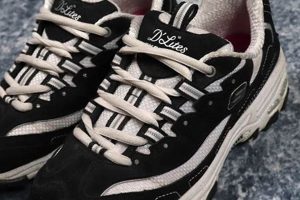
A recurring lacing pattern facilitates the even distribution of tension across the dorsal surface of the foot. This prevents localized pressure points that can cause discomfort or restrict circulation during extended skating sessions. For instance, alternating between over-under lacing on each eyelet row maintains a balanced pull, while skipping eyelets strategically can accommodate wider feet or bunions. This methodical approach mitigates potential foot fatigue and maximizes comfort, improving overall performance.
- Predictable Shoe Flex
Symmetrical lacing patterns contribute to predictable shoe flex, essential for maintaining consistent board feel. Unpredictable flex patterns, resulting from inconsistent lacing, can hinder a skaters ability to sense subtle movements of the board, impacting control and precision. Mirroring the lacing pattern on both shoes ensures that each foot experiences a similar level of support and flexibility, enhancing coordination and minimizing discrepancies in performance between the left and right foot.
- Structural Integrity and Lace Longevity
Adopting a uniform lacing approach prolongs the lifespan of the laces and the shoes eyelets. Consistent patterns minimize stress on individual eyelets and lace sections, preventing premature wear and tear. For example, using a “straight bar” lacing technique, where laces run horizontally between eyelets, reduces friction compared to crisscross patterns, extending lace durability. This contributes to the overall cost-effectiveness of skateboarding footwear by decreasing the frequency of replacements.
- Ease of Adjustment and Customization
A standardized lacing pattern allows for quicker and more intuitive adjustments. Skaters can rapidly fine-tune the fit of their shoes based on specific needs, such as increasing ankle support for a particular trick or loosening the laces for enhanced comfort during casual skating. Regularity in the pattern simplifies the process of making incremental changes without disrupting the overall balance of the shoe. This ease of adaptability allows for a highly personalized and responsive skating experience.
The deliberate selection and consistent application of a lacing pattern are integral to optimizing the performance and longevity of skateboarding footwear. Beyond mere aesthetics, the pattern serves as a functional parameter that directly impacts foot comfort, shoe flex, structural integrity, and adjustability. Mastery of this seemingly simple detail represents a significant step towards a more controlled and enjoyable skateboarding experience.
4. Heel lock utilization

The strategic use of a heel lock lacing technique, when employing methods to secure skateboarding footwear, plays a crucial role in optimizing performance and minimizing the risk of injury. This specialized lacing method directly addresses the issue of heel slippage within the shoe, a common problem that can compromise stability and control during demanding skateboarding maneuvers.
- Enhanced Ankle Support
Heel lock lacing effectively increases ankle support by creating a tighter, more secure fit around the ankle bone. This is achieved by threading the laces through the top eyelets in a manner that forms a loop or lock, preventing the heel from lifting during movement. This enhanced support reduces the likelihood of ankle sprains and provides a more stable platform for executing tricks.
- Improved Board Feel and Control
By minimizing heel movement within the shoe, heel lock lacing enhances board feel and control. When the heel is firmly secured, the skater experiences a more direct connection to the board, allowing for more precise adjustments and nuanced maneuvers. This is particularly beneficial when performing technical tricks that require a high degree of sensitivity and responsiveness.
- Reduced Risk of Blisters and Discomfort
Excessive heel slippage can lead to friction and the formation of blisters, causing discomfort and hindering performance. Heel lock lacing reduces this friction by keeping the heel securely in place, minimizing the rubbing that can cause blisters. This is particularly important during long skateboarding sessions where repetitive movements can exacerbate the problem.
- Customizable Fit Adjustment
Heel lock lacing provides a mechanism for fine-tuning the fit of the skateboarding footwear. The tightness of the heel lock can be adjusted to accommodate individual foot shapes and preferences. This allows skaters to achieve a customized fit that optimizes comfort and performance. For example, skaters with narrow heels may benefit from a tighter heel lock, while those with wider heels may prefer a looser fit.
The incorporation of heel lock lacing into the process of securing skateboarding footwear represents a deliberate strategy to enhance stability, control, and comfort. By addressing the specific issue of heel slippage, this technique contributes significantly to a safer and more enjoyable skateboarding experience. When carefully executed, heel lock lacing can provide a noticeable improvement in overall performance and reduce the risk of injury.
5. Regular lace inspection

Regular lace inspection constitutes a critical, often overlooked, component of maintaining skateboarding footwear. The act of securing skate shoes depends entirely on the integrity of the laces. A failure in this seemingly minor element can lead to significant consequences, impacting both performance and safety. Inspection involves visually assessing the laces for fraying, cuts, or general wear, particularly in areas subjected to high friction, such as near the eyelets or where contact with the skateboard’s griptape is frequent. A compromised lace presents a clear risk of breakage during skating maneuvers, leading to a sudden loss of shoe security. This instability can cause a skater to lose balance, potentially resulting in falls and injuries.
The implications of neglecting lace inspection extend beyond immediate safety concerns. Worn or damaged laces require increased force to achieve the desired tension, further accelerating their degradation and potentially damaging the shoe’s eyelets. Furthermore, the unexpected failure of laces during a critical moment, such as landing a trick, can erode a skater’s confidence and disrupt their performance. A proactive approach to lace inspection, coupled with timely replacement of compromised laces, not only mitigates safety risks but also contributes to the overall longevity and functionality of the skateboarding footwear. For instance, professional skateboarders routinely inspect and replace laces before competitions to ensure optimal performance and minimize the risk of equipment failure.
In conclusion, regular lace inspection is not a peripheral task but an integral element of responsible skateboarding practice. This vigilance ensures the consistent and reliable performance of skateboarding footwear, minimizing the risk of injury and maximizing the skater’s control and confidence. The small investment of time and attention in lace inspection offers a significant return in terms of safety, performance, and equipment longevity, reinforcing its importance within the broader context of skateboarding.
Frequently Asked Questions Regarding the Process of Securing Skateboarding Footwear
The following questions and answers address common inquiries and misconceptions surrounding the methods and implications of properly securing skateboarding footwear. These aim to provide clarity on best practices and the importance of meticulous attention to detail in this fundamental aspect of skateboarding.
Question 1: What constitutes an acceptable level of tightness when securing skateboarding footwear?
An acceptable level of tightness allows for a snug fit without constricting blood flow or causing discomfort. The foot should be firmly held in place to prevent slippage during maneuvers, but it must also allow for natural foot movement. Experimentation is encouraged to determine the optimal balance between security and comfort.
Question 2: How frequently should shoelaces be replaced on skateboarding footwear?
The replacement frequency of shoelaces depends on several factors, including skating frequency, style, and the quality of the laces. Regular inspection is advised. Laces exhibiting fraying, cuts, or significant wear should be replaced immediately to prevent breakage during skating.
Question 3: Does the choice of lacing pattern impact the performance of skateboarding footwear?
Yes, the lacing pattern significantly influences the fit and performance of the shoe. Different patterns distribute pressure differently across the foot. A consistent and well-chosen pattern can enhance comfort, board feel, and overall control. Experimentation with various patterns is recommended to find one that suits individual needs.
Question 4: What are the potential consequences of inadequately fastening skateboarding footwear?
Inadequate fastening can lead to diminished board feel, reduced stability, increased risk of ankle injuries, and the potential for shoe slippage during critical maneuvers. It is imperative to secure footwear properly to mitigate these risks and maintain optimal performance.
Question 5: Are there specific types of shoelaces that are more suitable for skateboarding applications?
Yes, shoelaces made from durable materials like reinforced nylon or polyester blends are preferable for skateboarding due to their superior abrasion resistance and tensile strength. These materials withstand the rigors of skateboarding better than standard cotton laces.
Question 6: Can over-tightening skateboarding footwear have negative consequences?
Yes, over-tightening can constrict blood flow, leading to numbness, discomfort, and reduced performance. It can also accelerate wear on the laces and the shoe’s eyelets. It is essential to find a balance between a secure fit and maintaining proper circulation.
Properly securing skateboarding footwear is not merely a matter of aesthetics but a critical element in ensuring safety, comfort, and optimal performance. Adherence to best practices, including regular inspection and the selection of durable materials, contributes significantly to a positive skateboarding experience.
The next section will explore the long-term maintenance and care of skateboarding footwear to maximize its lifespan and performance.
Securing Skateboarding Footwear
This exploration has underscored the multifaceted nature of the simple act of securing skateboarding footwear. From the selection of durable lace materials and the implementation of consistent lacing patterns to the critical importance of heel lock utilization and regular lace inspection, each element contributes to the overall performance and safety of the skater. The pursuit of optimal lace tension balances security with comfort, directly impacting board feel and maneuverability. Neglecting these details carries tangible risks, diminishing control and increasing the likelihood of injury. The act of tie skate shoes is therefore more than a mere fastening procedure; it is an exercise in risk management and performance optimization.
As skateboarding continues to evolve, so too must the understanding and execution of these fundamental practices. A commitment to meticulous attention to detail in securing skateboarding footwear represents a dedication to both personal well-being and the pursuit of skateboarding excellence. Continued research and refinement in this area are essential to ensuring the safety and progression of the sport. The seemingly simple task of securing footwear stands as a testament to the importance of mastering the fundamentals, regardless of one’s level of experience.