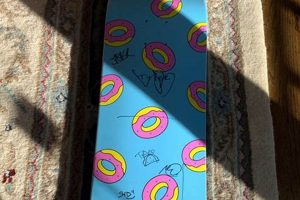
Unpainted, undecorated platforms designed for skateboarding offer a customizable surface. These items, constructed typically from laminated maple wood, provide a foundation upon which skaters can express their individuality through graphic design, artwork, or personalized grip tape application. For example, a skater might apply a custom heat-transferred graphic or hand-painted design to such a platform.
These customizable platforms hold significance for several reasons. They allow for complete creative control, fostering self-expression and a unique identity within skateboarding culture. They provide an accessible entry point for aspiring artists and designers to showcase their work. Historically, the ability to personalize equipment has been intrinsic to skateboarding, evolving from modifying existing boards to creating bespoke designs.
Further discussion will explore the manufacturing process of these items, the different types of wood and construction techniques employed, and the various methods used to customize their surfaces. Additionally, the economic factors influencing pricing and distribution will be examined.
Guidance on Selecting and Utilizing Unfinished Skateboard Platforms
The following constitutes a set of guidelines intended to aid in the selection, preparation, and customization of undecorated skateboard platforms, ensuring optimal performance and longevity.
Tip 1: Material Assessment: Scrutinize the wood composition. High-quality maple, typically sourced from North America, is considered the industry standard due to its strength and resilience. Examine the grain pattern for consistency, indicative of even stress distribution.
Tip 2: Construction Integrity: Evaluate the pressing process. Consistent lamination is critical. Delamination compromises structural integrity and increases the risk of failure. Ensure the plies are tightly bonded without visible gaps.
Tip 3: Shape and Concavity Considerations: Select a shape and concavity that aligns with the intended riding style. Deeper concavity provides enhanced foot lock-in for technical maneuvers, while flatter designs offer greater stability.
Tip 4: Surface Preparation is Crucial: Prior to applying any graphic or finish, lightly sand the surface with fine-grit sandpaper (220-grit or higher). This ensures proper adhesion and a smooth, consistent finish. Remove all sanding dust before proceeding.
Tip 5: Sealing for Longevity: Apply a sealant or primer to protect the wood from moisture and environmental factors. This step is particularly important if utilizing water-based paints or stains. Multiple thin coats are preferable to a single thick application.
Tip 6: Graphic Application Techniques: Explore various graphic application methods, including screen printing, heat transfer, and hand painting. Each method offers distinct advantages and disadvantages in terms of durability, cost, and complexity.
Tip 7: Grip Tape Application: Precise grip tape application is essential for control and stability. Employ a sharp blade to trim excess grip tape after application. Ensure a uniform surface free of air bubbles.
Following these recommendations facilitates the creation of a customized skateboard that meets specific performance and aesthetic requirements, thereby maximizing both rider experience and equipment lifespan.
The subsequent section will delve into the legal and ethical considerations surrounding the production and distribution of these items.
1. Material Composition

The selection of materials for undecorated skateboard platforms directly determines the deck’s structural integrity, performance characteristics, and overall lifespan. Maple wood, specifically sourced from North America, serves as the industry benchmark due to its high strength-to-weight ratio and inherent flexibility. These properties are crucial for absorbing impact, maintaining shape under stress, and providing the necessary “pop” for aerial maneuvers. A shift to alternative, lower-cost materials invariably compromises these attributes, resulting in decks that are more prone to breakage or exhibit diminished performance. For example, decks constructed from birch or poplar, while visually similar, lack the density and fiber structure of maple, leading to quicker wear and a higher risk of catastrophic failure.
Beyond the type of wood, the quality and arrangement of the plies within the laminated construction significantly impact performance. The orientation of the wood grain in each ply, along with the type and quantity of adhesive used, dictates the deck’s resistance to warping and delamination. Decks utilizing vertically laminated plies, for instance, exhibit increased stiffness but reduced flexibility, potentially hindering certain riding styles. Similarly, the use of water-based adhesives, while environmentally friendly, may compromise water resistance and long-term durability compared to solvent-based alternatives. The choice of materials directly dictates the deck’s suitability for specific skateboarding disciplines, such as street, park, or vert riding.
In summary, material composition is an inextricable element influencing the quality and performance of undecorated skateboard platforms. The selection of high-grade maple, coupled with meticulous lamination techniques, contributes to a durable, responsive, and safe riding experience. Conversely, the use of inferior materials results in a product with compromised performance and reduced lifespan. Understanding the nuances of material selection is paramount for both manufacturers and consumers seeking a reliable and enjoyable skateboarding experience.
2. Construction Techniques

The methods employed in the creation of undecorated skateboard platforms are paramount in determining the structural integrity, performance characteristics, and longevity of the final product. These techniques extend beyond mere assembly, encompassing precise processes from veneer selection to pressing and finishing.
- Veneer Selection and Preparation
The quality of the maple veneers used in lamination directly impacts the deck’s strength. Selected veneers must be of uniform thickness and free from defects such as knots or excessive grain irregularities. Kiln-drying processes are critical for reducing moisture content and preventing warping post-production. Uneven moisture distribution can lead to premature failure. The arrangement of these veneers, with strategically placed cross-grain layers, maximizes resistance to bending and torsional stress.
- Adhesive Application and Bonding
The choice of adhesive and its application method are critical for ensuring ply adhesion and preventing delamination. High-strength epoxy resins or specialized wood adhesives are commonly used. Uniform adhesive distribution is essential to create a cohesive bond across the entire surface area of each ply. Inadequate adhesive application or uneven pressure during the pressing process can result in weak spots and premature failure.
- Pressing and Curing Processes
Hydraulic presses are employed to mold the deck shape and bond the veneers together under controlled pressure and temperature. The duration and intensity of the pressing process influence the degree of wood fiber compression and adhesive curing. Over-pressing can damage the wood fibers, while under-pressing can lead to incomplete bonding. Consistent pressure distribution across the entire deck surface is vital for achieving uniform density and shape retention.
- Shaping and Finishing
Following the pressing and curing stages, the deck undergoes shaping and finishing processes. CNC routing machines or traditional woodworking tools are used to trim the deck to its final dimensions and create the desired concave shape. Sanding and sealing operations are then performed to create a smooth surface and protect the wood from moisture and environmental factors. Improper shaping or inadequate sealing can negatively impact the deck’s performance and aesthetics.
The interplay of these construction techniques collectively dictates the overall quality and performance of undecorated skateboard platforms. Deviations from established standards in any of these processes can significantly compromise the structural integrity and riding characteristics of the deck. Therefore, a thorough understanding of these techniques is crucial for both manufacturers and consumers seeking a reliable and durable product.
3. Shape Variations

Undecorated skateboard platforms exhibit a diverse range of shape variations, each directly influencing the board’s handling characteristics and suitability for different skateboarding disciplines. The absence of pre-applied graphics or artwork allows skaters and manufacturers to fully exploit these variations without aesthetic constraint. Shape variations encompass several key parameters, including deck width, length, nose and tail profiles, and concave depth. The interrelation of these parameters dictates the board’s responsiveness, stability, and overall maneuverability. A wider deck, for instance, provides increased foot placement area and enhanced stability, benefiting transition and vert skating. Conversely, narrower decks facilitate quicker turning and are favored for technical street skating.
Specific examples illustrate the practical significance of shape variations in undecorated skateboard platforms. A symmetrical shape with a deep concave, commonly found in double-kick decks, is optimized for executing flip tricks and intricate maneuvers. The absence of graphics on these platforms allows skaters to clearly visualize the board’s orientation during these tricks. Conversely, a flatter deck with a longer wheelbase provides greater stability for high-speed riding and long-distance cruising. These decks often feature a pointed nose and a squared-off tail for directional control. Custom deck shapes, ranging from asymmetrical designs to unconventional contours, are frequently employed by professional skaters seeking a unique performance advantage. The ability to experiment with shape variations on blank platforms allows for the development of innovative designs tailored to individual riding styles.
In summary, shape variations represent a critical component of undecorated skateboard platforms, directly impacting performance and catering to diverse skateboarding disciplines. The ability to manipulate these variations without aesthetic restrictions fosters innovation and allows skaters to fine-tune their equipment to meet specific needs. Understanding the interplay between shape parameters and riding style is essential for selecting and utilizing undecorated platforms effectively. Future advancements in deck construction and design will likely further expand the possibilities for shape customization and performance optimization. The challenges lie in balancing innovation with established design principles to ensure rider safety and maintain the structural integrity of the platform.
4. Customization Potential
Undecorated skateboard platforms derive significant value from their inherent customization potential, providing a canvas for individual expression and functional adaptation. This potential extends beyond mere aesthetics, influencing performance characteristics and fostering a sense of ownership among skaters.
- Graphic Application and Artistic Expression
The primary facet of customization lies in the application of graphics. Blank platforms offer a surface for screen printing, paint, decals, and other artistic mediums. This allows skaters to personalize their boards with original designs, team logos, or tributes to influential figures. Professional artists and aspiring designers often leverage these surfaces to showcase their work, contributing to skateboarding’s vibrant visual culture. This facet underscores the symbiotic relationship between skateboarding and artistic expression.
- Grip Tape Configuration and Traction Customization
Grip tape application represents another key area of customization. While the standard practice involves applying a uniform sheet of grip tape across the deck’s surface, variations exist. Skaters may opt for custom grip tape patterns, cutouts, or even the application of multiple types of grip tape to optimize traction in specific areas. This allows for enhanced board feel and control, particularly during technical maneuvers. Specific patterns can highlight foot placement, improve board awareness, and allow riders to lock into tricks.
- Component Selection and Performance Tuning
The customizable nature extends beyond the deck’s surface to encompass component selection. Blank platforms allow skaters to choose trucks, wheels, bearings, and hardware that align with their riding style and preferences. Truck width and height influence stability and turning radius, while wheel durometer and size affect speed and grip. Bearing quality impacts roll speed and smoothness. This facet enables performance tuning, allowing skaters to optimize their equipment for specific environments or disciplines.
- Shape Modification and Functional Adaptation
While less common, some skaters engage in shape modification to further customize their blank platforms. This may involve altering the concave depth, nose and tail profiles, or even the overall deck shape. Such modifications require specialized tools and expertise but can yield significant performance gains. By tailoring the deck’s shape to their specific biomechanics and riding style, skaters can achieve a more responsive and intuitive riding experience. Experimentation with shape parameters can also lead to the development of innovative deck designs.
These facets highlight the multifaceted nature of customization potential in relation to undecorated skateboard platforms. By leveraging graphic application, grip tape configuration, component selection, and shape modification, skaters can create a unique and personalized riding experience. This inherent potential contributes significantly to the enduring appeal and cultural significance of skateboarding.
5. Market Accessibility
The availability of undecorated skateboard platforms, or “market accessibility,” directly influences the skateboarding industry’s ecosystem, affecting manufacturers, distributors, retailers, and individual consumers. Increased accessibility fosters broader participation by reducing entry barriers, while limited accessibility can stifle innovation and restrict consumer choice. Cause-and-effect relationships are evident; for example, the proliferation of online retailers has expanded accessibility, leading to increased competition and potentially lower prices for these platforms. This, in turn, enables more individuals to engage in skateboarding and related creative pursuits. Conversely, tariffs or trade restrictions can impede accessibility, increasing costs and limiting the availability of specific materials or manufacturing techniques. As a component of the overall product lifecycle, market accessibility is vital, impacting product design, pricing strategies, and distribution networks.
A real-life example demonstrating the practical significance of market accessibility involves the rise of direct-to-consumer skateboard deck brands. These companies leverage online platforms to bypass traditional retail channels, offering undecorated platforms directly to consumers at competitive prices. This increased accessibility empowers skaters to support smaller, independent brands and access unique deck shapes or construction techniques that might not be available through mainstream retailers. Furthermore, accessible manufacturing processes, such as open-source deck-building plans and readily available materials, have facilitated the emergence of DIY skateboard communities. These communities allow individuals to create their own customized platforms, fostering innovation and a deeper understanding of deck construction.
In conclusion, market accessibility serves as a crucial determinant of the skateboarding industry’s health and vibrancy. Expanding accessibility promotes innovation, consumer choice, and broader participation, while restricted accessibility can hinder growth and limit opportunities. Understanding the dynamics of market accessibility, from raw material sourcing to distribution channels, is essential for manufacturers, retailers, and skaters alike. The continued development of accessible manufacturing techniques and distribution networks will likely shape the future of the undecorated skateboard platform market, empowering individuals and fostering greater creativity within the skateboarding community. Challenges remain in ensuring fair competition, sustainable manufacturing practices, and equitable access for all stakeholders.
Frequently Asked Questions Regarding Undecorated Skateboard Platforms
The following represents a compilation of frequently asked questions pertaining to undecorated skateboard platforms. These questions address common concerns and misconceptions regarding their usage, construction, and customization.
Question 1: What is the typical lifespan of an undecorated skateboard platform?
The lifespan of the platform is contingent upon factors such as riding frequency, intensity, terrain, and construction quality. A well-constructed deck, subjected to moderate usage, may last several months. Conversely, aggressive riding or substandard construction can significantly shorten its lifespan.
Question 2: Are all undecorated skateboard platforms constructed from maple wood?
While maple wood is the industry standard due to its superior strength and flexibility, alternative materials, such as birch or bamboo, are sometimes employed. These alternatives typically exhibit lower durability and performance characteristics compared to maple.
Question 3: How does the concave depth of an undecorated skateboard platform impact its performance?
Concave depth influences foot lock-in and board responsiveness. Deeper concaves provide enhanced grip and control, particularly during technical maneuvers. Shallower concaves offer greater stability and are often preferred for cruising or longboarding.
Question 4: Is prior preparation necessary before applying graphics to an undecorated skateboard platform?
Surface preparation is essential for optimal graphic adhesion. Light sanding with fine-grit sandpaper is recommended to create a smooth, even surface. Removal of sanding dust prior to graphic application is also crucial.
Question 5: Can any type of paint be used on an undecorated skateboard platform?
Acrylic-based paints are generally recommended due to their durability and flexibility. The use of specialized skateboard paint is advisable for enhanced resistance to chipping and cracking. Application of a sealant or clear coat is necessary to protect the paint from abrasion.
Question 6: What factors should be considered when selecting trucks and wheels for an undecorated skateboard platform?
Truck width should correspond to the deck width for optimal stability and control. Wheel durometer (hardness) influences grip and roll speed. Softer wheels provide greater grip, while harder wheels offer faster roll speed. The choice of trucks and wheels should align with the intended riding style.
In summary, informed decisions regarding the selection, preparation, and customization of undecorated skateboard platforms are crucial for optimizing performance and longevity. An understanding of material properties, construction techniques, and customization options facilitates a more satisfying and effective skateboarding experience.
The subsequent section will delve into the legal and ethical considerations surrounding the production and distribution of these items.
Conclusion
This discourse has elucidated the multifaceted nature of undecorated skateboard platforms, emphasizing the critical role of material composition, construction techniques, shape variations, customization potential, and market accessibility. These elements, individually and collectively, determine the quality, performance, and ultimate value of these platforms within the broader skateboarding ecosystem. Understanding these factors enables informed decision-making for both manufacturers and consumers.
Continued innovation in deck construction, sustainable material sourcing, and equitable distribution practices will be paramount in ensuring the longevity and ethical viability of the skateboard industry. Further investigation into advanced composite materials and alternative manufacturing processes is warranted to enhance performance and minimize environmental impact. The future trajectory of undecorated skateboard platforms hinges on a commitment to quality, innovation, and responsible business practices.