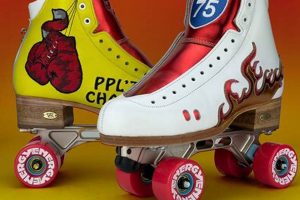
Skates crafted to individual specifications represent a significant departure from mass-produced options. These are meticulously designed and constructed to conform precisely to the unique contours and biomechanics of the skater’s feet. This process ensures an optimal fit, maximizing comfort and performance, particularly in demanding disciplines such as figure skating, hockey, and speed skating.
The significance of precision footwear lies in enhanced control, reduced risk of injury, and improved energy transfer. Historically, such personalized equipment was the domain of elite athletes. However, advancements in technology and manufacturing have broadened accessibility, enabling a wider range of skaters to experience the advantages of a tailored fit. The evolution of materials and production techniques has also contributed to enhanced durability and performance characteristics.
The following sections will delve into the specific aspects of the fabrication process, the advantages offered to different skating disciplines, and the considerations involved in selecting this type of equipment. This will encompass the measurement and fitting procedures, the selection of appropriate materials, and the maintenance requirements to ensure longevity and consistent performance.
Optimizing Performance with Precision Footwear
Achieving peak skating performance relies significantly on the interface between the skater and their equipment. The following tips offer guidance on maximizing the benefits derived from specifically designed skating footwear.
Tip 1: Prioritize Accurate Measurement: The foundation of effective personalization rests on precise foot measurements. Ensure a qualified professional captures detailed dimensions, including length, width, instep height, and arch profile. These measurements inform the construction process and guarantee a snug, supportive fit.
Tip 2: Select Appropriate Boot Stiffness: The level of stiffness should align with the skater’s skill level, skating discipline, and body weight. Beginners typically benefit from softer boots offering greater flexibility, while advanced skaters require stiffer boots for enhanced support and power transfer.
Tip 3: Consider Blade Mounting Position: The positioning of the blade relative to the boot impacts balance and agility. Experiment with different mounting positions under the guidance of an experienced technician to find the optimal configuration for individual skating style and preferences.
Tip 4: Invest in High-Quality Materials: The materials used in construction directly influence durability, performance, and comfort. Opt for premium-grade leather or synthetic materials that offer both support and breathability. Look for robust stitching and reinforced areas to withstand the rigors of intensive use.
Tip 5: Maintain Proper Boot Care: Regular maintenance prolongs the lifespan and performance of skating footwear. After each use, wipe down the boots with a damp cloth to remove moisture and debris. Allow them to air dry thoroughly, and apply a leather conditioner periodically to prevent cracking and maintain suppleness.
Tip 6: Regularly Inspect for Wear and Tear: Periodically examine the boots for signs of damage, such as loose stitching, worn soles, or cracks in the leather. Address any issues promptly to prevent further deterioration and maintain the structural integrity of the footwear.
Adhering to these guidelines maximizes the benefits and prolongs the functional life of skating footwear. The result is improved performance, enhanced comfort, and reduced risk of injury, allowing skaters to focus on refining their technique and achieving their athletic goals.
The subsequent sections will provide information of components and accessories and its benefits.
1. Optimal Fit and Custom Made Skates

Optimal fit represents a foundational element within the context of tailored skating footwear. The relationship between the two is causative: precisely designed skates are the direct means to achieving an optimal fit, which, in turn, yields significant performance advantages. Mass-produced skates, due to their generic design, often necessitate compromises in fit, leading to discomfort, blisters, and compromised control. Conversely, individualized construction addresses the specific anatomical variations present in each skater’s foot. This includes variations in length, width, arch height, and ankle shape. When the footwear mirrors these individual characteristics, the skater experiences enhanced proprioception, leading to greater responsiveness and more efficient power transfer.
The practical implications of this understanding are evident in various skating disciplines. In figure skating, for example, precise boot alignment and snug fit are crucial for executing complex jumps and spins. A poorly fitting boot can result in ankle instability, leading to falls and potential injuries. Similarly, in hockey, a secure and comfortable fit translates to improved agility and acceleration, allowing players to react more quickly and efficiently on the ice. Even in recreational skating, a well-fitted skate reduces fatigue and discomfort, enabling skaters to enjoy longer sessions without pain or hindrance. The meticulous measurement and fitting procedures inherent in the crafting process directly correlate to these enhanced outcomes.
Achieving optimal fit presents challenges, primarily related to the precision of measurement and the expertise required to translate those measurements into a functional and supportive boot. However, the benefits improved performance, reduced injury risk, and increased comfort outweigh the complexities of the process. Understanding the integral role of optimal fit in custom designed skating footwear is not merely an aesthetic consideration but a critical factor in maximizing athletic potential and ensuring a safe and enjoyable skating experience.
2. Material Selection and Custom Made Skates
The selection of appropriate materials constitutes a critical element in the fabrication of personalized skating footwear. The materials employed directly influence performance characteristics, durability, and overall comfort. Consequently, the choice of materials warrants careful consideration based on the intended skating discipline and the skater’s individual needs.
- Boot Shell Materials
The boot shell, providing primary support, typically consists of leather, synthetic polymers, or carbon fiber composites. Leather offers a balance of flexibility and support but may require more maintenance. Synthetic polymers, such as polyurethane, offer increased durability and water resistance. Carbon fiber composites provide maximum stiffness and weight reduction, favored in high-performance applications.
- Lining Materials
The lining material impacts comfort and moisture management. Common options include leather, synthetic fabrics, and thermal foams. Leather linings offer breathability and conform to the foot over time. Synthetic fabrics, such as microfiber, provide moisture-wicking properties. Thermal foams offer insulation and cushioning.
- Blade Mounting Materials
The interface between the boot and the blade requires robust and stable materials. Aluminum alloys are frequently used due to their strength-to-weight ratio and resistance to corrosion. The specific alloy and manufacturing process influence the rigidity and responsiveness of the blade mount.
- Fastening Systems
Fastening systems, including laces, buckles, and straps, contribute to fit and support. Leather or synthetic laces offer adjustability. Buckles provide secure closure and quick release. Straps offer additional ankle support. The selection depends on the skater’s preferences and the demands of the skating discipline.
The interplay between these material choices dictates the overall performance envelope of skating footwear. Skilled craftsmanship integrates these materials to produce a custom solution that meets the precise requirements of the skater and optimizes their on-ice experience.
3. Blade Alignment and Custom Made Skates
Blade alignment constitutes a critical element in the design and fabrication of personalized skating footwear. Precise alignment directly influences balance, stability, and maneuverability, thereby impacting overall skating performance and injury prevention. The following examines key facets of this relationship.
- Lateral Blade Positioning
Lateral blade positioning refers to the side-to-side placement of the blade relative to the boot’s center. Optimal lateral alignment ensures the skater’s weight is distributed evenly over the blade, promoting balance and edge control. Deviations from proper alignment can lead to pronation or supination, increasing the risk of ankle injuries and reducing skating efficiency. Custom made skates allow for precise lateral adjustment to accommodate individual biomechanics.
- Forward Blade Positioning
Forward blade positioning dictates the fore-aft placement of the blade. Adjusting this position alters the skater’s center of gravity and influences the ease with which they can perform specific maneuvers. A more forward position facilitates quicker turns and transitions, while a more rearward position enhances stability for straight-line skating. With custom made skates, blade can be mounted to skater performance based on their needs.
- Blade Pitch (Rocker) Adjustment
Blade pitch, or rocker, describes the curvature of the blade along its length. Modifying the rocker influences the contact area between the blade and the ice, affecting glide, agility, and stability. A more pronounced rocker increases maneuverability, while a flatter rocker enhances glide efficiency. Custom made skates permit precise rocker adjustment to optimize performance for specific skating styles or disciplines.
- Blade Angle and Ankle Alignment
The angle at which the blade is mounted relative to the boot influences ankle alignment and biomechanical efficiency. Misalignment can contribute to strain on the ankle joint and surrounding tissues, increasing the risk of injury. Correcting blade angle within the framework of personalized skating footwear promotes optimal ankle alignment and reduces stress on the lower extremities.
These facets of blade alignment underscore the intricate relationship between custom designed skating footwear and performance optimization. By carefully considering and adjusting each of these parameters, skaters can achieve a superior fit, enhanced control, and reduced risk of injury, ultimately maximizing their potential on the ice. Examples span from figure skaters adjusting blade pitch for enhanced spin control, to hockey players fine-tuning lateral positioning for increased agility on the rink.
4. Support Structure and Custom Made Skates
Support structure within individually designed skating footwear represents a fundamental element directly influencing stability, performance, and injury prevention. These structural components are engineered to provide the necessary rigidity and reinforcement to the ankle and foot, enabling skaters to execute complex movements with precision and minimizing the risk of sprains or fractures. The integration of customized support is not merely an enhancement but a necessity for skaters engaging in demanding disciplines such as figure skating, hockey, and speed skating. Without adequate support, the biomechanical stresses imposed on the lower extremities can quickly lead to fatigue, pain, and potentially debilitating injuries. Consequently, the support structure constitutes a key differentiator between mass-produced skates and those fabricated to individual specifications.
The customization process allows for targeted reinforcement based on the skater’s skill level, skating style, and any pre-existing biomechanical imbalances. For instance, skaters with a tendency to pronate or supinate may require additional medial or lateral support to maintain proper ankle alignment. Similarly, skaters executing high-impact jumps, such as those found in figure skating, necessitate a stiffer boot shell and reinforced ankle padding to withstand the compressive forces generated upon landing. These adjustments are impossible to achieve with generic skates, which are designed to accommodate a wide range of foot shapes and skating styles. The result is a compromise in support and a corresponding increase in the risk of injury. Real-world examples demonstrate the practical significance of tailored support. Elite figure skaters rely on custom designed support structures to execute quadruple jumps, while professional hockey players depend on robust ankle support to withstand the impact of collisions and maintain agility on the ice.
In conclusion, the support structure within custom-made skating footwear is not an optional feature but an integral component that significantly impacts safety and performance. The ability to tailor the support structure to individual needs represents a key advantage over mass-produced alternatives. While the process of designing and fabricating customized support structures may present challenges in terms of cost and technical expertise, the benefits enhanced stability, reduced injury risk, and improved performance far outweigh the drawbacks. Understanding the critical role of the support structure is essential for skaters seeking to maximize their potential and minimize the risk of injury.
5. Durability Assurance and Custom Made Skates
Durability assurance, when coupled with skates constructed to individual specifications, represents a critical factor in maximizing the return on investment and ensuring long-term performance. The inherent precision and personalized nature of such equipment necessitates a corresponding emphasis on the longevity and resilience of materials and construction techniques.
- Material Selection and Longevity
The choice of materials directly impacts the overall lifespan of the skate. Custom-made options often incorporate higher-grade leathers, advanced polymers, and reinforced stitching, contributing to enhanced resistance to wear and tear. For example, the use of full-grain leather in the boot’s construction, as opposed to cheaper, split-grain alternatives, provides superior abrasion resistance and structural integrity. This translates to a boot that maintains its shape and support over extended use.
- Reinforced Stress Points
Skates are subjected to significant stress, particularly in areas such as the toe box, ankle, and blade attachment points. Custom construction allows for targeted reinforcement of these areas with additional layers of material, specialized stitching patterns, and strategically placed rivets. Consider the reinforcement of the toe box with a layer of abrasion-resistant material to protect against scuffing and impact damage. Such measures significantly extend the skate’s lifespan.
- Quality Control and Craftsmanship
The bespoke nature of personalized equipment facilitates stricter quality control throughout the manufacturing process. Skilled craftsmen meticulously inspect each component and assembly, ensuring adherence to stringent standards. This contrasts with mass-produced skates, where automated processes and higher production volumes may compromise individual attention to detail. The result is a product with fewer manufacturing defects and a greater probability of long-term durability.
- Maintenance and Repair Options
Ownership of skating footwear designed and constructed to individual specifications often entails access to specialized maintenance and repair services. Experienced technicians, familiar with the specific materials and construction techniques employed, can address issues such as stitching repairs, sole replacements, and blade realignment. This level of support is not typically available for mass-produced skates, often rendering minor damage irreparable and necessitating premature replacement.
These facets of durability assurance collectively contribute to a superior long-term value proposition for custom designed skating footwear. While the initial investment may exceed that of mass-produced alternatives, the enhanced lifespan, reduced repair costs, and sustained performance characteristics ultimately translate to a more cost-effective solution. Moreover, the environmental benefits associated with reduced consumption and waste further enhance the appeal of durability-focused equipment.
Frequently Asked Questions
The following addresses common inquiries concerning the acquisition and utilization of skating footwear designed and constructed to individual specifications.
Question 1: What distinguishes skates crafted to individual specifications from mass-produced alternatives?
Custom designed options are meticulously constructed to conform to the unique anatomical characteristics of the skater’s feet, ensuring an optimal fit, enhanced support, and improved performance. Mass-produced skates, conversely, are manufactured to generic dimensions, often necessitating compromises in fit and potentially leading to discomfort or injury.
Question 2: What skating disciplines benefit most from personalized equipment?
Disciplines demanding precision, agility, and high levels of support, such as figure skating, hockey, and speed skating, derive the greatest benefit from individually designed skating footwear. However, even recreational skaters may experience enhanced comfort and reduced fatigue through the use of appropriately fitted skates.
Question 3: How is the process of measuring and fitting different from standard skate fitting procedures?
The process involves a comprehensive assessment of foot dimensions, including length, width, arch height, and ankle circumference. Digital scanning or casting techniques may be employed to create a precise three-dimensional model of the skater’s foot, ensuring unparalleled accuracy in the design and construction process.
Question 4: What material options are typically available, and what are their respective advantages?
Common material options include leather, synthetic polymers, and carbon fiber composites. Leather provides a balance of flexibility and support. Synthetic polymers offer enhanced durability and water resistance. Carbon fiber composites provide maximum stiffness and weight reduction. The optimal material selection depends on the skater’s individual needs and preferences.
Question 5: What is the typical lifespan of skating footwear designed and constructed to individual specifications, and what factors influence longevity?
The lifespan depends on the quality of materials, the intensity of use, and the adherence to proper maintenance procedures. Generally, individually designed options, constructed from premium materials and meticulously maintained, exhibit a significantly longer lifespan than mass-produced alternatives.
Question 6: What is the approximate cost associated with acquiring this type of equipment, and what factors contribute to the overall expense?
The cost varies depending on the complexity of the design, the materials employed, and the reputation of the manufacturer. Generally, individually designed options command a higher price point than mass-produced alternatives, reflecting the personalized nature of the construction process and the superior quality of materials.
Understanding the nuances associated with personalized skating footwear facilitates informed decision-making and ensures optimal performance, comfort, and safety on the ice.
The subsequent section will detail care and maintenance procedures critical to preserving skating equipment.
Custom Made Skates
This exploration has underscored the critical role of skates constructed to individual specifications in optimizing performance, enhancing comfort, and mitigating the risk of injury across various skating disciplines. Key considerations encompass the achievement of an optimal fit through precise measurement and fitting procedures, the careful selection of materials to balance durability and performance characteristics, meticulous blade alignment to ensure stability and maneuverability, and the integration of a supportive structure to safeguard the ankle and lower extremities. Durability assurance, achieved through high-quality materials and skilled craftsmanship, further contributes to the long-term value proposition of individualized equipment.
The decision to invest in custom made skates represents a commitment to maximizing athletic potential and prioritizing long-term well-being. While the initial expense may exceed that of mass-produced alternatives, the tangible benefits in terms of enhanced performance, reduced injury risk, and extended equipment lifespan warrant careful consideration. As skating technology continues to evolve, the principles of personalized design and construction will undoubtedly remain central to the pursuit of excellence on the ice.