The activity simulates on-ice movements without actually being on ice. It involves practicing skating techniques and routines on a dry surface, typically with specialized equipment designed to mimic the glide and feel of ice skating. For example, a skater might use off-ice skates or training aids to replicate edge control, stride length, and body positioning similar to what they would execute on an ice rink.
This method offers several advantages for skaters of all levels. It allows for year-round training regardless of ice availability, reduces the risk of injury associated with on-ice falls, and provides a cost-effective way to refine skills. Historically, skaters have used various off-ice methods to supplement their training; however, the development of specialized equipment and structured programs has significantly enhanced the effectiveness and popularity of this training approach.
The following sections will delve into the specific equipment used, the training methodologies employed, and the benefits derived from incorporating this supplemental practice into a comprehensive skating regimen. Specific drills and exercises that can effectively improve skating performance will be outlined and explained.
Off-Ice Training Tips
The following guidelines provide insights into maximizing the benefits of off-ice practice, enhancing skating technique and performance.
Tip 1: Emphasize Proper Posture. Maintaining correct alignment during off-ice drills is crucial. Focus on engaging core muscles, keeping the back straight, and aligning the shoulders over the hips to replicate the stability and balance required on the ice.
Tip 2: Utilize Mirrors for Visual Feedback. Training in front of mirrors allows for immediate correction of form. Observe body positioning, arm movements, and leg extensions to identify and address any technical flaws.
Tip 3: Incorporate Balance Exercises. Balance is fundamental to skating. Practice single-leg stances, wobble board exercises, and other stability drills to improve proprioception and control.
Tip 4: Focus on Edge Control Simulation. Even without ice, edge control can be trained through specific exercises. Use resistance bands or specialized off-ice skates to mimic the feeling of carving and maintaining edges.
Tip 5: Strengthen Supporting Muscles. Skating engages numerous muscle groups. A targeted strength training program focusing on legs, core, and upper body will improve power, endurance, and injury resistance.
Tip 6: Prioritize Repetition and Consistency. Off-ice practice is most effective when performed regularly. Consistent repetition of drills reinforces muscle memory and translates into improved on-ice performance.
Tip 7: Simulate Skating Drills. Adapt on-ice drills for off-ice practice. Replicate footwork patterns, crossovers, and turns to maintain muscle memory and enhance coordination.
Effective integration of these principles into a structured training regimen will contribute significantly to improved skating skill and overall performance. The focused off-ice preparation can be invaluable to on ice execution.
The concluding section will recap these insights and underscore the integral nature of off-ice training.
1. Technique Mimicry

Technique mimicry, within the context of off-ice training, serves as a cornerstone for replicating and refining on-ice movements. This systematic approach allows skaters to reinforce proper form and muscle memory without the physical constraints of ice. The effectiveness of technique mimicry is intrinsically linked to the precision and consistency with which movements are replicated, ensuring that off-ice practice directly translates to improved on-ice performance.
- Edge Control Simulation
Off-ice drills designed to replicate edge control involve the use of resistance bands or specialized training devices to mimic the pressure and angles required to maintain edges on the ice. For example, a skater might use resistance bands attached to their ankles to simulate the lateral force needed for inside and outside edges. Effective simulation translates to improved control and stability on the ice, particularly during turns and transitions.
- Stride Length and Push-Off
Simulating stride length and push-off mechanics off the ice involves practicing leg extensions and glute activation to replicate the power and efficiency of each stride. Skaters may use marked surfaces or training aids to ensure consistent stride length and proper push-off angles. Consistent practice reinforces the muscle memory required for efficient skating, leading to improved speed and endurance.
- Body Positioning and Balance
Maintaining correct body positioning and balance is crucial for effective skating. Off-ice training often involves practicing single-leg stances, core engagement exercises, and dynamic movements to simulate the balance challenges encountered on the ice. For example, a skater may practice balancing on a wobble board while maintaining proper skating posture. Enhanced balance translates to improved stability and control during complex skating maneuvers.
- Arm Movement Synchronization
Coordinated arm movements are essential for maintaining balance and generating power while skating. Off-ice drills focus on synchronizing arm swings with leg movements to replicate the rhythm and momentum of skating. Skaters may use resistance bands or weighted balls to enhance arm strength and coordination. Improved synchronization translates to more efficient energy transfer and enhanced skating speed.
These facets of technique mimicry collectively contribute to a more comprehensive and effective off-ice training regimen. By focusing on precise replication of skating movements, skaters can significantly improve their on-ice performance and reduce the risk of injury. The key is to approach off-ice training with the same focus and intensity as on-ice practice, ensuring that every repetition reinforces the desired technique and muscle memory.
2. Muscle Memory

Muscle memory, also known as motor learning, forms a critical link in the effectiveness of off-ice skating simulation. This neurological process, whereby repeated movements become automatic through practice, directly influences the transfer of skills learned off the ice to on-ice performance. Through consistent repetition of skating techniques in an off-ice environment, neural pathways are strengthened, enabling skaters to execute complex maneuvers with increased fluidity and precision.
- Repetitive Motion Reinforcement
Off-ice training provides an opportunity to reinforce the repetitive motions inherent in skating, such as strides, turns, and jumps. By consistently practicing these movements off the ice, the brain establishes neural pathways that automate the sequences. This automaticity reduces the cognitive load required during on-ice performance, allowing skaters to focus on strategy and artistry. For instance, repeatedly practicing a double axel jump off the ice can help the skater internalize the jump’s mechanics, making the on-ice execution more consistent and reliable.
- Neural Pathway Development
The development of neural pathways is fundamental to muscle memory. As a skater practices off-ice drills, the brain forms connections between nerve cells that control the involved muscles. These connections become stronger with each repetition, making it easier for the brain to activate the correct muscles in the correct sequence. The neurological adaptation contributes to smoother, more efficient movements on the ice. Repeated execution of crossovers off-ice, for example, strengthens the corresponding neural pathways, translating to more seamless and powerful crossovers on the ice.
- Proprioceptive Enhancement
Proprioception, the sense of body position and movement, is crucial for maintaining balance and control while skating. Off-ice training can enhance proprioception by challenging the skater’s balance and coordination in a controlled environment. Exercises such as balancing on one leg or using a balance board force the skater to engage their proprioceptive system, improving their awareness of their body’s position in space. Improved proprioception contributes to greater stability and agility on the ice.
- Movement Pattern Stabilization
Off-ice training assists in stabilizing movement patterns, ensuring that skaters perform techniques consistently and efficiently. By identifying and correcting flaws in their technique off the ice, skaters can prevent these errors from becoming ingrained in their muscle memory. For example, a skater might work on correcting their arm position during a spin off the ice, ensuring that they maintain proper balance and alignment. Stabilizing movement patterns reduces the risk of injury and improves the overall quality of the skater’s performance.
These interconnected facets underscore the importance of muscle memory in off-ice skating simulation. By strategically incorporating repetitive motion reinforcement, neural pathway development, proprioceptive enhancement, and movement pattern stabilization, skaters can optimize their off-ice training and achieve significant improvements in their on-ice performance. This synthesis creates a robust foundation for skill acquisition and mastery within the sphere of skating.
3. Equipment Specificity
Equipment specificity plays a pivotal role in the effectiveness of off-ice skating simulation. The design and functionality of training equipment must align with the specific demands of on-ice movements to ensure meaningful skill transfer. Without appropriate tools, the benefits of off-ice practice are diminished, and the translation of skills to the ice becomes less reliable.
- Off-Ice Skates
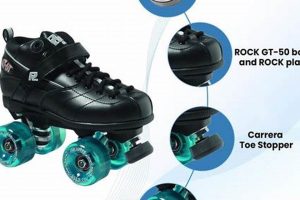
Off-ice skates, designed to mimic the feel and function of ice skates, are a primary tool. These skates typically feature a wheeled chassis that approximates the glide and edge control of traditional blades. The stiffness of the boot and the curvature of the “blade” are calibrated to replicate the stability and responsiveness experienced on the ice. Failure to utilize skates with appropriate characteristics can result in the development of improper technique and reduced skill transfer.
- Harness Systems
Harness systems provide a means to practice jumps and complex maneuvers in a controlled environment. These systems suspend the skater, reducing the impact of landings and allowing for repetition of techniques without undue physical strain. The design of the harness must allow for a full range of motion while providing adequate support and stability. An improperly fitted or poorly designed harness can hinder proper technique and increase the risk of injury.
- Resistance Bands
Resistance bands are used to simulate the resistance encountered during skating strides and edge work. Bands of varying resistance levels are employed to target specific muscle groups and enhance strength and power. The proper selection and application of resistance bands are critical to replicating the forces experienced on the ice. Incorrect usage can lead to improper muscle activation and ineffective training.
- Balance Boards
Balance boards and similar devices are utilized to improve proprioception and stability, essential components of skating performance. These tools challenge the skater’s balance and require constant adjustments to maintain equilibrium. The design of the balance board should provide a realistic simulation of the balance challenges encountered on the ice. Inadequate equipment may fail to provide sufficient stimulus for proprioceptive development.
The strategic selection and application of specific equipment are integral to maximizing the benefits of off-ice training. Integrating equipment that accurately replicates the demands of on-ice skating ensures that the skills and techniques acquired off-ice translate effectively to improved performance on the ice.
4. Spatial Awareness

Spatial awareness is a foundational element within the realm of off-ice skating simulation. It dictates the skater’s understanding of their body’s position in relation to the surrounding environment, a crucial element for executing complex maneuvers with precision and control. Without sufficient spatial acuity, the skater struggles to translate intended movements into accurate physical actions, resulting in compromised technique and increased risk of error. For instance, a skater practicing a jump rotation off-ice must accurately perceive the intended axis of rotation and the placement of their limbs to successfully mimic the on-ice execution. The effectiveness of off-ice training directly correlates with the skater’s ability to internalize and replicate the spatial relationships inherent in skating techniques.
The development of spatial awareness through off-ice training carries practical implications for on-ice performance. By utilizing visual aids, such as mirrors, and structured training environments, skaters enhance their ability to accurately perceive and anticipate spatial demands. Repeatedly executing simulated routines off-ice reinforces the cognitive map of the skating environment, improving reaction time and decision-making on the ice. This enhanced awareness reduces the mental load associated with spatial processing, allowing the skater to focus on other aspects of performance, such as artistry and speed. Improved peripheral vision, reaction time, and decision-making all flow from a greater sense of spacial awareness and its affect on shadow skate.
Challenges in developing spatial awareness for off-ice simulation primarily stem from the absence of the physical sensations associated with ice skating, such as the glide and edge control. Overcoming these challenges requires a concerted effort to translate the visual and kinesthetic information acquired during off-ice practice into a mental model of the on-ice environment. The integration of specialized equipment, such as balance boards and off-ice skates, further aids in bridging the gap between simulated and actual skating experiences. Spatial awareness, therefore, stands as a crucial link between the precision and safety for skaters of all levels.
5. Performance Translation
Performance translation represents the ultimate goal of off-ice training, specifically within the context of simulated skating activities. It denotes the degree to which skills acquired and refined in an off-ice setting manifest as measurable improvements in on-ice skating performance. The effectiveness of any off-ice training program hinges on its ability to bridge the gap between simulated practice and real-world application on the ice.
- Technique Transfer Fidelity
Technique transfer fidelity refers to the precision with which skating techniques practiced off-ice can be replicated on the ice. This aspect encompasses elements such as body positioning, stride mechanics, and edge control. For example, if a skater diligently practices proper body alignment during off-ice drills, the expectation is that this alignment will be maintained during on-ice skating, resulting in improved balance and efficiency. High technique transfer fidelity is indicative of a well-designed and executed off-ice training regimen.
- Muscle Memory Reinforcement
Muscle memory reinforcement involves strengthening neural pathways through repetitive practice, making movements more automatic and fluid. Off-ice training plays a crucial role in reinforcing the muscle memory required for complex skating maneuvers. A skater who consistently practices jumps and spins off-ice is more likely to execute those movements with greater consistency and confidence on the ice. The degree to which off-ice drills reinforce and enhance muscle memory directly impacts the skater’s ability to perform under pressure.
- Proprioceptive Adaptation
Proprioceptive adaptation is the refinement of the skater’s sense of body position and movement in space. Off-ice training can enhance proprioception through exercises that challenge balance and coordination. For instance, using a balance board or wobble board off-ice can improve a skater’s ability to maintain stability on the ice, particularly during turns and spins. Effective proprioceptive adaptation translates to enhanced control and reduced risk of falls.
- Conditional Skill Application
Conditional skill application is the ability to apply skills learned off-ice in various on-ice scenarios. This facet involves not only mastering individual techniques but also integrating those techniques into complete routines and adapting to changing conditions. A skater who has practiced a jump sequence extensively off-ice must be able to execute that sequence seamlessly within a full program, even when fatigued or under competitive pressure. Successful conditional skill application demonstrates a comprehensive understanding and internalization of the skills acquired off-ice.
The ultimate measure of performance translation lies in the tangible improvements observed in on-ice skating performance. This can be assessed through metrics such as improved jump height, increased spin speed, enhanced edge control, and greater overall consistency. Therefore, off-ice training, particularly shadow skating, must be carefully designed to maximize the transfer of skills and techniques to the ice, ensuring that the benefits are realized in practical, measurable ways.
6. Balance Refinement
Balance refinement, within the context of simulated skating practice, serves as a foundational element for effective skill development. The ability to maintain equilibrium and control body position is paramount to successful on-ice performance, and the pursuit of balance refinement directly impacts the efficacy of simulated skating routines. The practice of mimicking skating movements off-ice, often termed “shadow skate,” necessitates heightened proprioceptive awareness and core stability, creating a direct causal relationship between balance refinement efforts and improved skating proficiency.
The importance of balance refinement as a component of “shadow skate” is underscored by its influence on technique execution. For example, a skater practicing a jump rotation off-ice must maintain a stable center of gravity to accurately replicate the dynamics of the jump. Exercises involving single-leg stances, wobble boards, or balance beams are commonly incorporated into “shadow skate” programs to enhance this stability. These drills not only improve static balance but also cultivate dynamic balance, which is critical for navigating the variable and unpredictable conditions encountered on the ice. Moreover, refined balance minimizes energy expenditure and reduces the risk of falls, contributing to overall skating efficiency and safety.
The practical significance of understanding this connection is evident in the design of effective off-ice training programs. Coaches and skaters who recognize the integral role of balance refinement in “shadow skate” prioritize exercises that specifically target balance and stability. This strategic focus leads to more efficient skill acquisition, faster progress, and a reduced risk of injury. Balance refinement, therefore, functions as a catalyst for translating simulated skating practice into tangible on-ice improvements, solidifying its position as a core principle within the broader training paradigm.
Frequently Asked Questions about Shadow Skate
The following addresses prevalent inquiries surrounding off-ice training techniques designed to simulate skating movements, often referred to as “shadow skate.” These responses aim to provide clear and concise information.
Question 1: What constitutes “shadow skate” and how does it differ from traditional off-ice training?
“Shadow skate” is a specific form of off-ice training focused on directly mimicking on-ice movements and techniques using specialized equipment or simulations. It differs from general off-ice conditioning, which may include exercises like strength training or cardiovascular workouts, by prioritizing the replication of skating-specific skills.
Question 2: Is specialized equipment necessary for effective “shadow skate” practice?
While not strictly required, specialized equipment such as off-ice skates or resistance bands can significantly enhance the effectiveness of “shadow skate.” These tools are designed to replicate the feel and dynamics of on-ice skating, promoting more accurate technique transfer.
Question 3: How frequently should “shadow skate” be incorporated into a comprehensive training regimen?
The optimal frequency of “shadow skate” depends on individual training goals and ice availability. However, incorporating “shadow skate” sessions multiple times per week can provide significant benefits, particularly when ice time is limited.
Question 4: What are the primary benefits of utilizing “shadow skate” as a training method?
The primary benefits include improved technique, enhanced muscle memory, increased spatial awareness, and reduced risk of injury compared to solely relying on on-ice training. “Shadow skate” allows for focused practice of specific skills without the constraints of ice availability or the risk of falls.
Question 5: Can “shadow skate” effectively replace on-ice training?
“Shadow skate” should be viewed as a complement to, rather than a replacement for, on-ice training. While it offers numerous benefits, the unique sensory experience of skating on ice cannot be fully replicated off-ice. The integration of both approaches yields the most comprehensive training outcome.
Question 6: What potential risks or limitations are associated with “shadow skate” practice?
Potential risks include the development of incorrect technique if proper form is not maintained, and the possibility of overuse injuries if training intensity is not carefully managed. It is crucial to prioritize proper instruction and progressive overload to mitigate these risks.
In summary, “shadow skate” provides a strategic avenue for skill development and performance enhancement, complementing traditional on-ice training. Diligent application and appropriate technique supervision remain paramount.
The following section explores the integration of “shadow skate” into specific training programs and outlines best practices for implementation.
Conclusion
This exploration has examined the multifaceted dimensions of shadow skate. The effectiveness of mimicking on-ice techniques on dry surfaces rests upon stringent adherence to correct form, strategic equipment use, and a focused approach to replicating the nuances of skating. The reviewed techniques, ranging from balance exercises to resistance training, collectively contribute to the comprehensive development of muscle memory, spatial awareness, and physical conditioning. The application of shadow skate, as presented, facilitates improvement across all performance levels.
The integration of shadow skate into broader training regimens demands careful consideration of individual skater needs and training objectives. The pursuit of excellence in skating requires continual refinement of technique, enhancement of physical capabilities, and, fundamentally, an understanding of the crucial link between off-ice preparation and on-ice execution. This article serves as a resource to inform and empower athletes in their skating journey. Consider the application of these techniques, and may the pursuit of enhanced skating performance be both informed and rewarding.