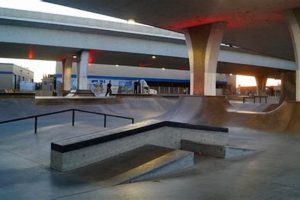
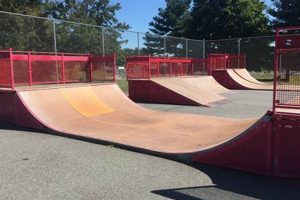
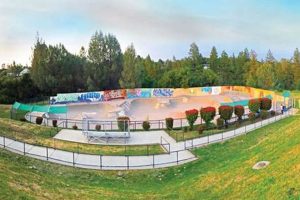
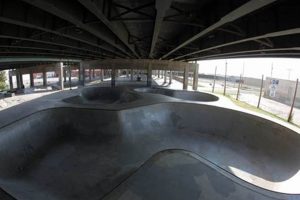
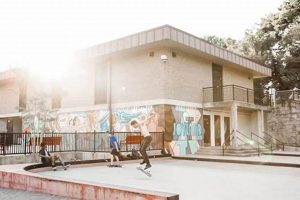
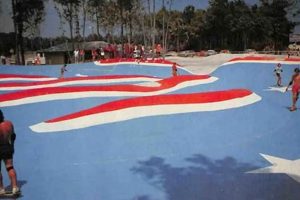
A specialized recreational environment, primarily constructed for skateboarding, BMX riding, and aggressive inline skating, features challenging obstacles. These spaces typically incorporate elements such as vert ramps, large bowls, complex street courses with rails, gaps, and stairs, and potentially foam pits or airbag landings. The design emphasizes opportunities for advanced maneuvers and high-risk athletic performance.
The existence of such facilities encourages the development of advanced skills and provides a controlled setting for practicing challenging tricks. This helps to mitigate the risk of injury associated with practicing in uncontrolled public spaces. Furthermore, these spaces offer a community hub for athletes, fostering a sense of belonging and promoting the progression of action sports. Over time, the design and features of these facilities have evolved to meet the demands of increasingly skilled participants and to incorporate new innovations in action sports.
The subsequent sections will examine specific design considerations for such facilities, including safety standards, material selection, obstacle construction techniques, and the integration of technology to enhance the user experience. Attention will also be given to community engagement and the impact of such environments on the surrounding area.
Design and Safety Considerations for Challenging Skateboarding Venues
The creation of spaces designed for advanced skateboarding requires careful planning and adherence to safety protocols. This section outlines key recommendations to ensure both the usability and the well-being of participants.
Tip 1: Comprehensive Risk Assessment: Prior to construction, a detailed evaluation of potential hazards is essential. This includes identifying potential collision points, assessing the impact of varying skill levels, and considering environmental factors.
Tip 2: Robust Material Selection: Concrete, steel, and specialized composite materials are typically employed for obstacle construction. The selection should prioritize durability, weather resistance, and appropriate surface friction to minimize the risk of slippage.
Tip 3: Progressive Obstacle Design: The arrangement and design of ramps, rails, and other features should allow for incremental skill development. Introducing increasingly challenging elements gradually reduces the likelihood of accidents among less experienced users.
Tip 4: Strategic Layout and Flow: The overall layout needs to encourage a natural flow of movement. Clear sightlines and adequate spacing between obstacles are crucial to prevent collisions and maintain a safe operating environment.
Tip 5: Regular Inspection and Maintenance: A schedule for routine inspections is essential to identify and address any structural deficiencies or surface irregularities. Prompt repairs prevent the escalation of minor issues into significant safety hazards.
Tip 6: Incorporation of Fall Zones: Adequate run-off areas and strategically placed safety surfaces, such as foam pits or resi ramps, should be incorporated around high-risk features to mitigate the impact of falls.
Tip 7: Clear Signage and Rules: Prominent signage outlining rules of conduct, recommended safety equipment, and designated skill levels for specific areas is vital for promoting responsible usage.
Adherence to these recommendations will contribute to the creation of a functional and secure skateboarding facility, allowing participants to pursue their sport with a reasonable expectation of safety.
The next section will delve into the sociological impact and community benefits derived from thoughtfully designed skateboarding venues.
1. Challenging Obstacle Design

Obstacle design within a specialized recreational environment plays a pivotal role in defining its character and appeal to advanced athletes. The incorporation of complex and demanding features directly influences the difficulty, potential for skill development, and the overall perceived value of the skateboarding facility.
- Vert Ramp Geometry and Transitions
Vertical ramps featuring varying heights, degrees of curvature, and extended platforms provide an environment for performing aerial maneuvers and sustained vertical riding. The precise geometry of the transition, from flat to vertical, dictates the difficulty and potential for executing complex tricks. Subtle variations in the radius can significantly alter the riding experience. Incorrectly designed transitions may pose significant risks to users.
- Street Course Complexity and Feature Density
Street courses that incorporate diverse elements, such as handrails, stairs, ledges, banks, and gaps, challenge users to adapt their skills to a variety of simulated urban environments. The proximity and arrangement of these features, often referred to as feature density, require riders to execute rapid transitions and combine multiple tricks in a single line. The effective integration of these elements can significantly increase the difficulty and creative potential of the course.
- Bowl Depth and Configuration
Deep bowls, with varying depths and configurations of pockets, hips, and extensions, present a complex three-dimensional riding surface. The steepness of the walls, combined with the potential for high speeds, demands precise control and spatial awareness. Variations in the bowl’s shape and depth introduce new challenges and opportunities for advanced maneuvers. The complexity is increased when multiple bowls are interconnected.
- Gaps and Transfer Obstacles
Gaps and transfer obstacles, which require riders to launch across a distance or transition between different surfaces, present a significant challenge to spatial judgement and landing accuracy. The length and height of the gap, as well as the landing surface’s angle and material, directly affect the risk and difficulty of the maneuver. Furthermore, transfer obstacles can link disparate sections of the recreational environment, creating fluid and dynamic lines.
The deliberate integration of these design features allows the recreational environment to meet the needs of skilled athletes while offering a compelling spectacle. Such a space acts as both a training ground and a showcase for extreme sports.
2. Advanced Skill Development

Advanced skill development is inextricably linked to specialized skateboarding facilities. These locations offer a controlled and progressively challenging environment that fosters the acquisition of complex techniques and maneuvers, enabling athletes to push the boundaries of their abilities.
- Progressive Obstacle Mastery
The design of these facilities encourages a systematic progression in skill. Novice users may begin on smaller ramps and gradually advance to more challenging obstacles as their competence increases. This allows athletes to develop a solid foundation before attempting higher-risk maneuvers. For instance, starting with a mini ramp helps develop foundational skills before tackling a full vert ramp.
- Precision and Control Enhancement
The intricate layouts and challenging features require precision and control. Executing complex tricks on rails, ledges, or in bowls necessitates refined motor skills and spatial awareness. The repetition inherent in practicing these maneuvers cultivates muscle memory and enhances an athlete’s ability to execute complex sequences with accuracy and consistency. Failure to do so could result in injury.
- Spatial Awareness and Risk Management
Negotiating the dynamic environment of an extreme skateboarding location demands acute spatial awareness and effective risk management. Athletes must accurately assess their surroundings, anticipate potential hazards, and adjust their movements accordingly. This cultivates a heightened sense of awareness and the ability to make split-second decisions under pressure. An individual who lacks this spatial awareness is unlikely to progress beyond basic skills.
- Creative Expression and Innovation
The challenging environment provides a platform for creative expression and innovation. Athletes are encouraged to experiment with new combinations of tricks, develop unique lines, and push the boundaries of what is possible. This fosters a spirit of creativity and innovation, leading to the evolution of skateboarding techniques and styles. For example, designing new tricks that involve a combination of grinds, flips, and grabs creates an opportunity to advance skill development.
The elements within a recreational setting designed for advanced skateboarding directly contribute to the refinement of skills. The deliberate challenges introduced within the facility enhance precision, spatial awareness, and risk assessment abilities. This, in turn, allows athletes to continuously innovate and push the limits of their capabilities within their sport. Such places provide a structured, if challenging, progression toward expert-level skill sets.
3. Controlled Risk Environment

The concept of a “controlled risk environment” is paramount in the context of spaces designed for advanced skateboarding. While the pursuit of challenging maneuvers inherently involves risk, the deliberate design and management of these spaces aims to mitigate potential hazards and create a safer setting for athletes to push their limits.
- Standardized Obstacle Construction
The implementation of standardized construction techniques and material specifications ensures a predictable and reliable environment. This reduces the likelihood of unexpected failures or inconsistencies in obstacle performance. For example, the use of precisely engineered steel coping on a vert ramp minimizes the risk of catching an edge, thus controlling a significant hazard. This also prevents the unexpected creation of new risks due to poor construction.
- Safety Padding and Fall Zones
Strategic placement of safety padding and designated fall zones around high-risk features provides a buffer in the event of a fall. Foam pits, resi ramps, and impact-absorbing surfaces mitigate the severity of potential injuries. This proactive approach minimizes the consequences of inevitable miscalculations and promotes a culture of calculated risk-taking. Furthermore, their specific placement influences the degree of risk.
- Supervision and Skill Level Segregation
The presence of trained supervisors and the implementation of skill level segregation policies contribute to a safer environment. Supervision allows for the identification and correction of unsafe practices, while skill level segregation minimizes the risk of collisions or accidents between participants of varying abilities. These measures promote a culture of responsible behavior and reduce the likelihood of incidents. This creates a structured format, allowing for lower risks.
- Regular Inspection and Maintenance Protocols
Consistent implementation of inspection protocols ensures early detection and rectification of any structural or surface deficiencies. Prompt repair and maintenance of damaged or worn features prevent the escalation of minor issues into significant safety hazards. A facility that does not address these is not considered a controlled environment. By proactively addressing potential risks, the overall safety of the environment is greatly enhanced.
The combination of standardized construction, strategic safety measures, active supervision, and diligent maintenance defines the “controlled risk environment”. These elements create a space where athletes can confidently challenge themselves, develop advanced skills, and express their creativity while minimizing the potential for serious injury. The absence of these controls substantially increases the inherent danger and transforms the location from a training ground into a potentially unsafe and unpredictable arena.
4. Community Social Hub

Specialized skateboarding facilities serve as central gathering points for individuals sharing a passion for action sports. The presence of a designated space attracts participants from diverse backgrounds, fostering interaction and collaboration. These hubs facilitate the exchange of knowledge, skills, and experiences, creating a sense of shared identity and purpose. The skate park itself becomes more than just a place to practice; it transforms into a dynamic social ecosystem, enhancing the overall well-being of its users. A notable example can be seen in the rise of community-led skate park initiatives, where local residents actively participate in the design and maintenance of the space, strengthening community bonds and promoting civic engagement. Therefore, the recreational venue is a catalyst for community development and social inclusion.
The impact of this social dynamic extends beyond the immediate user base. The visibility and accessibility of the facility can attract spectators and enthusiasts, contributing to the economic vitality of the surrounding area. Local businesses often benefit from increased foot traffic and spending, while community events and competitions generate a sense of excitement and pride. Furthermore, the presence of a well-maintained and actively used skate park can improve the perception of the neighborhood, attracting new residents and investment. For instance, the establishment of a skate park in a formerly underutilized area can revitalize the space, turning a potential source of blight into a positive community asset. Furthermore, mentorship opportunities often arise within these communities which allow for skilled participants to teach novice users. This allows for the advancement of action sports in the area.
In conclusion, a facility designed for advanced skateboarding functions as more than a physical space; it embodies a community social hub that strengthens bonds, promotes inclusivity, and enhances the overall well-being of its users and the surrounding area. Recognizing the importance of this social dimension is crucial for the successful design, management, and long-term sustainability of these facilities. Investing in these spaces is thus an investment in the social fabric of the community.
5. Evolving Feature Innovation

The continuous advancement of features is integral to the sustained relevance and appeal of specialized skateboarding facilities. These advancements reflect the ever-increasing skill levels of participants and the demand for novel and challenging obstacles that push the boundaries of athletic performance.
- Integration of Digital Technologies
The incorporation of digital technologies is revolutionizing the design and functionality of facilities. Examples include augmented reality overlays that provide real-time feedback to riders, sensor-equipped obstacles that measure performance metrics, and interactive lighting systems that respond to rider movements. These technologies enhance the training experience, promote objective assessment of skills, and create visually engaging environments. Sensors could be used to measure a rider’s air time, automatically record it, and display the recording on an integrated screen for feedback.
- Adaptive Obstacle Design
Adaptive obstacles represent a significant departure from traditional static features. These designs incorporate mechanical or pneumatic systems that allow for dynamic adjustments to obstacle geometry. Examples include adjustable-height ramps, variable-radius transitions, and customizable rail configurations. Such adaptive features cater to a wider range of skill levels and promote creativity by enabling users to tailor the environment to their specific needs. These obstacles can also allow for the creation of new tricks.
- Hybrid Material Compositions
The exploration of novel material combinations is leading to the creation of safer and more durable obstacles. Hybrid materials, such as reinforced polymers and advanced concrete composites, offer superior impact resistance, reduced surface friction, and enhanced weather resilience. These materials extend the lifespan of obstacles, reduce maintenance costs, and minimize the risk of injury. By utilizing a mix of materials, you can create obstacles with varying weight distribution.
- Biomimicry and Organic Forms
Drawing inspiration from natural forms and structures, designers are incorporating biomimicry principles to create more fluid and intuitive riding experiences. Organic shapes, such as undulating surfaces and asymmetrical transitions, mimic the natural terrain and challenge riders to adapt their movements to unpredictable contours. This promotes a more engaging and aesthetically pleasing environment. A good example of Biomimicry is using the shape of a wave to create a smooth but difficult quarter pipe.
The ongoing pursuit of feature innovation ensures that skateboarding facilities remain dynamic, engaging, and relevant to the evolving needs of athletes. The integration of digital technologies, adaptive designs, hybrid materials, and biomimicry principles pushes the boundaries of what is possible, providing athletes with new opportunities to challenge themselves, develop their skills, and express their creativity. Innovation can also act as a means to drive athlete participation or draw in new participants. These elements work together to attract both skilled athletes, novices, and spectators.
Frequently Asked Questions About Facilities Designed for Advanced Skateboarding
The following addresses common inquiries regarding the planning, construction, and operation of facilities intended for extreme skateboarding. These answers provide a factual overview, excluding subjective opinions.
Question 1: What distinguishes an ‘extreme skate park’ from a standard skate park?
An ‘extreme skate park’ incorporates more challenging obstacles, designed for advanced skill levels. These features typically include larger vert ramps, more complex street courses, deeper bowls, and transfer obstacles. Standard parks may offer a greater range of beginner-friendly features.
Question 2: What safety measures are essential for an ‘extreme skate park’?
Essential safety measures encompass standardized obstacle construction, strategic placement of safety padding and fall zones, mandatory helmet use, active supervision, and regular inspections to identify and address potential hazards.
Question 3: What are the primary considerations for obstacle material selection?
Obstacle material selection should prioritize durability, weather resistance, appropriate surface friction, and impact resistance. Concrete, steel, and specialized composite materials are frequently employed, each offering distinct advantages and disadvantages.
Question 4: How does an ‘extreme skate park’ contribute to the local community?
A well-designed facility can serve as a community social hub, promoting interaction among participants and attracting visitors. This can boost local businesses, increase property values, and provide a positive recreational outlet for youth.
Question 5: What are the key factors in designing a flowing and engaging course layout?
A flowing course layout considers obstacle placement, sightlines, and skill level progression. The design should encourage a natural flow of movement, allow for creative line combinations, and minimize potential collision points.
Question 6: How often should an ‘extreme skate park’ undergo inspection and maintenance?
Inspection and maintenance should occur on a regular schedule, with more frequent checks for high-use or weather-exposed areas. Any structural deficiencies or surface irregularities should be promptly addressed to maintain safety and prevent further deterioration.
The above responses outline core considerations relevant to the design, safety, and community impact of these facilities. Thorough planning and diligent management are critical for ensuring a successful and sustainable environment.
The next section explores case studies of exemplary facilities, providing practical examples of successful design and operational strategies.
Conclusion
This exploration has elucidated the key elements defining facilities designed for advanced skateboarding. Obstacle complexity, opportunities for skill progression, the establishment of controlled risk environments, the cultivation of community, and the commitment to feature innovation are all crucial. These factors interdependently contribute to the success and sustainability of these spaces.
Recognizing the multifaceted benefits of such venues is paramount. Prioritizing safety, investing in innovative design, and fostering community engagement are essential to maximizing their positive impact. These facilities represent more than recreational outlets; they are testaments to human potential, creativity, and the enduring appeal of challenging oneself. The continued development and responsible management of these areas will ensure they remain a vital part of the action sports landscape for years to come.