The configurations of polyurethane components affixed to wheeled sporting equipment significantly influence performance characteristics. These variations in cross-sectional profiles affect properties such as grip, speed, and stability. Examples include designs with rounded edges for maneuverability and designs with square edges for enhanced traction.
These design elements are critical in determining the user experience, enabling athletes to optimize their equipment for diverse terrains and competitive environments. The evolution of these designs reflects ongoing efforts to improve efficiency and control, dating back to the introduction of the first commercially produced iterations of wheeled recreational apparatus.
The subsequent sections will delve into specific types, detailing their properties, intended applications, and impact on overall apparatus handling and usability, providing a framework for understanding selection criteria.
Selecting Optimal Configurations
Selecting the appropriate configuration requires careful consideration of the intended application and desired performance characteristics. Factors such as surface type, rider skill level, and desired maneuverability should inform the selection process.
Tip 1: Consider Durometer in Conjunction with Configuration: Higher durometer compounds, when paired with a narrower profile, will typically offer increased speed but reduced grip, while softer compounds paired with a wider profile will enhance grip but may sacrifice some speed.
Tip 2: Evaluate Riding Surface: Smooth, polished surfaces generally benefit from designs optimized for speed, such as those with a narrower contact patch. Rougher surfaces demand configurations prioritizing grip and stability, such as wider designs with softer compounds.
Tip 3: Analyze Riding Style: Aggressive maneuvering and trick-oriented activities may necessitate profiles allowing for quick transitions and increased board feel. Conversely, distance riding and high-speed applications may benefit from profiles optimized for straight-line stability.
Tip 4: Observe Edge Profile: Squared edges tend to offer maximum grip for carving and controlled slides, while rounded edges facilitate smoother transitions and are more forgiving for beginners.
Tip 5: Experiment with Different Sizes: Larger diameters generally roll faster and maintain momentum better, while smaller diameters offer quicker acceleration and lower ride height.
Tip 6: Monitor Wear Patterns: Observing how the equipment wears can provide valuable insights into the rider’s style and indicate whether the selected configuration is appropriate for the application.
Optimal selection is achieved through a combination of understanding the fundamental principles governing the interaction between the apparatus and the riding surface, coupled with practical experimentation and rider feedback. These guidelines are intended to facilitate informed decision-making, leading to improved performance and enhanced riding experience.
The following section will address the influence of core materials and bearing types on overall performance, further expanding on the key determinants of wheeled sporting equipment functionality.
1. Profile Geometry

Profile geometry, pertaining to the cross-sectional contour of a component, is a critical determinant of handling characteristics and performance attributes. Its influence is substantial, directly impacting the manner in which the apparatus interacts with the riding surface. Alterations to the contour influence grip, speed, and slide characteristics.
- Rounded Profile
A rounded profile, characterized by a smooth, continuous curve from the outer edge to the hub, facilitates easier initiation of turns and smoother transitions. The decreased contact patch area reduces friction, potentially increasing speed, but also lessening overall grip. This configuration is common in applications prioritizing maneuverability and flow.
- Square Profile
The square profile, distinguished by its sharp, 90-degree edges, maximizes the contact patch area. This increased surface contact results in heightened grip and control, particularly during carving and controlled slides. Applications requiring precise control and aggressive cornering often utilize this design.
- Conical Profile
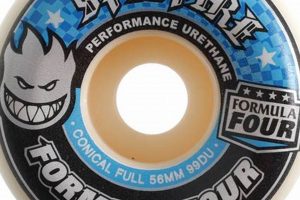
A conical profile, featuring a sloping or tapered edge, offers a balance between maneuverability and grip. The angle of the taper affects the responsiveness of turns and the amount of slide. This design finds use in a variety of riding styles, adapting to diverse terrains and user preferences. Variations in the angle adjust performance characteristics.
- Beveled Profile
The beveled profile incorporates a chamfered or angled edge between the main rolling surface and the side of the component. This feature assists in reducing the likelihood of edge catching and provides a more forgiving feel when initiating slides. It can also alter the wear pattern. This design is often favored by beginners and those seeking enhanced stability.
Variations in profile geometry represent a spectrum of trade-offs between grip, speed, and slide characteristics. Selection requires careful consideration of intended use and desired performance attributes, impacting overall ride quality and control.
2. Contact Patch

The contact patch, defined as the area of interface between the rolling component and the riding surface, is intrinsically linked to configurations. The shape dictates the size and geometry of this area, exerting a direct influence on traction, rolling resistance, and overall stability. A larger contact patch, achieved through wider profiles or softer compounds, typically yields increased grip but correspondingly higher rolling resistance. Conversely, a smaller contact patch, inherent in narrower designs or harder compounds, prioritizes speed at the expense of traction.
The interaction between the contact patch and surface irregularities determines the capacity to maintain consistent grip. Consider a configuration with squared edges. This design maximizes the contact patch, distributing force over a larger area, resulting in enhanced stability, particularly on smooth surfaces. This is advantageous for applications that necessitate precise control and limited slippage. As another consideration, a highly rounded configuration will offer minimal contact patch and is most suited for smooth, polished surfaces where friction is minimized and controlled maneuverability is favored. The design of longboarding equipment frequently accounts for significant variances in asphalt quality where stability and vibration absorption become crucial parameters. In these instances, a larger contact patch is preferred. Thus, the desired performance parameters necessitate a conscious selection of the contact patch via design considerations.
Understanding the relationship between configuration and contact patch is paramount for optimizing equipment setup based on riding style, terrain, and performance goals. Choosing a suitable shape is critical for maximizing control and promoting safety. Therefore, analysis and manipulation of contact patch dimensions via geometrical considerations are key aspects of design.
3. Edge Roundness

Edge roundness, a critical parameter influencing performance, directly correlates with the transition between the rolling surface and the lateral face of a component. Variations in this attribute dictate the handling characteristics of the apparatus, impacting both grip and slide properties. The precise radius of curvature affects the contact area under varying lean angles, thus governing the responsiveness and predictability of turns.
- Sharp Edges (Minimal Radius)
Configurations with sharp edges, characterized by a minimal radius of curvature, exhibit maximum grip at lower lean angles. The abrupt transition between the rolling surface and side wall creates a distinct edge that effectively “bites” into the riding surface. Such designs are suitable for applications demanding precise control and minimal slippage, such as slalom or downhill racing. However, this design is less forgiving and prone to “catching” on surface imperfections.
- Rounded Edges (Moderate Radius)
Rounded edges provide a smoother transition during turns, offering a more progressive and predictable slide response. The gradual curvature allows for controlled drift and greater tolerance for surface irregularities. This design balances grip and slide characteristics, making it versatile for various riding styles and terrains. Skateboard wheels, especially those intended for park or street skating, often feature moderate edge roundness.
- Full Radius Edges (Large Radius)
Configurations with a full radius, representing a continuous curve from the rolling surface to the lateral face, prioritize smooth sliding and reduce the likelihood of edge catching. This design is commonly employed in sliding-oriented disciplines, such as downhill freeride, where controlled drift and predictable release are essential. The lack of a defined edge reduces grip, promoting smoother transitions between grip and slide.
- Asymmetrical Edges
Asymmetrical edge designs intentionally vary the roundness on the inner and outer edges of a configuration. This is particularly relevant in longboarding, where differing turning dynamics are encountered. A sharper inner edge may enhance grip during turns, while a more rounded outer edge facilitates controlled slide initiation. Such designs offer tailored performance characteristics for specialized applications.
The selection of edge roundness is therefore a critical decision in optimizing a configuration for a specific riding style and application. Each variation represents a trade-off between grip, slide characteristics, and forgiveness, necessitating careful consideration of the rider’s skill level and intended use. Understanding the impact of edge roundness on handling dynamics enables riders to fine-tune their setup for optimal performance and control. These geometrical designs are significant for controlling critical performance parameters.
4. Core Offset

Core offset represents a critical design parameter intimately connected to the performance characteristics of wheeled sporting equipment. Its influence extends to grip, slide control, and overall handling responsiveness. This parameter defines the position of the bearing seat relative to the geometric center of the shape, a factor that significantly affects load distribution and deformation under stress.
- Centerset Configuration
In a centerset configuration, the bearing seat is aligned precisely with the center. This symmetrical design promotes even wear and consistent performance across various riding conditions. Its neutral balance contributes to predictable slide initiation and controlled drifts, favored in freeride and freestyle disciplines. The equal distribution of stress minimizes the risk of coning, enhancing the lifespan.
- Sideset Configuration
The sideset configuration positions the bearing seat closer to one edge. This asymmetrical design increases grip on the opposing edge, enhancing traction during carving and cornering. Such a configuration is often found in downhill setups where maximal grip is paramount. However, the uneven stress distribution can lead to asymmetrical wear patterns and a shorter lifespan under demanding conditions.
- Offset Configuration
Offset configurations represent an intermediate position, placing the bearing seat between the center and the edge. This design attempts to balance grip and slide characteristics, offering a versatile option for diverse riding styles. The degree of offset can be tailored to specific performance requirements, allowing manufacturers to fine-tune the handling characteristics. Small adjustments significantly affect performance.
- Influence on Lip Deformation
Core offset directly influences the deformation of the lip during cornering and sliding. In a sideset configuration, the lip adjacent to the bearing seat experiences greater stress, potentially leading to premature wear or deformation. Centerset configurations distribute the stress more evenly, mitigating this effect. The extent of lip deformation affects grip and slide characteristics, impacting handling responsiveness.
In summation, core offset represents a crucial element in determining the overall performance profile of wheeled sporting equipment. Varying the position of the bearing seat relative to the center allows for precise tailoring of grip, slide characteristics, and handling responsiveness. Understanding the implications of different core offset designs is essential for optimizing equipment selection based on individual riding styles and performance goals. The choice of design is important in optimizing performance and maximizing longevity.
5. Lip design

The lip, denoting the edge profile of a wheeled component, is integral to the functional characteristics of its overall design. This feature dictates how the equipment interacts with the riding surface during directional changes and speed modulation, impacting grip, slide control, and wear patterns. Consequently, variations in lip design, characterized by differences in thickness, sharpness, and angle, manifest discernible differences in performance. A sharp, defined lip, for example, typically enhances grip by maximizing contact surface area, whereas a rounded, beveled lip facilitates smoother slide initiation. The specific geometry is therefore a determinant of the intended application.
The influence of the lip is further exemplified through its effect on deformation under load. Thicker, more robust designs resist deformation during aggressive maneuvers, maintaining a consistent contact patch and minimizing loss of grip. Conversely, thinner, more flexible lips are prone to deformation, resulting in a progressive release and smoother slide initiation. The material compound also influences deformation characteristics, with softer compounds exhibiting greater compliance. Consider the application of downhill longboarding, where high speeds and sharp turns necessitate a lip design that balances grip and slide control, often achieved through a combination of moderate thickness and a slightly rounded edge. Conversely, street skateboarding benefits from thinner lips for easier sliding.
In conclusion, lip design constitutes a fundamental aspect of wheeled sporting equipment functionality, directly influencing grip, slide control, and overall handling responsiveness. Its proper implementation, considering factors such as thickness, sharpness, and material compound, is essential for optimizing performance. Understanding the interplay between lip design and broader configuration enables informed equipment selection, promoting both performance and safety within diverse riding applications. Furthermore, the lip design plays a crucial role in governing the equipment’s response to environmental conditions and surface irregularities.
6. Durometer Influence

Durometer, a measure of hardness, exerts a considerable influence on the interaction between geometric attributes and riding performance. This parameter quantifies the resistance of the polyurethane material to indentation, directly affecting grip, speed, and wear resistance. Variations in durometer, in conjunction with wheel shapes, permit customization of equipment for specific riding styles and surface conditions.
- Grip and Traction
Lower durometer values, indicative of softer compounds, yield enhanced grip due to increased surface deformation and conformity to irregularities. This maximizes the contact area, improving traction on diverse surfaces. This is particularly advantageous for carving and downhill applications where precise control is paramount. Examples include softer wheels in longboarding designed for grip rather than slide.
- Rolling Resistance and Speed
Higher durometer values, indicative of harder compounds, minimize deformation and reduce rolling resistance, thereby maximizing speed on smooth surfaces. This is advantageous for speed skating and applications prioritizing straight-line velocity. However, the reduced deformation translates to diminished grip, particularly on uneven or abrasive surfaces. A common example is the use of hard wheels for park skating on smooth concrete.
- Slide Characteristics
Durometer significantly affects slide initiation and control. Harder compounds initiate slides more readily due to reduced grip, while softer compounds offer more progressive and controlled slide behavior. The selection of durometer thus dictates the predictability and controllability of slides, influencing suitability for various freestyle and freeride disciplines. The characteristics of street skateboarding wheels enable easier sliding.
- Wear Resistance and Durability
The rate of degradation is directly correlated to the durometer. Harder compounds generally exhibit greater wear resistance, withstanding abrasion and deformation over extended periods. This enhances their durability and longevity. Softer compounds, while offering superior grip, are more susceptible to wear, requiring more frequent replacement under demanding conditions. Wheel choice is dependent on riding conditions.
The interplay between durometer and geometrical attributes provides a spectrum of customization options for wheeled sporting equipment. Selecting the appropriate durometer value in conjunction with shapes is essential for optimizing performance and adapting to diverse riding conditions. The ability to modulate grip, speed, and wear resistance via durometer adjustments empowers riders to fine-tune their equipment for specific goals and terrains.
Frequently Asked Questions
The following questions address common inquiries and misconceptions concerning skate wheel shapes and their influence on performance.
Question 1: What primary factors determine the optimal skate wheel shapes for a specific riding style?
The selection is primarily determined by intended riding surface, desired speed, and maneuverability. Smooth surfaces benefit from narrower, harder shapes, while rough surfaces necessitate wider, softer options. Style considerations include maneuverability preferences impacting wheel shape.
Question 2: How does wheel width influence riding characteristics?
Wider wheels generally provide greater stability and grip due to a larger contact patch. Narrower wheels offer increased speed and agility but may sacrifice some stability, a balancing act dependent on the rider’s need.
Question 3: What role does edge profile play in the functionality?
Sharp edges enhance grip for controlled carving, while rounded edges facilitate smoother sliding. Intermediate profiles strike a balance, catering to diverse riding styles, requiring riders to consider both grip and slide components.
Question 4: How does core offset impact the performance of skating apparatus?
Core offset significantly affects load distribution and stress on the bearings. Centerset wheels offer balanced wear, while sideset wheels maximize grip on one edge. Understanding the impact is key for wheel longevity.
Question 5: What are the trade-offs between hard and soft compounds?
Harder compounds offer greater speed and durability but reduced grip. Softer compounds provide enhanced grip but wear more quickly. The trade-off dictates surface compatibility.
Question 6: How frequently should skate wheels be replaced?
Replacement frequency depends on riding style, surface conditions, and durometer. Visual wear patterns and performance degradation indicate the need for replacement. Frequent inspections will lead to better equipment maintenance.
The selection of skate wheel shapes is a multifaceted process requiring careful consideration of various factors. Informed decisions maximize performance and enhance the overall riding experience.
The subsequent section will delve into advanced topics, covering maintenance and specialized applications.
Conclusion
This exposition has detailed the significant influence of skate wheel shapes on equipment performance, encompassing geometry, edge profiles, core offset, and durometer. Understanding these elements is crucial for optimizing equipment selection to match specific riding styles, terrains, and performance objectives. The interaction of these properties determines grip, speed, slide characteristics, and wear resistance, directly impacting the rider’s experience and control.
Continued research and development in materials science and design innovation promise further advancements in skate wheel shapes, enabling more precise customization and enhanced performance capabilities. A comprehensive understanding of these principles is essential for both manufacturers and riders seeking to push the boundaries of wheeled sporting equipment.