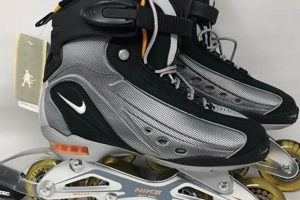
These recreational devices, characterized by a series of inline wheels affixed to a boot, provide a means of personal transportation and athletic activity. A common example is their use for fitness, racing, and various forms of artistic performance. This gear enables users to glide across smooth surfaces with relative ease.
The value of this equipment lies in its potential to enhance cardiovascular health, improve balance and coordination, and offer a low-impact exercise option compared to running. Historically, their development represented a significant evolution in wheeled sports, offering increased speed and maneuverability over traditional roller skates.
The subsequent sections will delve into the construction materials, performance considerations, maintenance procedures, and safety guidelines associated with this increasingly popular form of wheeled footwear.
Blade Skates
The following guidelines are provided to optimize performance and extend the lifespan of inline skates. Adherence to these recommendations can enhance the user experience and minimize potential hazards.
Tip 1: Wheel Rotation. Regular wheel rotation is crucial for even wear. As inner wheels typically experience more friction, interchange them with outer wheels periodically to maximize their lifespan and maintain consistent rolling performance. For example, rotating the wheels after every five hours of use will distribute wear more evenly.
Tip 2: Bearing Maintenance. Clean bearings are essential for smooth operation. Remove bearings from the wheels and clean them with a solvent designed for bearing maintenance. Subsequently, lubricate them with a light oil or lubricant specifically formulated for bearings. This should be done every month if used frequently.
Tip 3: Frame Alignment. Ensure the frame is properly aligned with the boot. Misalignment can lead to inefficient skating and premature wear. Regularly inspect the frame and adjust it as necessary to maintain optimal tracking.
Tip 4: Boot Care. Clean the boot regularly with a damp cloth and mild soap. Remove any debris from the interior to prevent odor and maintain hygiene. Allow the boot to air dry completely after each use.
Tip 5: Brake Pad Inspection. Regularly inspect the brake pad for wear. Replace the brake pad when it becomes excessively worn to ensure effective stopping power. A worn brake pad significantly compromises safety.
Tip 6: Tighten Fasteners. Periodically check and tighten all fasteners, including wheel axles, frame bolts, and buckle screws. Loose fasteners can compromise the stability and safety of the skates.
Tip 7: Use Protective Gear. Always use protective gear such as a helmet, wrist guards, elbow pads, and knee pads. This will protect you from serious injury if you fall.
Implementing these maintenance procedures will contribute significantly to the durability, performance, and safety of the skating experience.
The ensuing section will address safety protocols and responsible skating practices.
1. Wheel Hardness

Wheel hardness, measured by the durometer scale, significantly impacts the performance characteristics of inline skates. The selection of appropriate wheel hardness is crucial for optimizing speed, grip, and durability based on skating surface and style.
- Durometer Scale and Measurement
The durometer scale, typically using the “A” scale for inline skate wheels, quantifies the resistance of a material to indentation. Higher numbers indicate harder wheels, while lower numbers signify softer wheels. For example, an 85A wheel is harder than an 78A wheel, offering different performance trade-offs.
- Hardness and Speed/Grip Trade-off
Harder wheels (e.g., 84A-88A) generally exhibit lower rolling resistance, enabling higher speeds on smooth surfaces. However, they provide less grip, particularly on slick or uneven terrain. Softer wheels (e.g., 74A-82A) offer enhanced grip and shock absorption, ideal for rough surfaces, but at the expense of speed.
- Surface Compatibility
Skating on smooth surfaces, such as polished concrete or indoor rinks, benefits from harder wheels that maximize speed and minimize energy loss. Conversely, skating on asphalt or outdoor trails necessitates softer wheels for improved grip and vibration dampening.
- Durability Considerations
Harder wheels are typically more durable and resistant to abrasion, particularly on rough surfaces. Softer wheels wear down more quickly but provide better shock absorption and grip, mitigating the impact on joints and enhancing control.
The relationship between wheel hardness and inline skate performance is multifaceted, requiring careful consideration of skating environment, intended use, and personal preferences. The optimal wheel hardness balances speed, grip, durability, and comfort to enhance the overall skating experience.
2. Bearing Precision

Bearing precision is a critical determinant of performance in inline skates, directly influencing speed, smoothness, and overall efficiency. Understanding the standards and factors affecting bearing precision is essential for informed equipment selection and maintenance.
- ABEC Rating System
The Annular Bearing Engineering Committee (ABEC) rating system is an industry standard that classifies bearing tolerances. Higher ABEC numbers (e.g., ABEC 7, ABEC 9) denote tighter tolerances and greater precision. These bearings are designed to minimize friction and maximize rotational speed. However, ABEC ratings primarily assess manufacturing tolerances and do not fully encompass factors such as lubrication, materials, and assembly, which also affect performance.
- Influence on Speed and Roll Efficiency
Bearings with higher precision contribute to improved roll efficiency by reducing internal friction. This allows the wheels to rotate more freely and maintain momentum for longer periods. For example, skaters seeking maximum speed and minimal effort, such as speed skaters or marathon skaters, often opt for bearings with high ABEC ratings or alternative precision standards.
- Material Composition and Durability
The materials used in bearing construction, such as steel or ceramic, influence durability and resistance to corrosion. Ceramic bearings, for instance, exhibit lower friction and higher heat resistance than steel bearings. However, they are generally more expensive. The choice of material depends on the intended use and environmental conditions.
- Maintenance and Longevity
Proper maintenance, including regular cleaning and lubrication, is essential for preserving bearing precision and extending lifespan. Contaminants such as dirt and moisture can degrade bearing performance and accelerate wear. Periodic cleaning with appropriate solvents and relubrication with specialized bearing lubricants can maintain optimal performance.
The relationship between bearing precision and inline skate performance is nuanced. While higher precision bearings can enhance speed and efficiency, other factors such as wheel hardness, skating technique, and surface conditions also play significant roles. Selecting bearings that align with intended use and prioritizing proper maintenance are critical for maximizing the benefits of bearing precision in inline skating.
3. Frame Material

The frame material in inline skates directly affects performance characteristics, durability, and overall skating experience. The frame serves as the structural foundation connecting the wheels to the boot, and its material composition significantly influences energy transfer, stability, and responsiveness. Commonly used materials include aluminum alloys, composite plastics, and carbon fiber, each offering a distinct set of advantages and disadvantages.
Aluminum frames, widely employed in recreational and performance models, provide a balance of stiffness and weight. Their rigidity ensures efficient power transfer during strides, enhancing speed and control. For example, skaters engaged in speed skating or aggressive skating frequently prefer aluminum frames for their responsiveness. Composite frames, constructed from reinforced plastics, offer vibration dampening properties and are often found in fitness or recreational skates. These materials reduce fatigue on longer distances by absorbing road vibrations. Carbon fiber frames represent the premium option, providing maximum stiffness and minimal weight. They are primarily used in high-end speed skates where even marginal gains in efficiency are crucial.
Selection of an appropriate frame material hinges on skating style, skill level, and intended use. Aluminum delivers performance, composite enhances comfort, and carbon fiber optimizes efficiency. Understanding the cause-and-effect relationship between frame material and skating characteristics enables informed purchasing decisions and maximizes user satisfaction. The choice ultimately impacts the skater’s ability to efficiently convert energy into motion and maintain control across varying terrains and speeds.
4. Boot Support

Boot support, a foundational element in the design and function of inline skates, directly influences stability, control, and overall skating performance. The boot’s structure and materials dictate the degree of ankle flexion and extension permitted, thus affecting the skater’s ability to maintain balance and execute maneuvers. Inadequate support can lead to ankle instability, increased risk of injury, and reduced skating efficiency. For instance, recreational skates often feature softer boots, prioritizing comfort over rigid support, suitable for casual skating at moderate speeds. Conversely, aggressive skates designed for performing tricks and jumps incorporate reinforced boots with enhanced ankle support to withstand high-impact forces.
The correlation between boot support and skating performance is evident in various skating disciplines. Speed skaters necessitate low-cut boots that allow for maximum ankle mobility, facilitating a lower center of gravity and increased stride length. However, this design compromises support, requiring exceptional ankle strength and technique. Hockey skates demand a stiffer boot to provide the necessary stability for rapid turns and lateral movements. A properly fitting boot with adequate support enables efficient energy transfer from the skater’s body to the skates, enhancing acceleration, agility, and control. Ill-fitting or poorly supported boots, conversely, can result in energy loss, reduced responsiveness, and an increased likelihood of falls.
In summary, the level of boot support in inline skates is a critical factor influencing skating performance, safety, and comfort. Selection should align with the skater’s skill level, skating style, and intended use. Prioritizing boot support can significantly enhance the skating experience by promoting stability, control, and efficient energy transfer, minimizing the risk of injury and maximizing enjoyment.The following topic covers on braking system.
5. Braking System

The braking system in inline skates is a critical safety component, designed to provide controlled deceleration and stopping capabilities. Its functionality is paramount for preventing collisions, maintaining stability, and mitigating the risk of injuries across diverse skating environments.
- Heel Brake Mechanisms
The heel brake, a common configuration in recreational inline skates, consists of a brake pad attached to the rear of one or both boots. Activation occurs by lifting the toe of the foot, causing the brake pad to contact the ground. The effectiveness of the heel brake is influenced by the skater’s technique, brake pad material, and surface conditions. However, it can be less effective on steep inclines or wet surfaces.
- Inline Brake Systems
Advanced braking systems, such as those found on higher-performance skates, integrate brake pads directly into the frame, positioned between the wheels. These systems offer enhanced control and modulation, allowing for smoother and more precise deceleration. They are often favored by experienced skaters and those engaged in aggressive or speed skating.
- Brake Pad Material and Wear
The material composition of the brake pad significantly impacts its braking performance and longevity. Common materials include rubber compounds and synthetic polymers, each exhibiting varying degrees of friction, heat resistance, and wear characteristics. Regular inspection of the brake pad is essential to ensure adequate stopping power. Replacement is necessary when the pad becomes excessively worn.
- Maintenance and Adjustment
Proper maintenance of the braking system is crucial for optimal performance and safety. This includes periodic inspection of the brake pad for wear, adjustment of the brake pad position to maintain consistent contact with the ground, and cleaning of the braking mechanism to remove debris and contaminants. Neglecting maintenance can compromise braking effectiveness and increase the risk of accidents.
The braking system is an integral aspect of inline skate design, influencing both safety and performance. Understanding the different types of braking systems, the factors affecting their effectiveness, and the importance of regular maintenance is essential for responsible skating practices and injury prevention. The future steps are the Safety Guidelines.
Frequently Asked Questions About Blade Skates
This section addresses prevalent inquiries concerning inline skates, providing comprehensive insights into their usage, maintenance, and safety protocols.
Question 1: Are blade skates suitable for beginners?
Inline skates are viable for beginners, contingent upon appropriate safety measures and gradual skill acquisition. The utilization of protective gear, including helmets, wrist guards, elbow pads, and knee pads, is mandatory. Furthermore, initial practice should transpire in controlled environments, such as smooth, level surfaces devoid of vehicular traffic. Beginning with a smaller wheel size to reduce speed is also recommended.
Question 2: How frequently should blade skate wheels be rotated?
Wheel rotation frequency depends on skating intensity and terrain. Regular rotation is essential for uniform wear distribution. For typical recreational use, rotating the wheels every 10-15 hours of skating is advisable. More aggressive skating necessitates more frequent rotations.
Question 3: What is the optimal method for cleaning blade skate bearings?
Bearing cleaning requires the removal of bearings from the wheels. Submersion in a solvent specifically designed for bearing cleaning is recommended. Post-cleaning, thorough drying and lubrication with a synthetic bearing lubricant are essential to restore optimal performance.
Question 4: How do I determine the correct size of blade skates?
The determination of correct sizing involves measuring the foot length in millimeters. This measurement should then be cross-referenced with the manufacturer’s sizing chart. Fit should be snug but not restrictive, allowing for slight toe movement.
Question 5: What is the lifespan of blade skate wheels?
Wheel lifespan varies contingent upon wheel hardness, skating surface, and skating frequency. Softer wheels (lower durometer) degrade more rapidly than harder wheels. Frequent skating on abrasive surfaces also diminishes wheel longevity. Visual inspection for excessive wear is recommended.
Question 6: How should blade skates be stored to prevent damage?
Proper storage necessitates cleaning the skates to remove dirt and debris. Storage in a cool, dry environment, away from direct sunlight and extreme temperatures, is recommended. The use of a skate bag is advisable to protect against physical damage and dust accumulation.
These responses address common concerns and misconceptions, promoting safe and informed engagement with inline skating. Adherence to these guidelines enhances user experience and minimizes potential hazards.
The subsequent section will explore advanced skating techniques and training methodologies.
Conclusion
The preceding discourse has explored various facets of these devices, encompassing their components, performance dynamics, safety considerations, and maintenance procedures. The analysis has underscored the importance of selecting appropriate equipment, adhering to safety protocols, and implementing consistent maintenance routines to optimize the skating experience and mitigate potential risks.
The continued evolution of blade skates and associated technologies holds the potential to further enhance performance, safety, and accessibility. Responsible participation and a commitment to ongoing education are essential for maximizing the benefits and minimizing the hazards associated with this increasingly prevalent recreational activity. Further independent research is encouraged.
![Glide at Hertz Arena Open Skate: [City/Area] Fun! | How to Skateboard: A Beginner's Guide to Your First Board & Tricks](https://cruzskateshop.com/wp-content/uploads/2026/05/th-100-300x200.jpg "Glide at Hertz Arena Open Skate: [City/Area] Fun! How to Skateboard: A Beginner's Guide to Your First Board & Tricks")