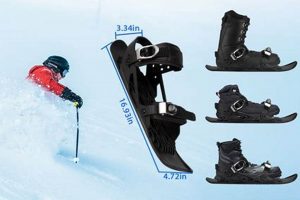
The central topic concerns the artistic process of representing ice skates or roller skates through drawing. This encompasses understanding their unique structure, from the boot and blade or wheels, to capturing their angles and perspective on paper. An example would be creating a sketch of a figure skater in motion, where the accurate portrayal of their footwear is essential for conveying the dynamism of the scene.
Visual depiction of skates holds value in various contexts. It allows for design exploration, serving as a preliminary step in creating new skate models or artistic representations. Historically, drawings of skates have provided valuable records of technological advancements in skate design and have contributed to the visual culture surrounding skating as a sport and recreational activity.
The following sections will explore specific techniques for achieving realistic and stylized skate drawings. These will include discussions of basic shapes, construction lines, shading, and methods for depicting motion and detail, offering a structured approach to the subject matter.
Drawing Skates
Effective skate drawings hinge on accurate proportions, attention to detail, and a strong understanding of perspective. The following guidelines offer practical advice for producing realistic and compelling illustrations.
Tip 1: Begin with basic shapes. Initiate the drawing by outlining the fundamental forms of the skate. Circles, rectangles, and ovals serve as the foundation for the boot, blade or wheel chassis, and overall structure.
Tip 2: Establish a clear perspective. Determine the viewing angle before adding details. Establishing a vanishing point is crucial for creating a sense of depth and realism, particularly when depicting skates in motion.
Tip 3: Pay attention to the boot’s construction. Observe the curves and contours of the skate boot meticulously. Note the placement of seams, laces, and any padding or support structures. Accurate representation of these elements enhances realism.
Tip 4: Focus on the blade or wheel chassis details. The blade (for ice skates) or the wheel configuration (for roller skates) are key identifying features. Render the shape, thickness, and mounting points of the blade or the number and arrangement of the wheels with precision.
Tip 5: Use construction lines effectively. Employ light construction lines to guide the placement and proportions of the various skate components. These lines should be erased once the final drawing is complete.
Tip 6: Apply shading to create volume. Use light and shadow to give the skate a three-dimensional appearance. Observe how light interacts with the different surfaces of the skate and translate these observations into realistic shading patterns.
Tip 7: Add details for realism. Small details, such as rivets, stitching, and scuff marks, contribute significantly to the overall realism of the drawing. Include these elements to enhance the visual appeal and believability of the depicted skate.
Careful application of these principles, combined with diligent observation, allows for the creation of compelling and accurate skate illustrations. These skills contribute to diverse artistic endeavors, from product design to visual storytelling.
With these guidelines in mind, the following section will address common challenges encountered during the drawing process.
1. Perspective

Perspective is fundamental to accurately representing three-dimensional objects, such as skates, on a two-dimensional surface. Improper application of perspective results in distorted or unrealistic depictions, detracting from the overall visual credibility. The selection of perspective type, whether one-point, two-point, or three-point, directly impacts the perceived depth and spatial relationships within the drawing. For instance, depicting a skate receding into the distance necessitates converging lines toward a vanishing point to simulate depth, a concept intrinsic to linear perspective. Without this consideration, the illustration will lack spatial coherence.
The chosen viewing angle significantly dictates the application of perspective. A skate viewed from a low angle necessitates a different perspective setup than one observed from eye level or above. Understanding how parallel lines converge and how shapes diminish in size with distance is crucial for portraying the skate’s components accurately. Furthermore, the complex curves of a skate boot and the intricate structure of the blade or wheels require a meticulous understanding of foreshortening, a perspective technique that addresses how objects appear compressed when viewed at an angle. Correct foreshortening maintains the visual integrity of these elements, preventing them from appearing flattened or disproportionate.
Mastering perspective is not merely an aesthetic consideration but a practical necessity for accurately conveying the form and dimensions of skates in technical illustrations, design sketches, and artistic renderings. The correct implementation of perspective ensures that the drawing effectively communicates the intended visual information, whether for design specifications, product visualization, or artistic expression. Overcoming the challenges inherent in representing complex forms in perspective ultimately elevates the quality and impact of the finished drawing, linking it directly to the viewer’s perception and understanding of the subject.
2. Proportions
Accurate proportions are essential for effectively rendering skates. Distortions in size relationships among the boot, blade (or wheels), and mounting hardware undermine the realism of the drawing. The human eye is highly sensitive to proportional inaccuracies; therefore, achieving a credible depiction necessitates precise measurements and careful observation. A skate boot excessively large compared to its blade or wheels, or vice versa, will immediately appear flawed. This principle extends to the internal components: laces too short for the eyelet spacing, or a heel counter significantly out of alignment, contribute to an unconvincing image. The cause-and-effect relationship is direct: inaccurate proportions result in a visually discordant and amateurish drawing, whereas precise proportions yield a realistic and believable representation.
The significance of proportions becomes particularly evident when illustrating skates from varying perspectives. Foreshortening, which alters perceived lengths and sizes, demands a heightened awareness of proportional adjustments. For example, a skate viewed from a three-quarter angle will exhibit a compressed boot length compared to its height. Correctly interpreting and depicting these relative changes in size is crucial for maintaining the illusion of depth and solidity. Furthermore, different types of skates ice skates, roller skates, inline skates possess distinct proportional characteristics. The elongated blade of an ice skate contrasts sharply with the compact wheel configuration of a roller skate. An understanding of these specific proportional differences is paramount for accurately capturing the unique features of each skate type. Consider the practical application: a design sketch intended for manufacturing requires precise proportional accuracy to ensure the resulting product aligns with the intended specifications. A failure in proportional accuracy at this stage could lead to design flaws and manufacturing errors.
In summary, mastering proportions is a non-negotiable element of successful skate illustration. It dictates the visual credibility of the drawing, influences the perception of depth and realism, and directly impacts the effectiveness of design communication. Overcoming the challenges of accurately depicting complex shapes and foreshortened views requires a commitment to observation, precise measurement, and a thorough understanding of the proportional relationships within the skate. The ability to represent proportions accurately is therefore inextricably linked to the overall skill and effectiveness of the skate illustrator, enabling them to create drawings that are both aesthetically pleasing and technically sound.
3. Construction Lines
Construction lines represent a fundamental technique in drawing, serving as the initial framework upon which a detailed illustration is built. Their application is especially pertinent when undertaking “how to draw skates,” providing a skeletal structure for accurately capturing the complex forms and proportions of skate designs.
- Establishing Basic Shapes
Construction lines facilitate the breakdown of the skate into simpler geometric forms, such as circles, rectangles, and cylinders. These basic shapes act as placeholders for the boot, blade or wheel chassis, and various structural components. This approach simplifies the initial drawing process, allowing for the accurate placement of elements before adding finer details. Failure to establish a strong foundation with these basic shapes can lead to proportional errors in the final rendering.
- Guiding Angles and Curves
Construction lines are instrumental in defining the angles and curves that characterize skate design. They can be used to establish the slope of the boot, the curve of the blade, or the orientation of the wheels. These lines act as guides, ensuring consistency and accuracy in the depiction of complex angles and curves. Without such guidance, rendering these elements becomes significantly more challenging, resulting in inaccurate or inconsistent shapes.
- Maintaining Proportional Accuracy
By establishing a grid or framework of construction lines, the artist can maintain proportional accuracy throughout the drawing process. These lines serve as reference points, allowing for the consistent scaling and placement of different skate components. This is particularly crucial when depicting skates from different perspectives, where foreshortening can distort perceived proportions. Properly utilized construction lines mitigate these distortions, preserving the visual integrity of the drawing.
- Aiding in Symmetry and Balance
Many skates exhibit symmetrical designs, and construction lines can aid in achieving this symmetry in the drawing. A centerline, for instance, can be used to ensure that corresponding features on either side of the skate are mirrored accurately. Furthermore, construction lines can help establish visual balance, ensuring that the drawing is aesthetically pleasing and not lopsided or awkward. These considerations are vital for creating visually compelling and technically accurate illustrations.
These facets demonstrate the essential role of construction lines in the process of drawing skates. Their application is not merely a stylistic choice but a fundamental technique for achieving accuracy, proportionality, and visual coherence. Mastering the use of construction lines is therefore a critical skill for anyone undertaking illustrations of skate designs, whether for artistic expression, technical documentation, or design visualization.
4. Blade/Wheel Details
The accurate depiction of blades or wheels is paramount in skate illustrations; these elements define the skate type and contribute significantly to the overall realism. Inaccurate rendering of blade curvature, wheel configuration, or mounting hardware immediately detracts from the credibility of the drawing. Consider, for example, the distinct profile of an ice hockey blade versus that of a figure skate blade. The former exhibits a more pronounced rocker, influencing maneuverability, whereas the latter features a straighter edge for stability. Similarly, the wheel arrangement on a roller skate directly affects its performance characteristics; inline skates with a single row of wheels differ substantially from quad skates with two sets of wheels, impacting the stride and balance. Neglecting these details results in a generic or inaccurate representation, failing to communicate the specific characteristics of the skate being illustrated. Effective drawing hinges on precise observation and representation of these defining features.
Furthermore, the interaction of blades or wheels with the skating surface demands careful consideration. The depth of the blade’s edge and its contact with the ice, or the compression of the wheel against the pavement, convey crucial information about motion and weight distribution. Representing these subtle interactions requires a nuanced understanding of physics and material properties. For example, depicting the ice shavings created by an ice skate blade or the slight deformation of a roller skate wheel under load enhances the realism and dynamism of the illustration. In technical drawings, accurate blade and wheel details are essential for conveying design specifications, such as blade thickness, wheel diameter, or bearing placement. Such detailed drawings serve as blueprints for manufacturing and ensure the functionality of the final product. These are not arbitrary aesthetic choices but integral elements of visual communication.
In conclusion, blade and wheel details are not merely superficial elements in skate illustrations, they are integral components that define the skate’s type, functionality, and interaction with its environment. Accurate and detailed depiction of these features requires diligent observation, a comprehensive understanding of skate mechanics, and meticulous execution. The ability to render these details effectively elevates the quality and credibility of the illustration, transforming it from a generic sketch into a precise and informative visual representation of the skate. The importance of blades and wheels must be addressed to teach how to draw skates effectively.
5. Boot contours
The accurate depiction of boot contours is fundamental to effective skate illustration. The boot’s shape defines the skate type and significantly impacts the realism of the drawing. Failure to capture the subtle curves and angles of the boot results in a generic or distorted representation, hindering the viewer’s ability to identify the skate accurately. For instance, an ice skate boot, with its rigid ankle support and sleek profile, differs markedly from a roller derby boot, which typically features a lower cut and reinforced construction. Understanding these differences and translating them into precise line work is essential. The contours communicate the form. Skimp on contours, and you miss out on the purpose.
Specific boot details, such as the placement of seams, the lacing system, and the presence of padding or reinforcement, further contribute to the boot’s unique visual identity. These features are not merely decorative elements; they reflect the skate’s intended use and performance characteristics. Consider the impact of contour lines depicting a figure skate. Accurately positioned seams suggest proper fit. Contours are vital for understanding “how to draw skates”. A drawing that omits these details lacks depth and fails to convey the skate’s functional design. Similarly, the rendering of subtle creases and wrinkles in the boot’s material adds realism and provides clues about its age and condition. The absence of these nuances makes the drawing appear flat and artificial. Accurate boot contours and detailing serve as a visual language, communicating not only the skate’s appearance but also its history and purpose.
In summary, accurate boot contours are not optional embellishments but rather essential components of a successful skate illustration. Precise contour rendering enhances the believability of the drawing, communicates important information about the skate’s design and function, and demonstrates the artist’s attention to detail. Mastering the art of capturing boot contours is therefore a critical skill for anyone seeking to create realistic and informative skate illustrations, contributing substantially to the overall effectiveness of the final visual representation. Boot contours are what make skates different from each other.
6. Shading depth

Shading depth is a critical element in depicting skates realistically. The application of light and shadow creates the illusion of volume and form, transforming a flat drawing into a three-dimensional representation. When executing “how to draw skates,” an understanding of light sources and their interaction with the skate’s surfaces is vital. Without adequate shading, the drawing will appear flat and lack visual interest, failing to capture the nuances of the skate’s construction. For example, consider a skate boot made of leather; its texture and curvature are only fully revealed through subtle variations in shading. These variations arise from the way light interacts with the material’s surface, creating highlights and shadows that define its shape.
The degree of shading depth directly affects the perceived realism of the skate. A drawing with minimal shading may be suitable for a simplified sketch, but a more detailed illustration requires a full range of tonal values to convey depth and texture. For instance, the metallic sheen of an ice skate blade necessitates careful rendering of highlights and reflections to simulate its reflective surface. Similarly, the complex contours of a roller skate wheel chassis require nuanced shading to reveal their intricate design. The failure to accurately depict these details diminishes the overall quality of the drawing, reducing its visual impact. Furthermore, shading can be used to create a sense of atmosphere and context, suggesting the environment in which the skate exists. This can be achieved by casting shadows on the surrounding surface, grounding the skate within its visual space.
In conclusion, shading depth is not merely an aesthetic consideration, but an essential component of realistic skate illustration. Its application enhances the perceived volume, texture, and material properties of the skate, transforming a flat drawing into a compelling three-dimensional representation. Mastering shading techniques is therefore crucial for anyone seeking to create accurate and visually engaging skate drawings, contributing significantly to the overall effectiveness of the illustration. Ignoring shading relegates skates to 2D design.
Frequently Asked Questions
This section addresses common inquiries regarding the process of creating accurate and compelling skate illustrations. The information aims to clarify techniques and address potential challenges encountered during the drawing process.
Question 1: What are the essential tools required for drawing skates?
The process necessitates basic drawing implements, including pencils of varying hardness (e.g., HB, 2B, 4B), erasers (both kneaded and standard), and suitable drawing paper. Optional tools include rulers, compasses, and specialized blending tools for shading.
Question 2: How does one accurately represent the perspective of a skate?
Perspective is achieved by establishing a vanishing point and utilizing converging lines to simulate depth. One-point, two-point, or three-point perspective can be employed, depending on the desired viewing angle. Careful attention to foreshortening is crucial for elements receding into the distance.
Question 3: What is the best approach to ensuring accurate proportions when drawing skates?
Begin by outlining the basic shapes of the skate, using construction lines to establish the overall proportions. Compare the relative sizes of the boot, blade/wheels, and hardware components. Regular measurement and comparison against reference images are recommended.
Question 4: How can one effectively depict the curvature of an ice skate blade?
The blade’s curvature can be represented by using a series of curved lines, gradually adjusting their thickness and direction to convey the blade’s profile. Careful observation of reference images is essential for capturing the specific curvature of different blade types.
Question 5: What are the key considerations for rendering the wheel configuration of roller skates?
The number, arrangement, and size of the wheels must be accurately depicted. The angle of the axles and the spacing between the wheels should be carefully observed. Use shading to highlight the three-dimensionality of the wheels and their relationship to the chassis.
Question 6: How can shading be used to enhance the realism of a skate drawing?
Shading should be applied to create the illusion of volume and depth. Identify the light source and render highlights and shadows accordingly. Use a range of tonal values to convey the texture and material properties of the skate’s components. Experiment with blending techniques to achieve smooth transitions between light and shadow.
Accurate representation hinges on careful observation, diligent practice, and a thorough understanding of perspective, proportion, and shading techniques. Mastering these principles will lead to more realistic and compelling illustrations.
The subsequent section will delve into advanced techniques.
Conclusion
This article has explored essential techniques for achieving accurate and compelling skate illustrations. Emphasis has been placed on understanding perspective, maintaining proportional accuracy, utilizing construction lines, depicting blade/wheel details, rendering boot contours, and applying shading depth. Each of these elements contributes to the overall realism and visual impact of the drawing.
Mastery of these techniques requires dedicated practice and diligent observation. The ability to effectively represent skates visually holds value across diverse fields, from product design to artistic expression. Continued exploration and refinement of these skills will lead to increasingly sophisticated and informative skate illustrations, solidifying the importance of understanding the fundamental principles outlined herein.